10 GST Mistakes Businesses Make in March Before Year-End
March is not just the last month of the financial year — it is also the most sensitive month for GST compliance.
Many businesses make small mistakes that later lead to notices, ITC reversal or interest liability.
Here are 10 common GST mistakes to avoid:
1️⃣ Claiming ITC without verifying GSTR-2B
Always match supplier invoices before claiming credit.
2️⃣ Forgetting to reverse ineligible ITC
Blocked credits under Section 17(5) are often missed.
3️⃣ Mismatch between books and GST returns
Turnover in financial statements must match GST filings.
4️⃣ Not reconciling e-way bills with sales data
Large differences may trigger scrutiny.
5️⃣ Delayed GST payment
Late payments attract interest and late fees.
6️⃣ Incorrect classification of goods/services
Wrong HSN/SAC codes may lead to tax disputes.
7️⃣ Ignoring reverse charge liabilities
RCM on certain expenses is often overlooked.
8️⃣ Failure to issue proper invoices
Incomplete invoices can create compliance problems.
9️⃣ Not reviewing vendor GST compliance
If suppliers fail to file returns, your ITC may be affected.
🔟 Waiting until the last minute for reconciliation
Year-end reconciliation should start well before March end.
📊 Takeaway
March is the best time to review GST records, reconcile ITC, and ensure compliance before the financial year closes.
#GST #GSTIndia #GSTCompliance #Taxation #Finance #Accounting
A company moves goods from its Mumbai warehouse to its Delhi branch.
Same owner. Same PAN.
Zero sale. Zero consideration.
GST officer walks in. Raises a demand notice.
The company argues: “It’s internal. We didn’t sell anything.”
The officer smiles and opens the CGST Act.
🧵 Here’s the provision that changed everything ↓
No more vouchers, no more refund delays: DGCA rewired airline cancellation rules:
DGCA just introduced an “UNDO” rule. (Effective 26 Mar 2026) ✈️
✅ 48-hour FREE cancel/change window
Only if booked directly on airline website
• Domestic: flight must be ≥ 7 days away
• International: ≥ 15 days away
⏱️ Refund timelines now fixed
• Card refund: within 7 working days
• Agent/portal bookings: airline must ensure refund within 14 working days
• Cash paid at airline office: refund immediately at that office
💸 Cancellation charges are capped
No more “we’ll deduct whatever we want” — charges can’t exceed Basic Fare + Fuel Surcharge
And agent fees must be disclosed upfront.
https://t.co/XggQm76eCB
India’s home broadband is entering a “land grab” phase — and your home is the prize.
What’s coming next:
•Faster fibre + 5G home internet rollout
•Aggressive offers: free/cheap installs, bundles (OTT/IPTV), intro pricing
•Hard selling + “limited period” deals as telcos race to lock you in
What you should do:
•Compare 2–3 options available in your locality (fibre vs 5G FWA)
•Ask before paying: total monthly bill, install/router charges, lock-in, speed drops/FUP, service timelines
•Avoid long lock-ins unless savings are real
•Test in peak hours (speed + latency) in the first week and raise tickets fast
•Watch bundles: separate “internet price” from “content price”
•Save screenshots/receipts of what was promised
Use the competition to get a better deal — but don’t get trapped by hidden costs or lock-ins.
https://t.co/WJ03KjsoGr
IDFC FIRST Bank has uncovered a significant fraud totaling Rs 590 crore. The incident involves employees at one of its Chandigarh branches. Four suspected officials have been suspended pending a thorough investigation. The bank is also appointing an independent agency to conduct a forensic audit. Strict action will be taken against all involved parties.
https://t.co/Lnw9btPOd4
AI IMPACT SUMMIT — WHO SAID WHAT
(EXCLUSIVE COLLECTION)
Prime Minister of India:
“AI must be given an open sky, while command must remain in human hands.”
“We must democratise AI. It must become a tool for inclusion and empowerment, particularly for the Global South.”
UN Secretary-General:
“The future of AI cannot be decided by a few countries or left to the whims of a few billionaires.”
“No child should be a test subject for unregulated AI.”
President of France:
“Europe is a space for innovation and investment, but it is a safe space — and safe spaces win in the long run.”
Union IT Minister, India:
“In IndiaAI Mission 2.0, we will be creating a bouquet of solutions. It will be tried, tested, and free. It will be hosted like UPI.”
Secretary, MeitY:
“Many large companies are making investment announcements after seeing the energy and potential of AI in India.”
Former NITI Aayog CEO:
“The winner in the technology race is not the one who did it first, but the one who builds trust and guardrails.”
CEO, Google:
“AI is the biggest platform shift of our lifetimes.”
“To build AI that is truly helpful for everyone, we must pursue it boldly, responsibly, and together.”
CEO, OpenAI:
“India will be one of the biggest AI markets in the world and will have enormous influence.”
“India is well positioned not just to build AI, but to shape what the future looks like.”
President, Microsoft:
“The world has come to India to think together about bringing AI to more of the world — especially the Global South.”
CEO, Accenture:
“This summit recognises the importance of countries, governments, and the private sector coming together on AI.”
Chairman, Reliance Industries:
“India cannot afford to rent intelligence.”
“Jio will now connect India to the intelligence era.”
Chairman, Tata Sons:
“AI is the next big infrastructure — the infrastructure of intelligence.”
CEO, Google DeepMind:
“AGI is on the horizon — possibly within the next five years.”
CEO, Mistral AI:
“India’s focus on self-reliance is critical for a country of this size.”
AI Executive, Meta:
“We are releasing new AI models this year, with the first coming in the next few months.”
Former CEO, Infosys:
“We supported OpenAI early on, and it was a remarkable experience working with them.”
CEO, FedEx:
“The world is undergoing a fundamental shift, including a new phase of re-globalisation.”
Different voices.
Different incentives.
Same message.
AI is no longer just about models.
It is about sovereignty, scale, trust, and power.
Which statement will matter most 10 years from now?
The Quote of the Day today by Paul McCartney is:
“Take these broken wings and learn to fly.”
The line suggests that damage does not define destiny. It is an invitation to transform pain into strength.
Why I’m posting this
(as many tracking telecom stocks get confused):
Spectrum licences are usually valid for long periods and the payments may be in instalments — but accounting is NOT driven by the instalment schedule. It is driven by Ind AS recognition, measurement, amortisation and impairment rules.
Here’s the clean Ind AS position.
1) What is “spectrum” in financial statements?
Under Ind AS 38, a spectrum licence typically meets the definition of an INTANGIBLE ASSET (identifiable non-monetary asset without physical substance) when the entity controls the rights and expects future economic benefits.
2) When is it recognised?
Ind AS 38 requires recognition only when:
(a) it is probable that future economic benefits will flow to the entity, and
(b) the cost of the asset can be measured reliably.
Practically, recognition is linked to obtaining CONTROL/RIGHTS under the licence (not to when cash instalments are paid).
3) Initial measurement (cost)
Ind AS 38: an intangible asset is initially measured at COST.
If the arrangement involves DEFERRED PAYMENT terms, Ind AS requires measuring the asset at the CASH PRICE EQUIVALENT / PRESENT VALUE at the recognition date. The difference between the total payment and the cash price equivalent is recognised as INTEREST expense over the credit period using effective interest method under Ind AS 109 (unless that borrowing cost qualifies for capitalisation under Ind AS 23 — only if the asset is a “qualifying asset” as defined there).
So, instalments affect:
• the timing of CASH OUTFLOWS, and
• the FINANCE COST (interest unwind),
but they do not change the underlying recognition principle once control exists.
4) Subsequent measurement: amortisation
Ind AS 38: intangible assets with FINITE useful life are AMORTISED over their useful life.
Amortisation starts when the asset is AVAILABLE FOR USE (i.e., in the location and condition necessary for it to operate as intended), not when instalments are fully paid.
The amortisation method must reflect the pattern of consumption of economic benefits; if that pattern can’t be reliably determined, use straight-line.
Useful life / amortisation method are REVIEWED at least at each financial year end and adjusted prospectively if expectations change (Ind AS 38).
5) Impairment
Ind AS 36 applies: if there is any INDICATION of impairment, the spectrum (as part of the relevant CGU) is tested and any impairment loss is recognised in P&L immediately.
6) How it hits performance & key ratios
P&L impact:
• Amortisation expense (operating impact)
• Interest expense on deferred spectrum liability (finance cost)
Balance sheet impact:
• Higher Intangible assets (spectrum)
• Higher Financial liabilities (unpaid dues measured per Ind AS 109)
Cash flow impact (Ind AS 7):
• Actual instalment payments are cash outflows (classified based on their nature; interest cash flows as per Ind AS 7 policy, with consistent classification).
Bottom line:
Spectrum accounting under Ind AS is about (i) recognition on control, (ii) cost at cash price equivalent / PV, (iii) amortisation once available for use, and (iv) impairment when indicators exist. Instalments mainly change liability/interest and cash flow timing — not the core recognition logic.
Why do telecom companies report heavy amortisation even when spectrum dues are still unpaid?
#IndAS38 #IndAS36 #TelecomAccounting #FinancialReporting #CAFinal
🚨 BIG NEWS for CA Professionals!
ICAI Prez confirms — Professional Services Firms (CAs, Cost Accountants, CS) may soon join PM Internship Scheme (PMIS)!
Key Highlights 👇
✅ CA firms to get PMIS access without CSR funds — Govt may grant special exception
✅ Interns get ₹6,000/month via DBT + free insurance under PMJJBY & PMSBY
✅ ‘Corporate Mitra’ initiative to train grads for 9 months → serve MSMEs affordably
✅ System Audits guidelines finalised — cybersecurity & IT audits to become mandatory for CAs soon
✅ ICAI reviewing Gensol & IndusInd cases — disciplinary action possible
✅ On AI: “It won’t replace CAs — but CAs who use AI will replace those who don’t”
💡 What this means for YOU as a CA Firm:
→ Access to trained interns at subsidised cost
→ New service line: System/IT Audits for MSMEs
→ Expand into Tier-II & Tier-III markets via Corporate Mitra
The profession is evolving fast. Are YOU ready?
#ICAI #PMIS #CharteredAccountant #MSMEs #CorporateMitra #Budget2025
https://t.co/hsJRvCPkER
🧵 Govt plans ₹80,000 cr via Rail PSU stake sales by FY30
The proposal is being examined under CGAM (Core Group of Secretaries on Asset Monetisation), chaired by the Cabinet Secretary, as part of the upcoming National Monetisation Pipeline (NMP 2.0).
Railway PSUs and Govt holding (%):
IRFC 86.36 | RVNL 72.84 | RITES 72.20
IRCON 65.17 | RailTel 65.17 | IRCTC 62.40 | CONCOR 54.80
Reduce stakes closer to 51% without losing control
🔴 Ind AS 36 taught India’s biggest lesson through Vi’s collapse.
Vodafone Idea wrote off ₹70,000+ Cr in spectrum & goodwill impairment.
Not in one shot. Year after year. Till net worth turned negative.
Here’s what every CA Student must understand 👇
Quote of the day by Johnny Depp:
“You can close your eyes to the things you don’t want to see, but you can’t close your heart to the things you don’t want to feel.”
Meaning of the Quote
The quote explores the difference between mental avoidance and emotional reality.
While we can choose not to see painful situations, emotions remain to exist beneath the surface.
Everyone’s talking about AI — but no one agrees on what it actually is.
🔴 Tech CEOs: “AI will replace humans”
🟡 WFP’s Magan Naidoo: “AI is an accelerator, not a replacement”
🟢 Governments: “We need regulation first”
🔵 Workers: “We’re already losing jobs”
So who’s correct?
The hype exists because AI genuinely does different things at different scales. For a humanitarian agency feeding millions, it’s a tool. For a call center employee, it’s a threat.
The uncertainty exists because no one — not even AI companies — fully controls where this goes.
Context matters. Don’t let one headline define your entire view of AI.
🧵 What’s your take — accelerator or replacement?
https://t.co/aUHoNxZHEu?
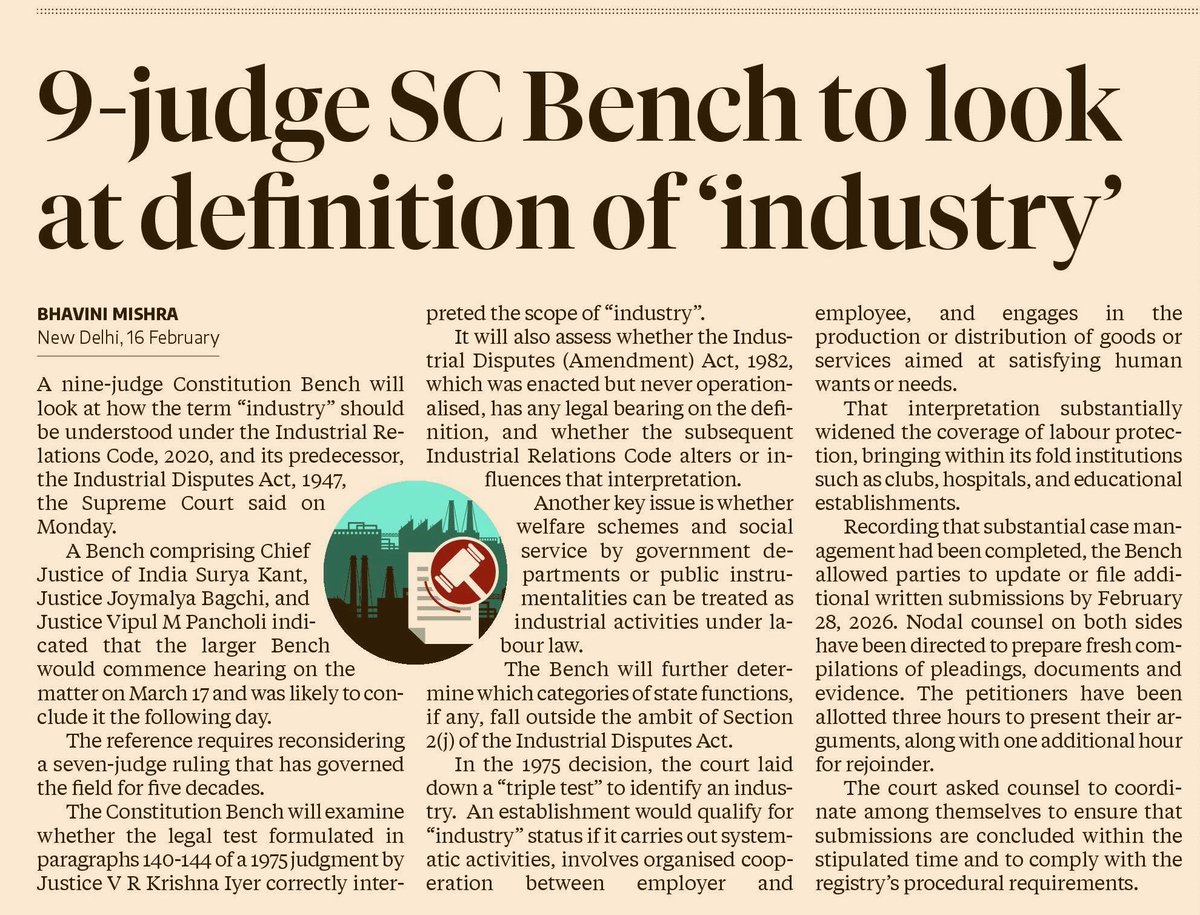
🚨 A 9-Judge SC Bench will redefine “INDUSTRY” from March 17.
Why now?
1978: SC gave a VERY wide definition — even hospitals, universities, govt depts became “industries”
1982: Parliament tried to narrow it. Amendment was NEVER notified. 43 years.
2020: Industrial Relations Code replaced the old law & explicitly excluded sovereign govt functions.
But the IR Code itself isn’t fully operational.
So the SC must now decide:
→ Was the 1978 test correct?
→ Does the new IR Code change the game?
→ Are govt welfare schemes “industrial activities”?
If you’re a govt employee, hospital worker, or NGO staffer — this ruling decides your labour rights.
CJI Surya Kant’s bench. March 17-18.
One of the most consequential hearings of this decade.
#SupremeCourt #LabourLaw #IndustrialRelationsCode
Al adoption isn't reshaping employment — it's reshaping hiring priorities.
Hybrid skills, GenAl literacy, and data capabilities now matter more than traditional roles.
The real disruption is in skills, not jobs.
AI adoption is reshaping hiring priorities across Indian firms: Study
https://t.co/aiCvKAkWu8
🧵 A satisfying thread you MUST save.
Filing a wrong return ≠ Going to jail.
But most taxpayers don’t know where the line is.
Here’s the difference between a MISTAKE and a CRIME under Indian Tax Laws 👇
India spends 7–10% of public expenditure on subsidies.
But who actually benefits?
A new ADB–PwC study submitted to the 16th Finance Commission has some uncomfortable answers.
🧵👇
India is losing customs revenue because of tariff cuts under Free Trade Agreements (FTAs) — and that loss is becoming large enough to worry policymakers.
According to Budget documents, customs duty forgone due to FTAs may cross ₹1 trillion in FY27.
This is the cumulative cost of India’s trade strategy
India’s Free Trade Agreements are boosting trade — but they’re not free.
https://t.co/wrngMmzUZ4
A bank manager may restrict accounts for regulatory or safety reasons, but cannot freeze accounts as a punitive or coercive measure without legal authority.
Even under PMLA - Bank Manager has Reporting obligation (NOT punitive power)