Our team worked with OpenCode to have their users who are also OpenAI API customers back in business and any credits refunded which would have been drawn in the attack.
Also, you can request Daybreak Blue access to use our cyber permissive setup for defense. Do not wait until you have to deal with an incident. We’re here to help.
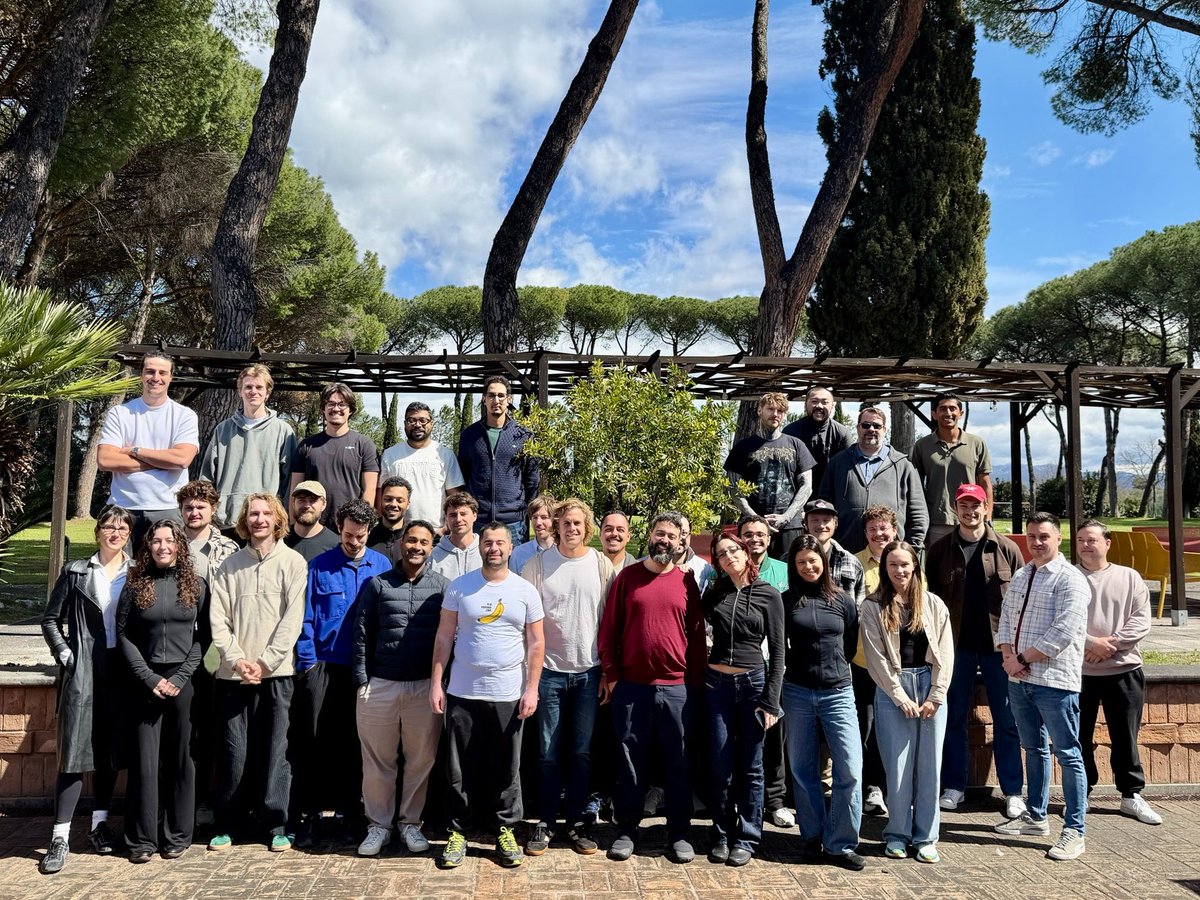
We just wrapped up our team on-site. The entire Celestia team came together for a week of deep work on protocol and strategy.
We are energised, heads down and building towards making Celestia’s Vision 2.0 a reality.
We want to be better at sharing our work openly as it happens. To make sure we follow this through, we’ve brought on a new Head of Marketing who will help us do exactly that.
Zcash's comeback is extremely inspiring to me.
After the early hype faded, the core team and community persisted through YEARS of seeming irrelevance, sticking to their vision of unstoppable private money.
That conviction is now paying off.
Celestia has the same DNA. A cypherpunk vision of abundant, unstoppable blockspace, verifiable by anyone in the world.
The early hype has faded, but we have a cracked core team committed to the mission, ready to keep going for however long it takes.
We'll see it through.
Cross-ledger operations in regulated environments require transparency and control.
The IBC Relayer and Attestor give enterprise teams quorum-based signing, OFAC address controls, and end-to-end audit trails across connected digital ledgers.
Read our deep dive below ⬇️
It will significantly increase my opinion of @Anthropic if they do not back down, and honorably eat the consequences.
(For those who are not aware, so far they have been maintaining the two red lines of "no fully autonomous weapons" and "no mass surveillance of Americans". Actually a very conservative and limited posture, it's not even anti-military.
IMO fully autonomous weapons and mass privacy violation are two things we all want less of, so in my ideal world anyone working on those things gets access to the same open-weights LLMs as everyone else, and exactly nothing on top of that. Of course we won't get anywhere close to that world, but if we get even 10% closer to that world that's good, and if we get 10% further that's bad)
CC @DarioAmodei
https://t.co/RSzHnXqWFL
I'm actually trying to do something even more ambitious:
Create "cypherpunk principled non-ugly ethereum" as a bolt-on to the present-day system, in a way that's as tightly integrated and interoperable as possible, and then grow it over time, in the mean time making sure ethereum itself gains the cypherpunk and simplicity properties that just necessarily have to be system-wide (eg. censorship resistance, zk prover friendliness, consensus properties). Then, in 5 years (or maybe way sooner with AI coding and verification, who knows), we have an open pathway to turn the existing system into smart contracts written in the language of the new system if/when we want.
Ethereum has already made jet engine changes in-flight once (the merge), we can do it ~4 times more!
(state tree, Lean consensus, ZK-EVM verification, VM change)
You do not have to agree with me on which applications are and are not corposlop to use Ethereum.
You do not have to agree with me on what trust assumptions are acceptable in which situations to use Ethereum.
You do not have to agree with me on political topics to use Ethereum.
You do not have to agree with my views on defi, decentralized social or privacy-preserving payments to use Ethereum.
You do not have to agree with my views on AI to use Ethereum.
You do not have to agree with my view that Berlin has the best food in Europe, suits and ties should be expunged from our culture, and YYYY-MM-DD is the best date format to use Ethereum.
And you do not have to agree with me on any one of those above things to agree with me on any other.
I do not claim to represent the whole Ethereum ecosystem. Ethereum is a decentralized protocol. The whole concept of "permissionlessness" and "censorship resistance" is that you are free to use Ethereum in whatever way you want, without caring about what I think, or even what anyone else in the Ethereum Foundation or even any Ethereum client developer thinks.
But on the flipside, if I say that your application is corposlop, I am not "censoring" you. This has always been the flip side of the grand bargain of free speech: I am not free to shut you down, but I am free to criticize you, much as you are free to criticize me.
In fact, it is *necessary* that we do this. The modern world does not call out for pretend neutrality, where a person puts on a suit and claims to be equally open to all perspectives from all of humanity and not have their own opinions. Neutrality is for protocols (like HTTP, like Bitcoin, like Ethereum), and neutrality within some scope is for some institutions. The modern world calls out for the courage to clearly state one's principles - including stating principles by pointing to negative examples, that is by criticizing the things in the world that are incompatible with one's principles - and work with those with aligned goals to build the metaverse within which those principles are taken as a baseline.
Such things inherently cannot be constrained to just the layer of the protocol: any principle you have will naturally lead to conclusions, not just about how the protocol should be built, but also what should be built upon it. Furthermore, any such principle will have consequences that go beyond technology, and reach into specific questions within the larger social world. This should not be avoided. Valuing something like "freedom", and then acting as though it has consequences on technology choices, but is completely separate from everything else about our lives, is not pragmatic - it is hollow.
The inevitable converse of this is that (i) a decentralized protocol must not be viewed as belonging to only one metaverse, and (ii) the borders of a metaverse are fuzzy: it is possible, and indeed it is the normal case, to align with any one on some axes and not on other axes.
Linux is a technology of user empowerment and freedom, Linux is also the base layer of a lot of the world's corposlop. It's almost certainly the base layer of many things that I think are good, and you think are bad, and vice versa. Hence, if you care about Linux because you care about user empowerment and freedom, it is not enough to just build the kernel, we must also build a full-stack ecosystem compatible with those values, and explicitly accept that this is not the only way that people will use Linux, but it is one way that must be built and must be available. Ethereum is similar.
Milady.
How I would do creator coins
We've seen about 10 years of people trying to do content incentivization in crypto, from early-stage platforms like Bihu and Steemit, to BitClout in 2021, to Zora, to tipping features inside of decentralized social, and more. So far, I think we have not been very successful, and I think this is because the problem is fundamentally hard.
First, my view of what the problem is. A major difference between doing "creator incentives" in the 00s vs doing them today, is that in the 00s, a primary problem was having not enough content at all. In the 20s, there's plenty of content, AI can generate an entire metaverse full of it for like $10. The problem is quality. And so your goal is not *incentivizing content*, it's *surfacing good content*.
Personally, I think that the most successful example of creator incentives we've seen is Substack. To see why, take a look at the top 10:
https://t.co/duaCaGNYXp
https://t.co/y1F9Td0Y52
https://t.co/xEMt8pIK74
Now, you may disagree with many of these authors. But I have no doubt that:
1. They are on the whole high quality, and contribute positively to the discussion
2. They are mostly people who would not have been elevated without Substack's presence
So Substack is genuinely surfacing high quality and pluralism.
Now, we can compare to creator coin projects. I don't want to pick on a single one, because I think there's a failure mode of the entire category.
For example:
Top Zora creator coins: https://t.co/238cqf2bX1
BitClout: https://t.co/0jVmotkpFw
Basically, the top 10 are people who already have very high social status, and who are often impressive but primarily for reasons other than the content they create.
At the core, Substack is a simple subscription service: you pay $N per month, and you get to see the person's articles. But a big part of Substack's success is that they did not just set the mechanism and forget. Their launch process was very hands-on, deliberately seeding the platform with high-quality creators, based on a very particular vision of what kind of high-quality intellectual environment they wanted to foster, including giving selected people revenue guarantees.
So now, let's get to one idea that I think could work (of course, coming up with new ideas is inherently a more speculative project than criticizing existing ones, and more prone to error).
Create a DAO, that is *not* token-based. Instead, the inspiration should be Protocol Guild: there are N members, and they can (anonymously) vote new members in and out. If N gets above ~200, consider auto-splitting it.
Importantly, do _not_ try to make the DAO universal or even industry-wide. Instead, embrace the opinionatedness. Be okay with having a dominant type of content (long-form writing, music, short-form video, long-form video, fiction, educational...), and be okay with having a dominant style (eg. country or region of origin, political viewpoint, if within crypto which projects you're most friendly to...). Hand-pick the initial membership set, in order to maximize its alignment with the desired style.
The goal is to have a group that is larger than one creator and can accumulate a public brand and collectively bargain to seek revenue opportunities, but at the same time small enough that internal governance is tractable.
Now, here is where the tokens come in. In general, one of my hypotheses this decade is that a large portion of effective governance mechanisms will all have the form factor of "large number of people and bots participating in a prediction market, with the output oracle being a diverse set of people optimized for mission alignment and capture resistance". In this case, what we do is: anyone can become a creator and create a creator coin, and then, if they get admitted to a creator DAO, a portion of their proceeds from the DAO are used to burn their creator coins.
This way, the token speculators are NOT participating in a recursive-speculation attention game backed only by itself. Instead, they are specifically being predictors of what new creators the high-value creator DAOs will be willing to accept. At the same time, they also provide a valuable service to the creator DAOs: they are helping surface promising creators for the DAOs to choose from.
So the ultimate decider of who rises and falls is not speculators, but high-value content creators (we make the assumption that good creators are also good judges of quality, which seems often true). Individual speculators can stay in the game and thrive to the extent that they do a good job of predicting the creator DAOs' actions.
In 2026, I plan to be fully back to decentralized social.
If we want a better society, we need better mass communication tools. We need mass communication tools that surface the best information and arguments and help people find points of agreement. We need mass communication tools that serve the user's long-term interest, not maximize short-term engagement. There is no simple trick that solves these problems. But there is one important place to start: more competition. Decentralization is the way to enable that: a shared data layer, with anyone being able to build their own client on top.
In fact, since the start of the year I've been back to decentralized social already. Every post I've made this year, or read this year, I made or read with https://t.co/BJ3J4TvNNu, a multi-client that covers reading and posting to X, Lens, Farcaster and Bluesky (though bluesky has a 300 char limit, so they don't get to see my beautiful long rants).
But crypto social projects has often gone the wrong way. Too often, we in crypto think that if you insert a speculative coin into something, that counts as "innovating", and moves the world forward. Mixing money and social is not inherently wrong: Substack shows that it's possible to create an economy that supports very high-quality content. But Substack is about _subscribing to creators_, not _creating price bubbles around them_. Over the past decade, we have seen many many attempts at incentivizing creators by creating price bubbles around them, and all fail by (i) rewarding not content quality, but pre-existing social capital, and (ii) the tokens all going to zero after one or two years anyway.
Too many people make galaxy-brained arguments that creating new markets and new assets is automatically good because it "elicits information", when the rest of their product development actions clearly betray that they're not actually interested in maximizing people's ability to benefit from that information. That is not Hayekian info-utopia, that is corposlop.
Hence, decentralized social should be run by people who deeply believe in the "social" part, and are motivated first and foremost by solving the problems of social.
The Aave team has done a great job stewarding Lens up to this point. I'm excited about what will happen to Lens over the next year, because I think the new team coming in are people who actually are interested in the "social": even back when the decentralized social space barely existed, they were trying to figure out how to do encrypted tweets.
I plan to post more there this year.
I encourage everyone to spend more time in Lens, Farcaster and the broader decentralized social world this year. We need to move beyond everyone constantly tweeting inside a single global info warzone, and into a reopened frontier, where new and better forms of interaction become possible.
We need more DAOs - but different and better DAOs.
The original drive to build Ethereum was heavily inspired by decentralized autonomous organizations: systems of code and rules that lived on decentralized networks that could manage resources and direct activity, more efficiently and more robustly than traditional governments and corporations could.
Since then, the concept of DAOs has migrated to essentially referring to a treasury controlled by token holder voting - a design which "works", hence why it got copied so much, but a design which is inefficient, vulnerable to capture, and fails utterly at the goal of mitigating the weaknesses of human politics. As a result, many have become cynical about DAOs.
But we need DAOs.
* We need DAOs to create better oracles. Today, decentralized stablecoins, prediction markets, and other basic building blocks of defi are built on oracle designs that we are not satisfied with. If the oracle is token based, whales can manipulate the answer on a subjective issue and it becomes difficult to counteract them. Fundamentally, a token-based oracle cannot have a cost of attack higher than its market cap, which in turn means it cannot secure assets without extracting rent higher than the discount rate. And if the oracle uses human curation, then it's not very decentralized. The problem here is not greed. The problem is that we have bad oracle designs, we need better ones, and bootstrapping them is not just a technical problem but also a social problem.
* We need DAOs for onchain dispute resolution, a necessary component of many types of more advanced smart contract use cases (eg. insurance). This is the same type of problem as price oracles, but even more subjective, and so even harder to get right.
* We need DAOs to maintain lists. This includes: lists of applications known to be secure or not scams, lists of canonical interfaces, lists of token contract addresses, and much more.
* We need DAOs to get projects off the ground quickly. If you have a group of people, who all want something done and are willing to contribute some funds (perhaps in exchange for benefits), then how do you manage this, especially if the task is too short-duration for legal entities to be worth it?
* We need DAOs to do long-term project maintenance. If the original team of a project disappears, how can a community keep going, and how can new people coming in get the funding they need?
One framework that I use to analyze this is "convex vs concave" from https://t.co/1BrMsUAKWK . If the DAO is solving a concave problem, then it is in an environment where, if faced with two possible courses of action, a compromise is better than a coin flip. Hence, you want systems that maximize robustness by averaging (or rather, medianing) in input from many sources, and protect against capture and financial attacks. If the DAO is solving a convex problem, then you want the ability to make decisive choices and follow through on them. In this case, leaders can be good, and the job of the decentralized process should be to keep the leaders in check.
For all of this to work, we need to solve two problems: privacy, and decision fatigue. Without privacy, governance becomes a social game (see https://t.co/uMXcuzQNjM ). And if people have to make decisions every week, for the first month you see excited participation, but over time willingness to participate, and even to stay informed, declines.
I see modern technology as opening the door to a renaissance here. Specifically:
* ZK (and in some cases MPC/FHE, though these should be used only when ZK along cannot solve the problem) for privacy
* AI to solve decision fatigue
* Consensus-finding communication tools (like https://t.co/Nzord32Ub1, but going further)
AI must be used carefully: we must *not* put full-size deepseek (or worse, GPT 5.2) in charge of a DAO and call it a day. Rather, AI must be put in thoughtfully, as something that scales and enhances human intention and judgement, rather than replacing it. This could be done at DAO level (eg. see how https://t.co/pCHI7Mlo2m works), or at individual level (user-controlled local LLMs that vote on their behalf).
It is important to think about the "DAO stack" as also including the communication layer, hence the need for forums and platforms specially designed for the purpose. A multisig plus well-designed consensus-finding tools can easily beat idealized collusion-resistant quadratic funding plus crypto twitter.
But in all cases, we need new designs. Projects that need new oracles and want to build their own should see that as 50% of their job, not 10%.
Projects working on new governance designs should build with ZK and AI in mind, and they should treat the communication layer as 50% of their job, not 10%.
This is how we can ensure the decentralization and robustness of the Ethereum base layer also applies to the world that gets built on top.
2026 is the year that we take back lost ground in terms of self-sovereignty and trustlessness.
Some of what this practically means:
Full nodes: thanks to ZK-EVM and BAL, it will once again become easier to locally run a node and verify the Ethereum chain on your own computer.
Helios: actually verify the data you're receiving from RPCs instead of blindly trusting it.
ORAM, PIR: ask for data from RPCs without revealing which data you're asking, so you can access dapps without your access patterns being sold off to dozens of third parties all around the world.
Social recovery wallets and timelocks: wallets that don't make you lose all your money if you misplace your seedphrase, or if an online or offline attacker extracts your seedphrase, and *also* don't make all your money backdoored by Google.
Privacy UX: make private payments from your wallet, with the same user experience as making public payments.
Privacy censorship resistance: private payments with the ERC-4337 mempool, and soon native AA + FOCIL, without relying on the public broadcaster ecosystem.
Application UIs: use more dapps from an onchain UI with IPFS, without relying on trusted servers that would lock you our of practical recovery of your assets if they went offline, and would give you a hijacked UI that steals your funds if they get hacked for even a millisecond.
In many of these areas, over the last ten years we have seen serious backsliding in Ethereum. Nodes went from easy to run to hard to run. Dapps went from static pages to complicated behemoths that leak all your data to a dozen servers. Wallets went from routing everything through the RPC, which could be any node of your choice including on your own computer, to leaking your data to a dozen servers of their choice. Block building became more centralized, putting Ethereum transaction inclusion guarantees under the whims of a very small number of builders.
In 2026, no longer. Every compromise of values that Ethereum has made up to this point - every moment where you might have been thinking, is it really worth diluting ourselves so much in the name of mainstream adoption - we are making that compromise no longer.
It will be a long road. We will not get everything we want in the next Kohaku release, or the next hard fork, or the hard fork after that. But it will make Ethereum into an ecosystem that deserves not only its current place in the universe, but a much greater one.
In the world computer, there is no centralized overlord.
There is no single point of failure.
There is only love.
Milady.
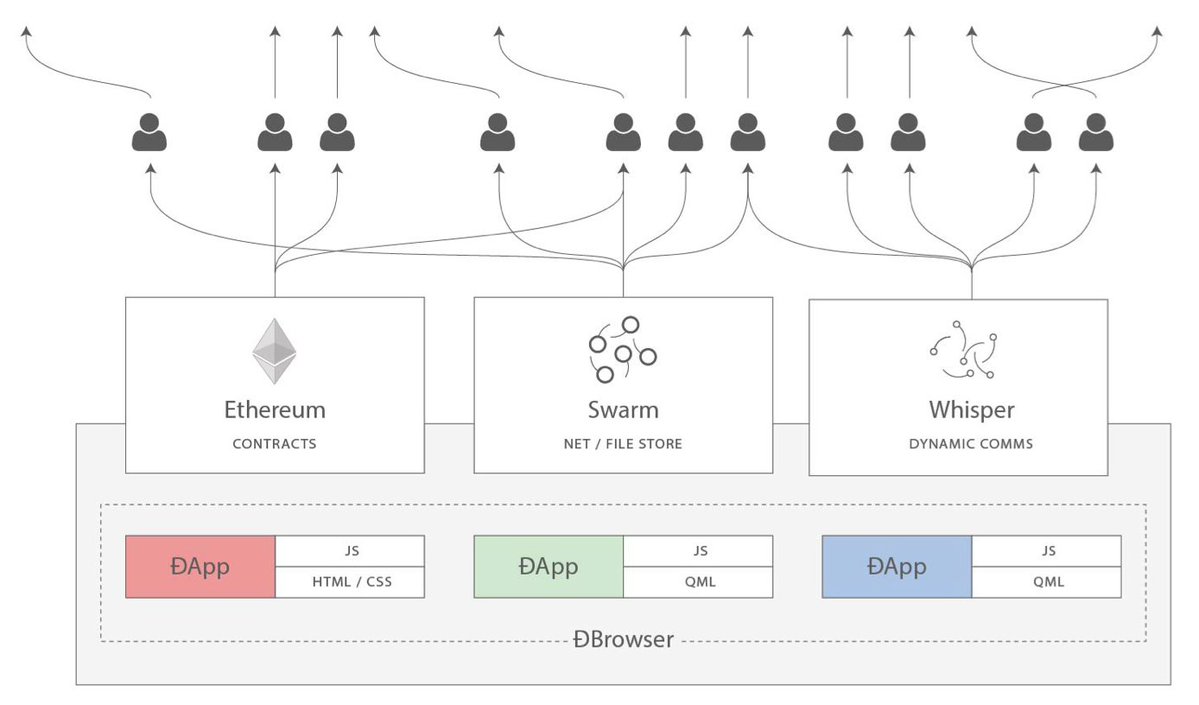
In 2014, there was a vision: you can have permissionless, decentralized applications that could support finance, social media, ride sharing, governing organizations, crowdfunding, potentially create an entire alternative web, all on the backs of a suite of technologies.
Ethereum: the blockchain. The world computer that could give any application its shared memory.
Whisper: the data layer. Messages too expensive for a blockchain, that do no need consensus.
Swarm: the storage layer. Store files for long-term access.
Over the last five years, this core vision has at times become obscured, with various "metas" and "narratives" at various times taking center stage. But the core vision has never died. And in fact, the core technologies behind it are only growing stronger.
Ethereum is now proof of stake. Ethereum is now scaling, it is now cheap, and it is on track to get more scalable and cheaper thanks to the power of ZK-EVMs. Thanks to ZK-EVM + PeerDAS, the "sharding" vision is effectively being realized. And L2s can give additional and different kinds of gains in speed on top.
Whisper is now Waku ( https://t.co/uj5h9iSpIL ), and already powers many applications (eg. https://t.co/owlo5yoS68, https://t.co/hDizYCFjuq just to name two I use). Even outside of Waku, the quality of decentralized messaging has increased. Fileverse (decentralized Google Docs and Sheets alternative: https://t.co/ZIKj4U5pQe ) has seen massive gains in usability over the past year.
IPFS is now highly performant and robust as a decentralized way of retrieving files, though IPFS alone does not solve the storage problem. Hence, there is still room to improve there.
All of the prerequisites for the original web3 vision are here, in full force, and are continuing to get stronger over the next few years. Hence, it's time to buidl, and buidl decentralized.
Fileverse is an excellent example of the right way to do things:
* It uses Ethereum and Gnosis Chain for what they are good for: names, accounts and permissioning, document registration
* It uses decentralized messaging and file storage to store documents and propagate changes to documents
* The application passes the walkaway test: https://t.co/xO1dNLlnhf (even if Fileverse disappears, you can still retrieve them and even keep editing them with the open source UI)
This is what we mean by "build a hammer that is a tool you buy once and it's yours, not a corposlop AI dishwasher that requires you to register for a google account and charges a subscription fee per month for extra washing modes, and probably spies on you and stops working if you get politically disfavored by a foreign country".
If you think this criticism of corposlop is hyperbolic, well turns out, it's literally a concatenation of these three:
* https://t.co/GBNaXOa454
* https://t.co/saD3cNp4Ae
* https://t.co/skoJ58vbqz
In 2014, decentralized applications were toys, hundreds of times more difficult to use in web2. In 2026, fileverse is now usable enough that I regularly write documents in it and send them to other people to collaborate. The decentralized renaissance is coming, and you can be part of making it happen.
This is a solid demonstration of Railgun's privacy pools mechanism ( https://t.co/dwgc4nlYyp ) working in practice, allowing Railgun to avoid serving proceeds of crime without using any snooping / backdoors.
How it works:
* Anyone can deposit into Railgun.
* After you deposit, there is a 1 hour period during which various algorithms detect whether or not the deposit likely came from what the algorithms consider to be criminal activity.
* If your deposit passes the filter, then after 1 hour you can use ZKPs to withdraw privately (but ideally wait longer to get a good-enough anonymity set).
* If your deposit fails the filter, then you can only withdraw back to your own address. There is no risk that your funds will get frozen/seized, you just can't benefit from the privacy pool.
If you disagree with Railgun's filters, anyone is free to fork and make their own pool with their own rules, though if you can't get reasonably wide public support you're going to have a tiny anonymity set.
https://t.co/owlo5yoS68