Закрыл гештальт и отклеил один стикер с окна – запилил мини-курс по современному использованию Make: https://t.co/AM8lvV3QQh
Айда вместе популяризировать Make!
Автоматизация не всегда освобождает. Иногда она просто превращает старые obligations в новые зависимости.
Stripe вместо инвойсов — это не исчезновение обязательств. Это их миграция.
Вопрос на после AI: не что мы автоматизируем, а кто владеет нашей средой.
AI не заменяет, а усиливает. Но что, если это усиление сделает нас ненужными? Общество стремится к автоматизации, чтобы избавиться от рутины. Но где тогда ценность нашей работы, если AI сделает всё за нас? #AI#БудущееРаботы
Мы не в фазе трансформации, а в фазе трансформационности. Всё, чего касается, меняется, и это изменение не останавливается. Пока вы внедряете одно — появляется что-то новое. #Технологии#Будущее#Инновации
↯ Vibe coders vs. old-school developers — two extremes, both missing the point.
On one side, you have vibe coders who don’t really understand what’s happening, depend on tokens and cloud tools, and can’t properly evaluate the result.
On the other, you have old-school developers who fetishize the ability to code “for real,” as if manual coding alone still guarantees an edge.
But the most dangerous group is somewhere in the middle — or rather, above that whole plane.
These are people who know how to program, but don’t turn programming into a cult. They got a new tool, and they’re exploring it seriously.
They don’t use AI just to increase output. Output comes as a side effect.
What they’re really increasing with AI is cognitive power:
✦ they understand more clearly what problem they’re actually dealing with,
✦ they explore the solution space faster,
✦ they choose the angle of attack more precisely,
✦ they test hypotheses faster,
✦ and they get better at spotting garbage, weak points, and good abstractions.
Those are the ones to beware of.
Ask yourself something uglier:
Do you know a single company where self-transformation is part of the core design?
- Not a patch.
- Not a process.
- Not a crisis response.
A company built on the assumption that it must keep changing shape and remain coherent.
People still treat change like an annoying exception.
- A customer changed their priorities.
- A competitor showed up.
- The team lost alignment.
- The market moved.
As if reality briefly stopped cooperating.
Even “adaptive” companies usually think the same way.
They still assume stability is the normal state.
Change is just something to survive until things calm down again.
So they don’t design for transformation.
They design for maintenance.
Your best ChatGPT conversations are the ones that crash your browser.
The longer you talk, the smarter the AI gets — and that's exactly when the frontend gives up. Not the AI. The React UI just shoves every message into the DOM at once and dies.
This drove me crazy enough to dig in and fix it. Turns out it's not even hard — which makes it even more frustrating.
30KB Chrome extension. Install and forget: https://t.co/99strVrAQX
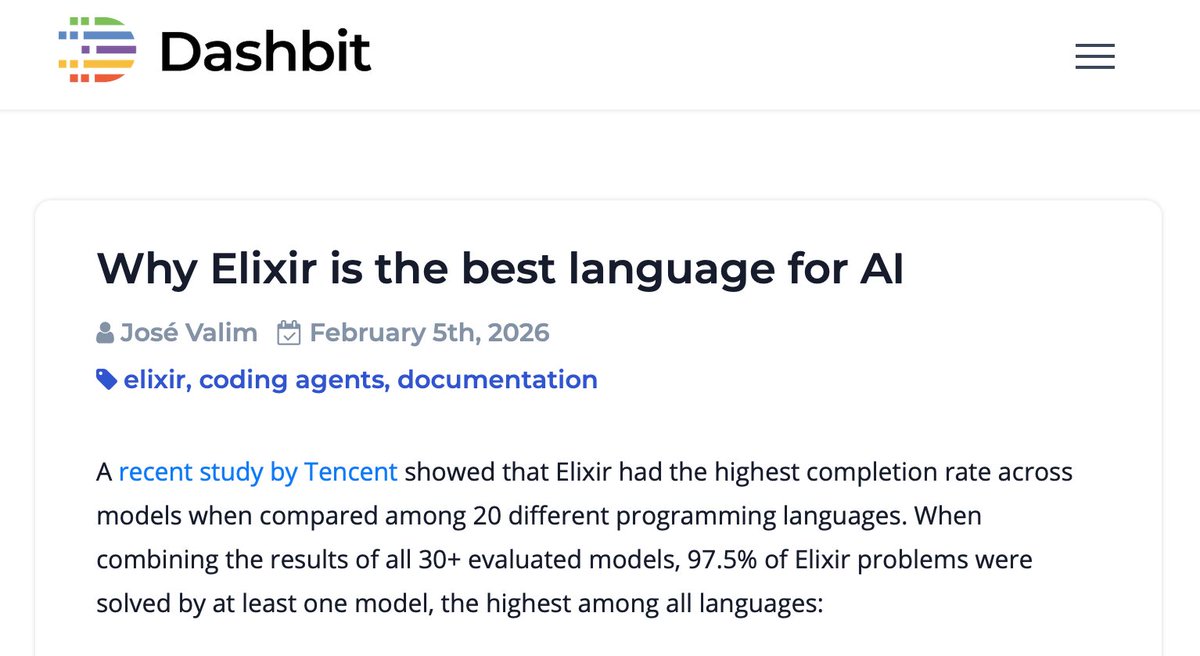
Here is my take on why Elixir is the best language for AI: immutability, documentation, stability, and tooling for coding agents.
It builds on the recent study in which Elixir had the highest completion rate across models among 20 different languages.
Link in the thread below.