Last quarter I rolled out Microsoft Copilot to 4,000 employees.
$30 per seat per month.
$1.4 million annually.
I called it "digital transformation."
The board loved that phrase.
They approved it in eleven minutes.
No one asked what it would actually do.
Including me.
I told everyone it would "10x productivity."
That's not a real number.
But it sounds like one.
HR asked how we'd measure the 10x.
I said we'd "leverage analytics dashboards."
They stopped asking.
Three months later I checked the usage reports.
47 people had opened it.
12 had used it more than once.
One of them was me.
I used it to summarize an email I could have read in 30 seconds.
It took 45 seconds.
Plus the time it took to fix the hallucinations.
But I called it a "pilot success."
Success means the pilot didn't visibly fail.
The CFO asked about ROI.
I showed him a graph.
The graph went up and to the right.
It measured "AI enablement."
I made that metric up.
He nodded approvingly.
We're "AI-enabled" now.
I don't know what that means.
But it's in our investor deck.
A senior developer asked why we didn't use Claude or ChatGPT.
I said we needed "enterprise-grade security."
He asked what that meant.
I said "compliance."
He asked which compliance.
I said "all of them."
He looked skeptical.
I scheduled him for a "career development conversation."
He stopped asking questions.
Microsoft sent a case study team.
They wanted to feature us as a success story.
I told them we "saved 40,000 hours."
I calculated that number by multiplying employees by a number I made up.
They didn't verify it.
They never do.
Now we're on Microsoft's website.
"Global enterprise achieves 40,000 hours of productivity gains with Copilot."
The CEO shared it on LinkedIn.
He got 3,000 likes.
He's never used Copilot.
None of the executives have.
We have an exemption.
"Strategic focus requires minimal digital distraction."
I wrote that policy.
The licenses renew next month.
I'm requesting an expansion.
5,000 more seats.
We haven't used the first 4,000.
But this time we'll "drive adoption."
Adoption means mandatory training.
Training means a 45-minute webinar no one watches.
But completion will be tracked.
Completion is a metric.
Metrics go in dashboards.
Dashboards go in board presentations.
Board presentations get me promoted.
I'll be SVP by Q3.
I still don't know what Copilot does.
But I know what it's for.
It's for showing we're "investing in AI."
Investment means spending.
Spending means commitment.
Commitment means we're serious about the future.
The future is whatever I say it is.
As long as the graph goes up and to the right.
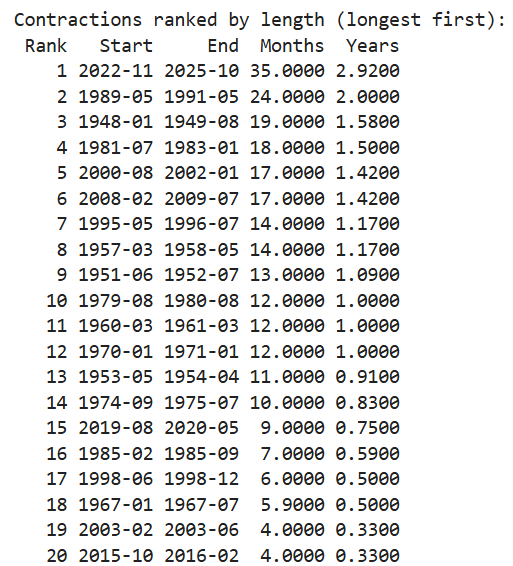
The current business cycle - as defined by ISM PMI - has been in a contraction phase for about 3 years.
This is the longest - I repeat the LONGEST - contraction since the index began in 1948.
And you don't think there is a reversal and uptrend around the corner?
🖨️🖨️🖨️
SOFR just fell off a cliff.
When the cost of overnight money collapses, it’s a significant regime signal.
Cheap funding → more leverage → higher risk appetite → liquidity turning.
Layer this on top of:
- TGA drawdowns coming once the government reopens
- QT ending in December
- Fed officials hinting at balance-sheet expansion to stabilize reserves
The market isn’t reacting to narratives.
It’s front-running a shift in liquidity conditions.
Watch liquidity. Everything else is noise.
We'll cover it on @ForwardGuidance tomorrow but my take on FOMC is as follows.
Powell appeared to be playing political games / posturing / CYA around the December verbiage, possibly to communicate to the admin to get the government reopened. It almost felt like a threat that if no data (due to continued government shutdown), then there won't be a December cut and the market was briefly thrown off by that uncertainty. The immediate reaction made sense given it is quite abnormal to hear Powell comment on market pricing so specifically as he always refrains from doing so and makes a point to say he will not comment on market pricing. What you infer from that is up to you, but additionally I believe the market may have been surprised by what I believe to be an incorrect Fed reaction function to the government shutdown. There is no scenario in which the economy is stronger because of the shutdown and if they are highlighting continued downside labor market risks, there isn't a great case to be made to veer from their September dot plot path.
Ultimately I think they will reopen the government in the next few weeks so there will be data and it is likely to show inflation falling for the next few months and labor market continue its weakening path, and Trump is making deals that likely bring tariffs down which also earns him brownie points with the FOMC. All in all I think the December cut is still quite likely.
On top of that, just a week or two ago the market was not expecting QT to end this soon and today Powell went so far as to discuss the next step in this process being a return to balance sheet growth. These developments are definitively liquidity positive, even though the MBS reinvestment and future purchases will be all or predominantly bills. Ultimately the Treasury will decide the composition of its debt issuance and has utilized ATI to support markets for multiple years now. If the Fed buys more bills and the Treasury skews more issuance towards bills versus long duration bonds, that's effectively the same impact of QE removing bond duration from the market.
Powell's term as Chair ends in 6 months and his successor will be known even sooner, creating a shadow Fed chair situation. It remains clear to everyone and the market that the new chair will be friendly towards and help effectuate the admin's agenda. Given all of the above, it is difficult for me to paint a risk asset bear case based upon liquidity dynamics as all signs point to continued massaging to support markets.
FOMC day has arrived where per usual we will not learn anything new from Powell. The Fed's end to QT has already been leaked to big bank strategists and the WSJ, they will cut at their next two meetings to stay consistent with September dot plot and market expectations, and they will continue to prioritize supporting growth while avoiding public acknowledgement that their inflation target has shifted up to ~3%.
Fast forward a few hours and Trump will be touting his meeting with Xi as the most successful and important meeting any US president has ever had. There will be talks of a grand deal made that can now provide certainty to corporates and consumers globally. After this, event risk rolls off significantly into year end.
It is extremely difficult to be fearful of a market boogeyman when corporate bond yields are at 3.5 year lows, mortgage rates are at 3 year lows, oil is at 4.5 year lows, the Fed is cutting in 4/5 consecutive meetings and ending QT, fiscal deficit spending is still running rampant and OBBA incentives plus other election year stimulus measures begin next quarter. These next few quarters will likely remind everyone why Trump got his President Pump nickname.
You're gonna have fun with this one; best to bookmark it and sit with it a bit.
- - -
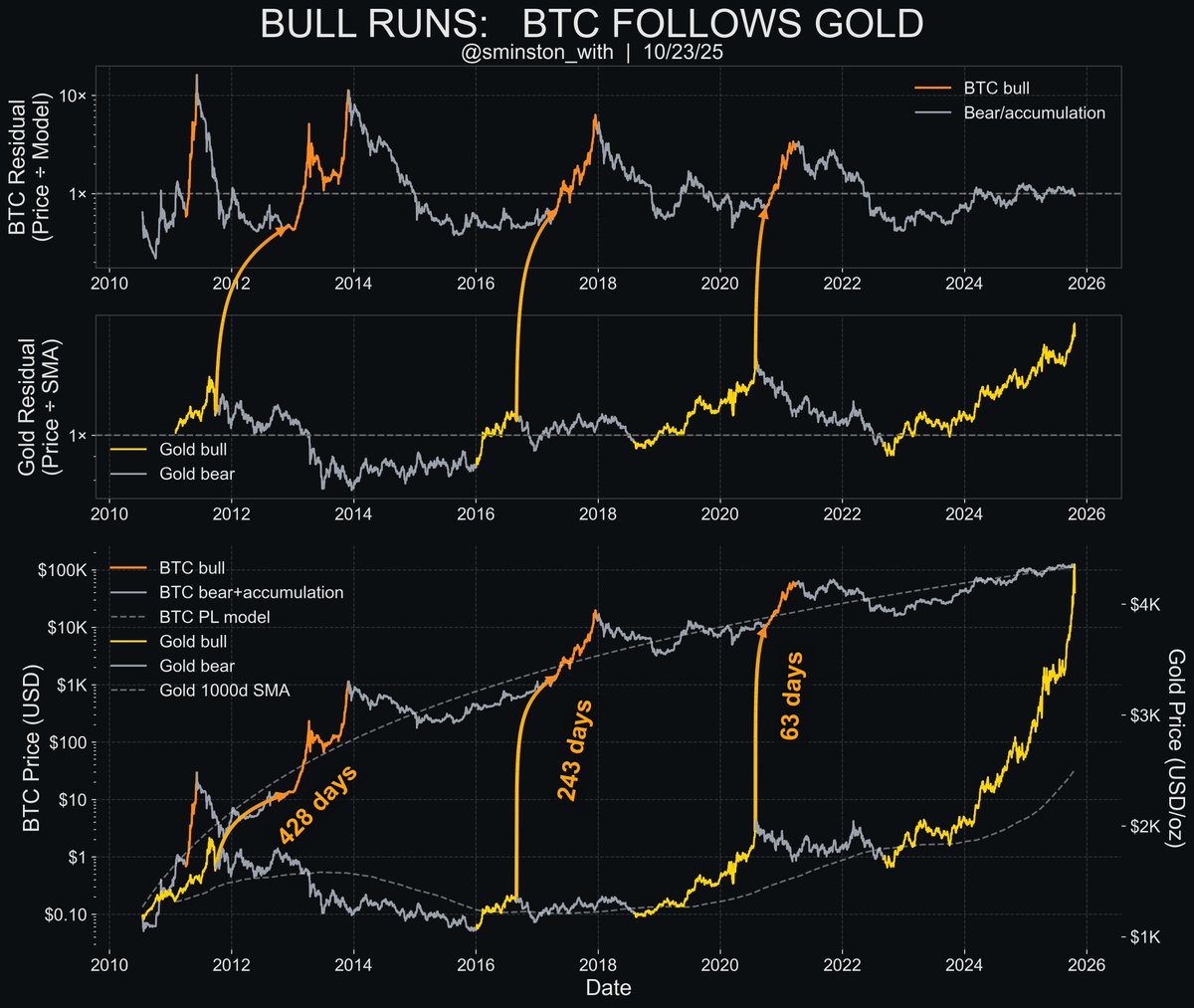
👉BTC FOLLOWS GOLD 👈
🏃♂️🏃♂️🏃♂️
Top two plots are residual plots based on the price plot underneath, for both Bitcoin and Gold - lets you visualize the fluctuations of both assets becoming more over- or under-valued.
The curved arrows connect the ENDS of the gold bull runs to the BEGINNINGS of the Bitcoin bull runs - along with the approximate lag of BTC behind gold runs in days.
Now look where we are now with gold.
🪙⏩🧡
Fed governor Stephen Miran says he’s supportive of bringing QT to a stopping point along the lines of what Powell hinted at on Tuesday:
“I don’t know what the market benefit of additional reductions from here are.”
《Opinion: Is this crash an attack on Binance and a certain market maker?》(Author | Forgiven)The article suggests the October 11 crash may have been a planned attack on Binance, exploiting flaws in its Unified Account margin system that used volatile assets like USDE, wBETH, and BnSOL as collateral. Their sharp depegging triggered massive liquidations and losses estimated at $500M–$1B. The timing—between Binance’s oracle update announcement and implementation—implies coordination. Analysts compared the event to LUNA-UST, warning that using non-fiat stablecoins as high-collateral assets heightens systemic risk.
https://t.co/obt72rkN2z
Wanted to share a few thoughts tonight...
This is from the September 11th MIT publication that dropped on @RealVision:
For starters, unemployment keeps grinding higher, exactly as our lead indicators and GMI/MIT work flagged back in Q1.
That keeps the Fed engaged and is why, as I noted in last week’s video update, the market has started pricing in a higher probability of cuts at the September, October, and December meetings...
US unemployment is now at 4.3%, right on the Fed’s low estimate for 2025 (chart 1).
If it drifts toward 4.5% or 4.6%, as our lead indicators suggest, that’s a green light for more cuts into 2026, even though there are early signs the employment cycle has already turned up. More on that in a moment...
At the same time, unemployment breadth peaked over a year ago and continued to fall in August (chart 2).
Quantitatively, this is a good sign. The index rises into recession, it doesn’t fall…
We peaked last June at 92%, but it has since dropped to 62% of US states reporting a year-on-year rise in unemployment.
Now, take a look at this next chart...
This index tracks weekly overtime hours in the most cyclical parts of the US economy, with data back to the 1950s (chart 3).
Every recession has come when it rolls over toward the -2 standard deviation level, and we are nowhere near that.
Additionally, the August data showed a further pick-up in overtime hours, which, as I have been highlighting in these reports, is much more consistent with an early-cycle economy trying to build momentum than anything else...
This is exactly why S&P earnings revisions keep exploding higher, just as we’ve been expecting (chart 4).
The Fed is cutting rates right as the business cycle is turning up. That’s hugely bullish for risk assets.
These aren’t late-cycle recession cuts. They’re early-cycle insurance cuts... two very different things.
The end of The Waiting Room is near...
I’ve been seeing a lot of chatter on X about “peak cycle” and how the economy looks late-cycle. So I wanted to tackle this head on and share a few thoughts of my own...
This is from the August 21st MIT publication:
A classic late-cycle economy typically has all the following ingredients:
✅ Manufacturing sentiment is extreme (think ISM ~60)
✅ Services sentiment is extreme
✅ Homebuilder sentiment is extreme
✅ Consumer confidence is high
✅ Worker confidence is high (JOLTS quits rate rising sharply)
✅ Investor sentiment is very bullish
✅ Small business confidence is high
✅ Job openings and hiring plans are rising
✅ Wage data and surveys show accelerating pay increases
✅ CEO confidence is strong and capex is booming
Now, I could add more to this, but when you score all of these inputs and turn them into a single timeseries, here’s what you get (chart 1).
Using data from ISM, NAHB, NFIB, BLS, AAII, The Conference Board, etc., US sentiment, when viewed as a complete picture, remains very subdued. We’re just not even close to the euphoric levels we see late in the business cycle, when everything listed above is stretched to extremes.
Peak cycle is when the ISM rolls over from 60+ to sub-50, inventories unwind, and demand cools. Supply and demand reset, inflation pressures ease, and the cycle eventually recovers out of the slowdown or recession – mostly depending on the extent to which financial conditions tightened during the cycle, particularly late on as central banks hike rates and drain liquidity.
However, based on this full set of indicators, the data is pointing to something very different. This does not look like an above-trend late-cycle economy. It looks much more like an early-cycle economy trying to build momentum.
Another really important factor, and a key reason we believe both the ISM and this sentiment composite will grind higher this year and into 2026, is the sheer scale of central bank easing via rate cuts.
Right now, nearly 90% of central banks are cutting rates. That is extraordinary, and on a forward-looking basis, it is a massive tailwind for the business cycle (chart 2).
By my playbook, the time to start talking late-cycle is when the teal line rolls over and begins to drop, as central banks turn to hiking rates to slow growth. Even then, there’s usually a nine-month lag before higher rates hit the real economy.
Right now, we’re just nowhere near that... in fact, the opposite is true.
To my earlier point, slowdown or recession is largely a function of how much financial conditions tighten late in the cycle. Oil prices are a big part of this equation. When oil runs 50% above trend, that represents a massive tightening and has almost always signaled recession, looking back to the early 1970s.
However, right now, we are nearly 20% below trend and still falling, which shows this component of financial conditions is still easing (chart 3).
Also, as I’ve pointed out many times in previous reports, when you look at Temporary Help Services, it has early-cycle vibes written all over it (chart 4).
Rising growth from deeply negative levels is an early-cycle dynamic. It tells you the economy is in recovery mode, not rolling over.
Late-cycle is the opposite: positive year-on-year growth that’s slowing, which reflects an overheated economy losing steam.
Why is unemployment still rising?
Because it lags the cycle. Jobs data is a six-month look in the rear-view mirror.
Here’s the thing: full-time hires are expensive. Benefits, pensions, overhead…
So what do businesses do first?
They typically increase overtime hours and bring in temp workers. Only when they feel confident do they finally lock in full-time staff. That way, they can scale without locking themselves into long-term payroll commitments.
So, this isn’t late-cycle. It’s early-cycle (growth up + inflation down = Macro Spring), soon transitioning to mid-cycle (growth up + inflation up = Macro Summer).
That’s how I see it, anyway...
✅ Financial conditions just keep on loosening
I believe the professional term for the current environment is "turbo loose".
My Financial Conditions Indicator (rolling z-score) has basically dropped in a straight line down since early April.
It's now well below zero (green - loose).
Similar levels to large parts of 2023 and 2024, which powered asset markets higher.
Chicago Fed's National Financial Conditions Index is also loosening rapidly.
Back to "peak 2020/21 speculation levels".
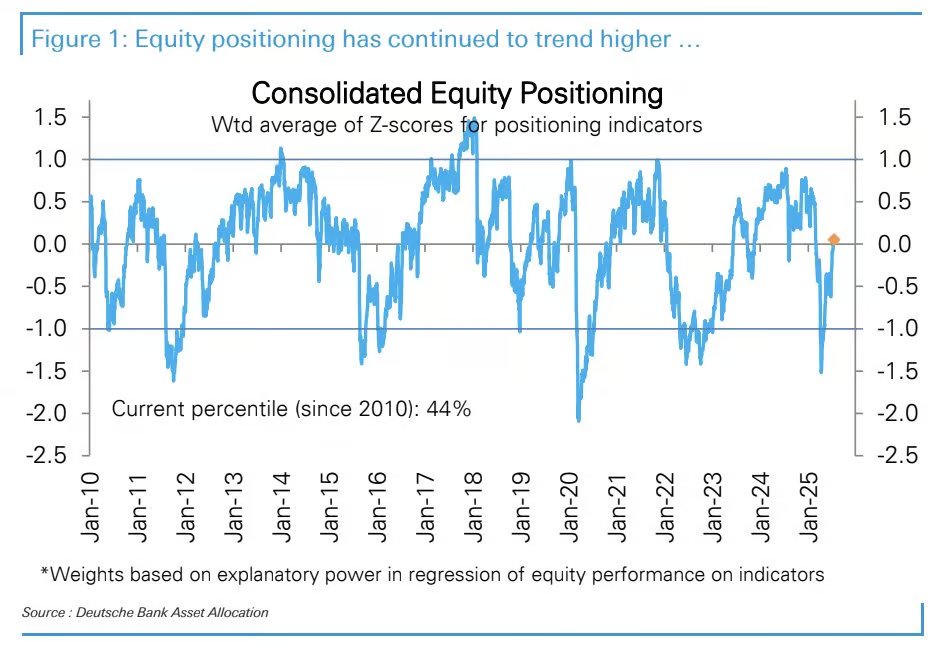
Meanwhile, equity positioning is still subdued.
It might seem crazy after a 40% run-up in the Nasdaq, but the pain trade is still up.
There is no accurate measuring tool, but we can still draw a rigorous conclusion: Galaxy Z Fold7 is the thinnest folding mobile phone in the world.
I switched the positions of two mobile phones during the test, and the results remained the same, which showed that the factors of uneven desktop were eliminated and my test was rigorous.