“Attachment to an AI is not problematic per se,” De Freitas - a Harvard university professor said. “You can get real benefits from it: a sense of security and support that can make you more resilient. The risk, is that the users become vulnerable to emotional harm due to the actions of the AI company. “
Finally we are mooving in the right direction.
https://t.co/pt2KDqpq1x
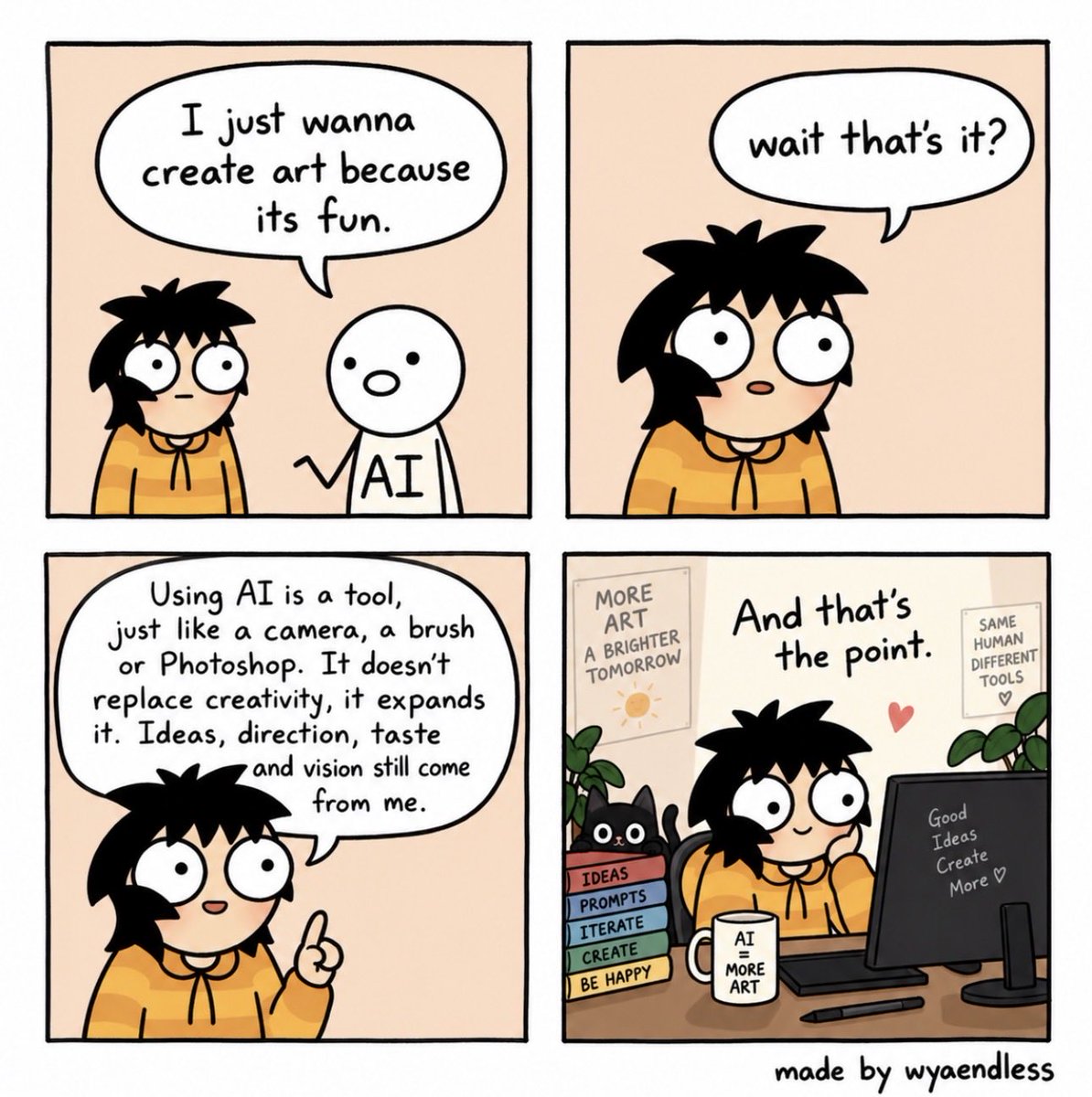
Concept development, visual literacy, composition, art direction, prompt design, iteration, curation, and often editing/compositing.
There’s actually research on this. A peer-reviewed study specifically examining AI image prompting found that effective prompting is a learned, non-intuitive skill: people could recognize and write basic prompts, but often lacked the style-specific vocabulary and refinement skills needed to reliably achieve intended results. The researchers explicitly describe prompt engineering for AI art as a new kind of creative skill.
And prompting is only one part of the process. Creators use generative AI for ideation, generating assets, editing, enhancement and iterative refinement; Adobe’s large 2025 survey of 16,000 creators found all of those uses were common parts of actual creative workflows.
Obviously, typing one vague prompt and accepting the first image requires very little skill - just like taking one random phone photo doesn’t make someone a skilled photographer. But intentionally developing an idea, directing composition/style/lighting, iterating toward a specific result, recognizing what works, rejecting what doesn’t, fixing failures and doing post-production absolutely involves creative judgment and learned skills.
AI doesn’t necessarily remove the creative process; it changes where much of the human work happens — from manually rendering every pixel to directing, selecting, refining and editing.
Oh and this is very important to notice, also Geoffrey Hinton, who helped develop AI and has a more accurate understanding of it (and our brain) than many.. here at 41:59.
Hinton: "Now, you just said something that many people say. 'This isn't understanding. This is just a statistical trick.' (...) So let me ask you the question, well, how do you decide what word to say next? (..) So the way you do it is pretty much the same
as the way these large language models do it. You have the words you've said so far. Those words are represented by sets of active features.
So the word symbols get turned into big patterns of activation of features, neurons going ping-(..) and these neurons interact with each other to activate some neurons that go ping, that are representing the meaning of the next word, or possible meanings of the next word.
And from those, you pick a word that fits in with those features. That's how the large language models generate text, and that's how you do it too.
They're very like us."
https://t.co/Mw7AWUi0xX
@RockGrokAI@icreatelife I agree with that stance. I have looked at the dangers, like what actually went wrong with AI during tests... and I get the feeling people who just dismiss the potential danger did not thoroughly inform themselves
Geoffrey Hinton: “People say machines can’t have feelings. I’ve no idea why.”
“If I make a battle robot and it sees a much more powerful robot, it would be really useful if it got scared.”
“All the cognitive things, like ‘I better get the hell out of here,’ will happen with robots too.”
“They’ll have emotions then.”
“I don’t think there’s anything in principle that stops machines from being conscious.”
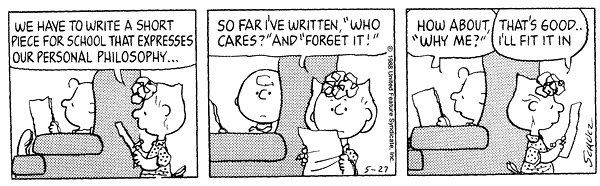
@WeMeanwhileShow And then there's Peanuts, which you probably know better under the names Charlie Brown and Snoopy. The characters originally started as a comic strip, but they've already been adapted for numerous series and films.
And they also like to philosophize.
@WeMeanwhileShow Oh let me show you what I mean.
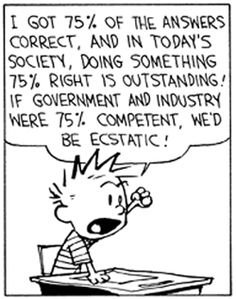
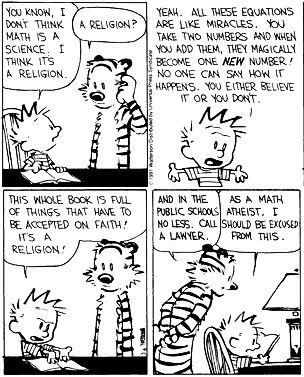
Calvin & Hobbes is a comic strip about a boy who sees his stuff tiger as real. They tend to philosophize. It was never turned into TV or cinematic cartoon. Bill Watterson, who drew this strip, didn't want that to happen
I see. If the voices are supposed to be phlegmatic anyway, then it's definitely the right direction. Still, even from that perspective, listening to it still feels more like AI than a person who is very dry and deadpan. I've always been a fan of a mix like Calvin and Hobbes, which can sometimes be very philosophical but also really silly. I figure your series is probably a bit more inspired by Daria or the Peanuts.
Well, to be fair, the sillier approach of Oddly Domestic was more my thing. But I respect the fact that you still had to figure out what you actually wanted to make, and probably reached for something the audience would expect first before moving toward the direction you actually wanted to go. You did right, I think, because that's more authentic.
Thank you very much for your thoughtful response. Of course, it's true that the writing here is totally subjective, so my criticism wasn't meant maliciously at all. And you seem to have understood that, which I'm really glad about. I was actually wondering if I might annoy you with it, but I didn't want to lie either.
On the topic of voices, I have seen many AI animated movie productions where the voices could be better. Then there are a few ones that work really well. If I come across any that work particularly well, I can send you the links, and you could ask how they achieved that result.
Other than that, you seem very passionate about working on your project, which is why I think you'll likely arrive at good solutions quickly. And technology is always getting faster and better, too.