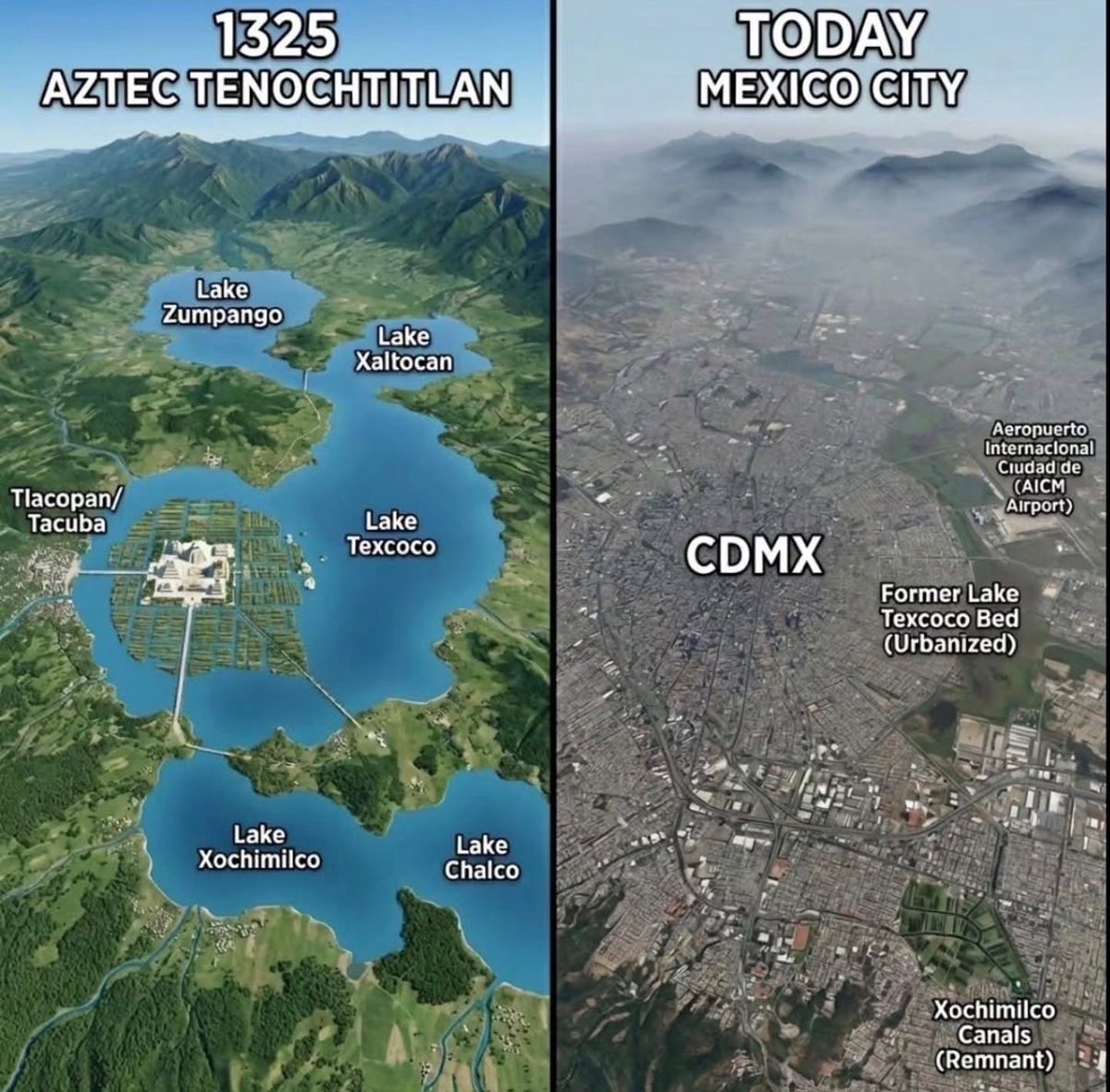
Long before Mexico City existed, the magnificent city of Tenochtitlan ruled the Valley of Mexico.
I think one of the greatest moments in history to witness would be the height of Tenochtitlan in the early 1500s, before Hernán Cortés and the Spanish conquistadors conquered and destroyed the city. Seeing one of the world’s most remarkable urban centers at its peak would be an unforgettable experience.
When the Spanish first arrived in 1519, Tenochtitlan was among the largest cities on Earth, with an estimated population of 200,000 to 300,000—larger than most European capitals of the era. Built on an island in Lake Texcoco, it was connected to the mainland by three massive causeways equipped with removable bridges for defense. A network of canals ran throughout the city, allowing canoes to transport people and goods so efficiently that Europeans often compared it to the “Venice of the Americas.”
At the heart of the city stood the Templo Mayor, an enormous twin-temple pyramid dedicated to the gods Huitzilopochtli and Tlaloc. Surrounding it were palaces, government buildings, temples, and bustling plazas. Nearby, the Great Market of Tlatelolco drew thousands of merchants each day, offering everything from food and pottery to textiles, jewelry, and luxury goods from across Mesoamerica.
The Aztecs also demonstrated extraordinary engineering and agricultural innovation. They expanded farmland using chinampas—highly productive artificial farming plots built in shallow lake waters—while aqueducts supplied the city with fresh water from nearby springs. Carefully planned neighborhoods organized by occupation and social status completed a city that combined sophisticated engineering, architecture, and urban planning, making Tenochtitlan one of the greatest achievements of the pre-Columbian world.