#RDC: 🚨‼️🛑De violents affrontements ont opposé les Forces armées de la République démocratique du Congo (FARDC) à un groupe armé à #Bukama, chef-lieu du territoire du même nom, situé dans la province du Haut-Lomami, dans le sud-est de la RDC.
#Rwanda 🇷🇼 _ #Uganda : Le Président @PaulKagame a reçu aujourd’hui le Général Muhoozi Kainerugaba @mkainerugaba , Chef des Forces de défense du peuple ougandais (UPDF). Au cours de leur entretien, ils ont échangé sur la solide coopération bilatérale entre le Rwanda et l’Ouganda, ainsi que sur les questions relatives à la paix, à la sécurité et à la stabilité dans la région. Ces discussions ont réaffirmé l’engagement des deux pays à renforcer leurs relations et à promouvoir une paix durable ainsi qu’une coopération étroite au bénéfice de la région.
🔵“@YolandeMakolo : Gacaca Delivered What the ICC Never Could”
The Government of Rwanda has firmly rejected attempts to use the country as an example in defense of the International Criminal Court (ICC), with Government Spokesperson Yolande Makolo arguing that Rwanda’s post-genocide experience demonstrates the effectiveness of nationally owned justice mechanisms over what she described as a “selective” and “unaccountable” international institution.
The exchange followed comments by Cameron Hudson, who criticized a statement from the United States Embassy in Kigali regarding the ICC. Hudson argued that Rwanda, having experienced international justice efforts after the 1994 Genocide against the Tutsi, should be viewed as evidence of the importance of institutions such as the ICC.
“This feels so discordant coming from our embassy in Kigali, a country that has benefitted from restorative and international justice and is often cited as a reason for creating the ICC,” Hudson wrote, warning that criticism of the Court without reaffirming the value of international justice could embolden authoritarian leaders and armed groups.
However, Makolo rejected that characterization, stating that Rwanda has never regarded the ICC as a model for delivering justice.
“Hi Cameron, Rwanda is the wrong example to use to defend the ICC,” she responded. “We have consistently opposed the ICC as a selective, unaccountable institution which has been used to target Africans disproportionately.”
Makolo pointed instead to Rwanda’s Gacaca courts, the community-based justice system established after the 1994 Genocide against the Tutsi to address the unprecedented number of genocide-related cases.
According to her, Gacaca processed nearly two million cases over approximately a decade while operating at relatively low cost. Beyond criminal accountability, she argued, the courts also sought to uncover the truth, encourage confessions, facilitate reconciliation, and enable communities devastated by genocide to coexist once again.
For Rwanda, Makolo suggested, justice was inseparable from national reconstruction. Rather than relying exclusively on distant international institutions, the country developed a system designed to respond to the realities facing millions of survivors and perpetrators living side by side.
Makolo’s remarks also echoed a longstanding position maintained by successive Rwandan governments regarding the ICC. Kigali has repeatedly argued that the Court has applied international criminal justice unevenly and has disproportionately focused its prosecutions on African states while failing to demonstrate the same resolve elsewhere.
This criticism has been shared at various times by several African leaders and regional organizations, who have questioned whether the Court applies justice consistently across the globe.
Makolo concluded that Rwanda’s recovery was made possible not merely through punishment, but through a justice system adapted to the country’s unique circumstances.
“Gacaca was pivotal to Rwanda’s recovery, progress and stability,” she said. “A distant, biased court such as the ICC could never have delivered justice and reconciliation on that scale; not in our lifetime.”
Her response underscores Rwanda’s enduring belief that sustainable peace after mass atrocities requires locally owned solutions capable of balancing accountability, truth, reconciliation, and national healing. Rather than viewing the ICC as the defining symbol of post-genocide justice, Rwanda continues to present Gacaca as one of the country’s most significant contributions to transitional justice and post-conflict reconstruction.
@TomNdahiro@EgidieBibio@paul_rukesha@SadateMunyakazi@KARANGWASewase@EmmanuelMacron@rpfinkotanyi@PatriotNkotanyi@NkotanyiYvette@Ali_Rukaliza@VictorMurashi@damiennkaka@FelixMugenzi@anniemongi1@DrDamascene@NshimyimanaEmma@PaulMash424427@sheilakamuzinzi@Nadia_MUGUNGA1@PatrickRugaba@ruhumuza@gmbonyumutwa
Collaboration militaire #Rwanda et #Uganda.
Le chef des forces de défense de l'armée ougandaise (UPDF), le général Muhoozi Kainerugaba, est arrivé au Rwanda pour une visite de travail de deux jours. Il a été accueilli par le chef d'état-major de la défense des forces rwandaises de défense (RDF), le général Mubarakh https://t.co/F9X7rVZmAG cours de cette visite, le général Muhoozi devrait également être reçu par le président Paul Kagame.
Depuis Paris 7e, Rodriguez Katsuva.
La #RDC s’enfonce chaque jour davantage.
À la tête de cette descente, un responsable : #Tshisekedi.
S’il ne peut pas relever le pays, qu’il cesse de s’accrocher au pouvoir et laisse la place aux compétents.
Le pays n’a pas besoin d’un fauteuil occupé, mais d’un leadership capable
Hi Cameron, Rwanda is the wrong example to use to defend the ICC. We have consistently opposed the ICC as a selective, unaccountable institution which has been used to target Africans disproportionately. Post-genocide Rwanda established Gacaca, a home-grown system of justice and reconciliation, which completed nearly two million cases in ten years, at modest cost, while establishing truth, accountability and a basis for communities to live together again.
Gacaca was pivotal to Rwanda’s recovery, progress and stability. A distant, biased court such as the ICC could never have delivered justice and reconciliation on that scale—not in our lifetime.
En 2023 : Déshabillée et lynchée en pleine ville de #Mbuji_Mayi pour avoir soutenu @moise_katumbi : voilà le prix qu'une femme a payé pour la #démocratie.
L'intolérance politique de l'#UDPS menace la cohésion nationale.
La #RDC mérite la paix, pas la barbarie & la division ! 🇨🇩
@moise_katumbi 🛑 Rappel des faits à Mbuji-Mayi :
Battue, déshabillée et laissée nue sur la voie publique uniquement parce qu'elle était candidate sur la liste de #Katumbi .
Humilier les femmes pour museler l'opposition est une honte.
L'#UDPS ne doit pas fracturer le pays ! 🇨🇩
#RDCongo#RDC
#RDC : 🚨‼️🛑Naissance de la Plateforme Internationale de la Diaspora Katangaise (PIDK) .
« Nous faisons naître une institution internationale qui ambitionne de rassembler les filles et les fils du Katanga établis aux quatre coins du monde autour d'une même vision : celle d'un Katanga uni, prospère, moderne, influent et pleinement acteur de son propre développement. Notre région possède des ressources naturelles exceptionnelles, une jeunesse dynamique, une richesse culturelle incomparable et un potentiel humain remarquable. Pourtant, ces richesses ne pourront produire leurs effets que si nous savons unir nos intelligences, nos compétences, nos expériences et nos ressources. La diaspora katangaise représente aujourd'hui une force extraordinaire »Billy Ilunga Kalenga, président.
Il est 11h15. Dans le 15e arrondissement de Paris. Café, verre d’eau et un croissant ! La France que j’aime ! Ma France.
Depuis Paris, Rodriguez Katsuva.
Il est 11h15. Dans le 15e arrondissement de Paris. Café, verre d’eau et un croissant ! La France que j’aime ! Ma France.
Depuis Paris, Rodriguez Katsuva.
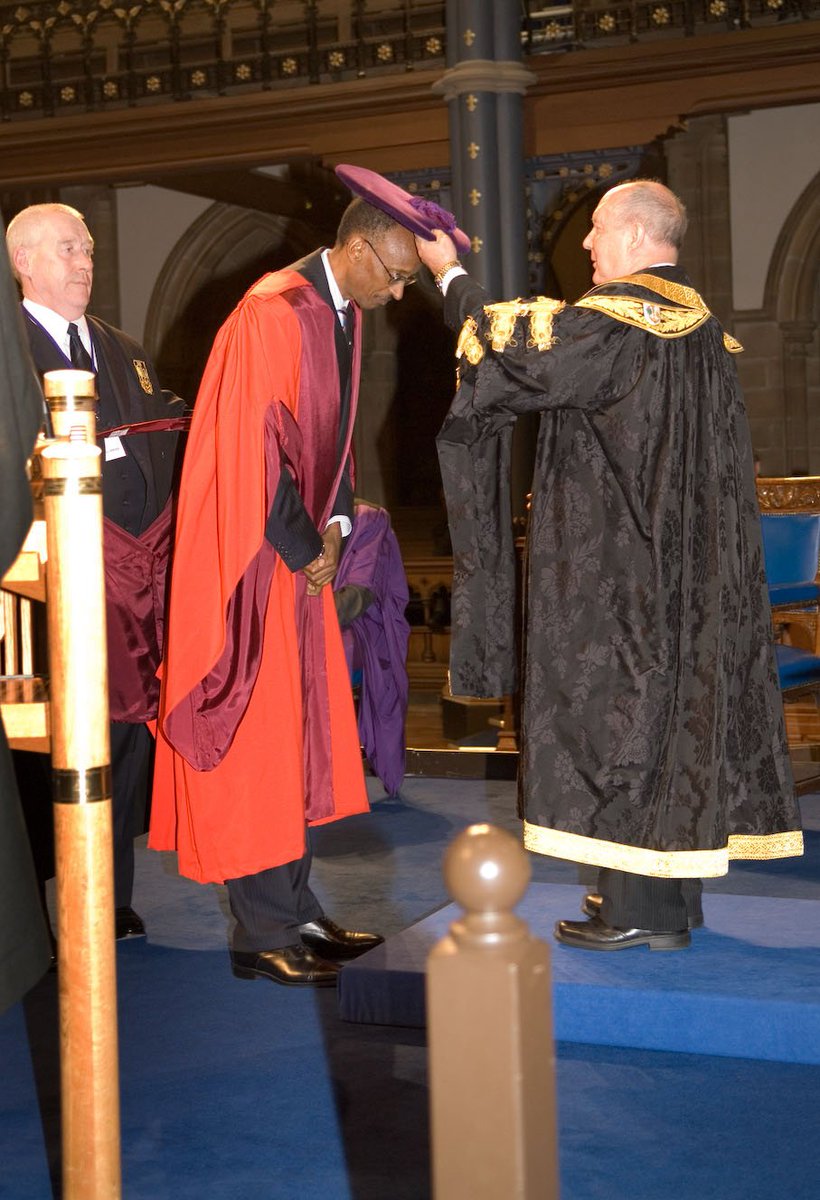
Prestigious universities around the world have awarded President Paul #Kagame at least eight honorary doctorates in recognition of his leadership, contributions to peacebuilding, and role in Rwanda's economic transformation.
His documented honorary degrees include:
1. Doctor of Laws (LL.D.) – University of the Pacific, United States (April 2005)
2. Honorary Doctorate – Oklahoma Christian University, United States (April 2006)
3. Doctor of Laws (LL.D.) – University of Glasgow, Scotland (November 2007)
4. Doctor of Laws (LL.D.) – Florida State University, United States (February 2009)
5. Doctorate in International Relations – Fatih University, Türkiye (March 2012)
6. Doctor of Humane Letters – William Penn University, United States (May 2012)
7. Doctor of Laws (Honoris Causa) – Bahir Dar University, Ethiopia (July 2016)
8. Doctorate in Public Policy and Management – Yonsei University, South Korea (June 2024)
These honors reflect international recognition of President Kagame's leadership, his commitment to national development, and his contributions to peace, governance, and public policy.
@StanysBujakera L’armée de la RDC comprend des éléments des FDLR, tandis que les FDLR existent également comme groupe distinct et sous différentes autres appellations. Cette réalité est bien connue.
@StanysBujakera Véritable solution serait le départ de Tshisekedi et la mise en place d’une armée nationale professionnelle, unifiée et débarrassée des FDLR. Cette armée pourrait alors neutraliser efficacement les FDLR. Mais vouloir imposer le FDLR par la force n’est pas une solution réaliste.
This morning in Gabiro, Minister @onduhungirehe held an interactive session with participants of Itorero #Indangamirwa16 in a session on “Rwanda’s Diplomacy and the Role of Young Rwandans at Home and Across the World.” He highlighted the important role of young Rwandans wherever they are in contributing to the country’s development, unity and progress.