For twenty-five years the web ran on an implicit deal. Publishers let crawlers index their content freely. Search engines sent readers back as traffic. Nobody wrote it down. AI answer engines have ended the deal unilaterally.
Similarweb measured zero-click searches (queries that end without a single click to any website) at 69% by May 2025. By 2026 the figure is above 80%. A Pew Research Center study of 68,000 real queries found click-through rates fall by half when an AI summary appears: 8% versus 15% without one. Only 1% of users click the citations listed inside the summary. Ahrefs measured the click-through rate for content ranked first on informational queries, the kind where knowledge matters most, and found it had collapsed from 7.6% to 1.6%. A 79% decline, for content ranked first.
On the other side: Cloudflare data puts Anthropic's crawlers at roughly 70,000 page requests per referral visit sent. The AI system takes at scale; it returns almost nothing.
For ad-funded publishers this is a revenue crisis. Some have closed entirely. "The extinction-level event is already here," said Helen Havlak, publisher of The Verge.
For researchers, NGOs and archives, the threat is different and in some ways sharper. Their revenue doesn't primarily depend on traffic. Their credibility does. Citation and attribution are the currency that academic and mission-driven work runs on — they justify the grant, validate the methodology, establish the institution.
An AI answer that draws on research without naming it, or naming it in citations 99% of readers never click, doesn't just lose the visit. It breaks the attribution chain that makes the work legible as knowledge rather than noise. A paraphrase without a name attached makes an institution disappear in plain sight, even while its work is actively in use.
The question is not only: how do we recover the traffic? It is: how does original work establish, in the age of AI interfaces, that it exists, is trustworthy, and came from somewhere specific?
Those are not SEO questions. They are questions about what it means to be a canonical source.
Next: what the standards bodies are building in response.
#AIcopyright #ScholComm
In the AI copyright fight, there are two kinds of rights-holders: those big enough to sue, and those big enough to sign.
The New York Times, Disney and Getty are litigating. News Corp signed with OpenAI for a reported $250M over five years. Reddit licenses its corpus to Google for a reported $60M a year. Content, it turns out, has a price for those with the scale to negotiate.
Below that line sits almost everyone who actually creates original work: independent publishers, individual academics, NGOs, cultural archives. Too small to sue. Too small to license individually. Ingested all the same: no consent, no credit, no cheque.
And the grievance isn't only about money. When Taylor & Francis licensed academic content to Microsoft for a reported $10M, the authors were neither consulted nor compensated, and could not opt out. The backlash from researchers was less about the cheque than the consent: being used without permission, mis-cited, or stripped of context.
For researchers, NGOs and archives, credibility is the asset. The real risk of the AI era isn't lost ad revenue. It's invisibility and mis-attribution, as AI answers quietly replace the visit to the source. A paraphrase with no name attached makes a body of work disappear in plain sight.
First in a series on attribution, consent and the economics of original content in the AI era: what's settled, what isn't, and what small, mission-driven publishers can practically do about it.
#AIcopyright #ScholComm
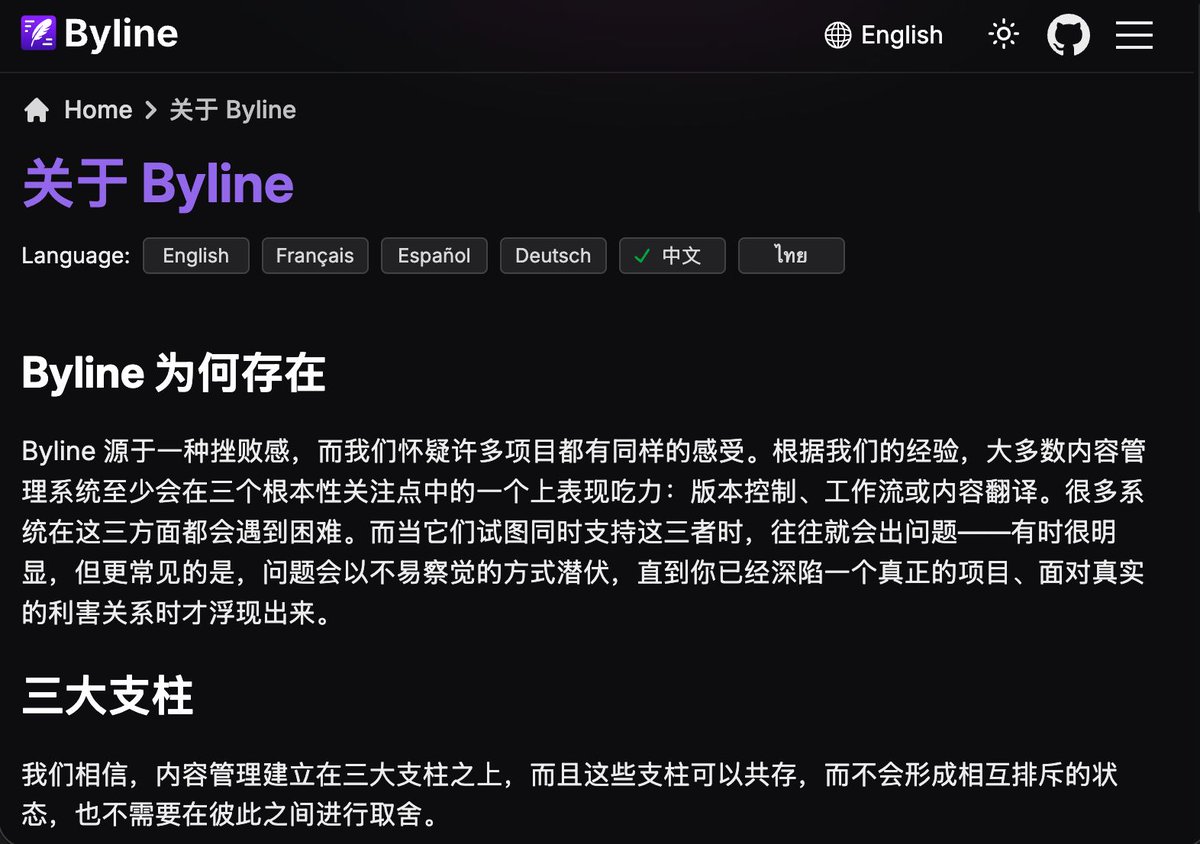
Byline CMS now publishes its about page in six languages.
Two of them (English, French) are full interface locales. Interface locales are 'sticky' - the surrounding application and admin chrome follow you as you navigate. The other four (Spanish, German, Chinese, Thai) are content-only (and not sticky). The page translates but the surrounding interface stays put.
More importantly, all six locales (including the four content-only ones) have correct, standards-based <html lang> attribute, hreflang alternates, canonical URLs, and sitemap entries - reflecting the published locale rather than defaulting to the source language (with native markdown endpoints coming soon).
Built with original-content publishers in mind: teams authoring source-language material in collections that produce original, attributable and auditable content - which we feel matters even more in the age of AI.
Built on TanStack Start, Lexical, and with a little help from Base UI - thanks @tannerlinsley@colmtuite@lexicaljs@tan_stack@matteocollina
Feel free to get in touch for a closer look.
#i18n #headlessCMS
TIL: content negotiation at a single URL — when your CDN doesn't honor Vary by header — looks like this 👇
That's the Next.js RSC flight protocol getting dumped straight onto the visitor's screen. Ouch.
The App Router serves the HTML doc and the text/x-component RSC payload from the same URL, split only by the RSC request header. Next sets Vary: rsc correctly… but Cloudflare ignores Vary on everything except Accept-Encoding — so both variants collapse into one cache entry, and whichever lands first gets served to everyone.
Fix: a Cache Rule to bypass cache on RSC requests. (Mind the ordering — Cache Rules are "last match wins," the opposite of WAF rules.)
Looking at you, Cloudflare, Next.js + RSC 👀
#nextjs #cloudflare #rsc #webdev #caching
We still believe in the open web — and in curated public knowledge.
Because whether you love AI, hate it, or feel uncertain about it… AI runs on content. https://t.co/a1bAPUsZBc #archives#Collections#knowledge#content
Migrating from Drupal to Payload CMS: A long-ish post that describes how - and more importantly, why, we migrated from Drupal to Payload CMS. https://t.co/PhiWexAUna
Thinking more about integrating AI into specialized content collections. This is probably one use case that would add real value to local and highly specialized content - and compliment the web, as opposed to trying to replace it. #web#AI
One of our early posts in our series designed to help our clients prepare for working with us - in this case, for early-stage analysis by getting everyone on the same page with a shared vocabulary from the start. https://t.co/icjc0u0AcF