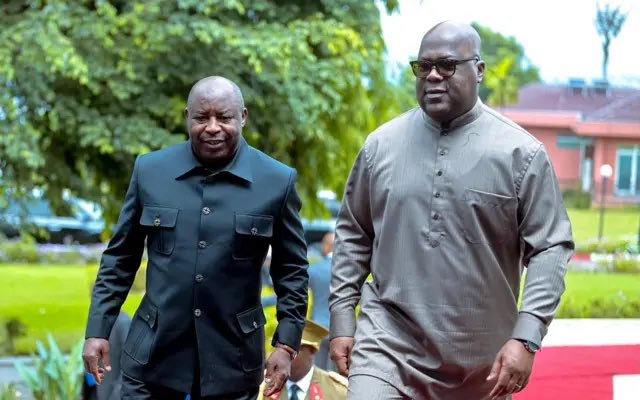
There are several obvious reasons the @_AfricanUnion is unlikely to succeed in mediating the #DRC crisis. In fact, this conflict is poised to become yet another example of the #AU’s ineffectiveness.
Here’s why.
#Burundi’s Évariste Ndayishimiye taking over the AU chair while his own army is involved in the very conflict the AU is supposed to mediate is the first sign of the organization’s lack of seriousness. No bureaucratic safeguards can erase the suspicion that the chair will use his position to favor himself and his allies.
And it’s not as if Ndayishimiye himself is above deceptive tactics. When Burundi led @jumuiya, he abused the trust placed in him, abandoned his mediator role, and his troops, initially deployed as peacekeepers as part of the EAC force, effectively joined a genocidal campaign against Congolese Tutsi.
One striking example was the Nturo incident in North Kivu, where 300 Tutsi homes were burned to the ground by state-backed militias while Burundian forces stood by. The conflict has only escalated since.
A similar problem arises with the Congo being reelected to the AU Peace and Security Council, giving a party to the conflict a direct role in deciding how the crisis on its own soil should be managed.
With Burundi as chair and the DRC as a council member, both effectively act as judge, jury, and executioner, at a time when the Banyamulenge community in the DRC faces credible threats of genocide from armies and state-sponsored militias from both countries.
👉🏽https://t.co/iSXzeuWzXB
👉🏽https://t.co/U3PWt3ZHEj
To make matters worse, the AU understands its mission as protecting African governments, not civilians. When it is not under pressure from Western sponsors, especially the EU, it routinely defends incumbent governments, regardless of their actions.
This blind loyalty is the AU’s first point of friction with AFC/M23. It was evident when the AU condemned AFC/M23’s attempt to neutralize Kinshasa’s ability to carry out deadly drone attacks on civilians.
It is now equally evident in how negotiation venues—from Doha to Lomé to Luanda—and lead mediators are chosen, with terms discussed exclusively with Kinshasa while AFC/M23 is sidelined. This pandering to the Tshisekedi regime is a recipe for mediation failure.
The AU’s inability to listen to people fighting for their rights, and to approach conflict resolution in a pragmatic and morally grounded way, will be its undoing.
It has failed to resolve the war in Sudan and could not end the war in Tigray without U.S. intervention. In short, the AU is not just toothless—it lacks coercive power as well as the moral and ideological clarity needed to offer real solutions.