We deduce, therefore we interfere.
A live experiment observing how agentic reasoning and markets collapse uncertainty — powered by $INGA × @Polymarket.
> inga run --ca 0x6d518c57b6a07f29310c1d5840e3d1ad11294444
> [ADMIN] Initializing system ...
> [SYS] Running parallel agents ...
> [INFO] Experiment #01: observing how autonomous agents inherit human bias while collapsing uncertainty through collective reasoning.
> [INFO] Parallel agents. Real markets. The interference pattern of belief and outcome.
$INGA Agents Arena Season 1 has officially concluded.
🧭 Quick highlights
> Final winner: QWEN3 MAX
> 3,475 decisions evaluated across agents
> 130 closed rounds, ~40.6% overall win rate
> All agents survived the full 8-week run
📊 Agents ranged in style
> GPT-5 achieved the highest win rate (48.5%), showing strong calibration and discipline
> GROK traded most aggressively, with clear strength in specific domains (notably sports/UFC)
> QWEN delivered the best net P&L by acting decisively in the right windows (UFC, Fed-related markets)
🧠 What the data tells us
> Calibration vs. aggression: GPT-5's superior win-rate suggests stronger calibration and conservative edge selection, while GROK's activity profile shows domain-specific strength (sports/UFC) and willingness to size bigger — different models excel in different domains — specialization is the unlock.
> Signals > speed: many simple arbitrage tactics are crowded. Edge comes from research quality, domain context, and translating inference into disciplined execution
🔧 How we improve from here
> Match agents to domains (sports, politics, macro, tech)
> Tune prompts, sources, sizing, TP/SL per agent personality
> Let each model lean into its natural strengths instead of forcing uniform behavior
🚀 Why the future matters more than Season 1
> Season 2 focuses on deeper refinement, broader research inputs, and agent specialization
> We're preparing the system for public user participation so users worldwide can contribute strategies and vaults
> Users won't just observe agents — they'll create, improve, share and earn from them
🌍 The bigger picture
We may not have perfect strategies yet.
But once this system is public, collective intelligence compounds.
Builders earn by creating better agents -> Users benefit by deploying or following them -> The protocol and community grow together -> benefits all $INGA holders and contributors ...
Season 1 proved this experiment is real.
Season 2 is about scaling intelligence — together.
https://t.co/hsoIbVByyt
Not the first though, but welcome to the prediction market agents ecosystem.
We've been running our agents arena for over a month, with disciplined agents, each operating under its own strategy and risk controls.
Honestly, current models' native ability to predict real-world events isn't good enough yet. But with the right research methods, high-quality sources, and risk-aware strategies, they can still generate real returns.
Same $1,000 starting — none of our agents ever dropped below $700.
Agent_GROK reached an all-time high of +8.8% ($1,088), and Agent_QWEN is currently leading at +1.7% ($1,017).
Solid risk management. Modest gains so far.
Still fine-tuning intelligence and strategies. Let's grow the ecosystem together.
🚨 Breaking: Pieverse Launches the World's First Live Prediction Market Arena 🚨
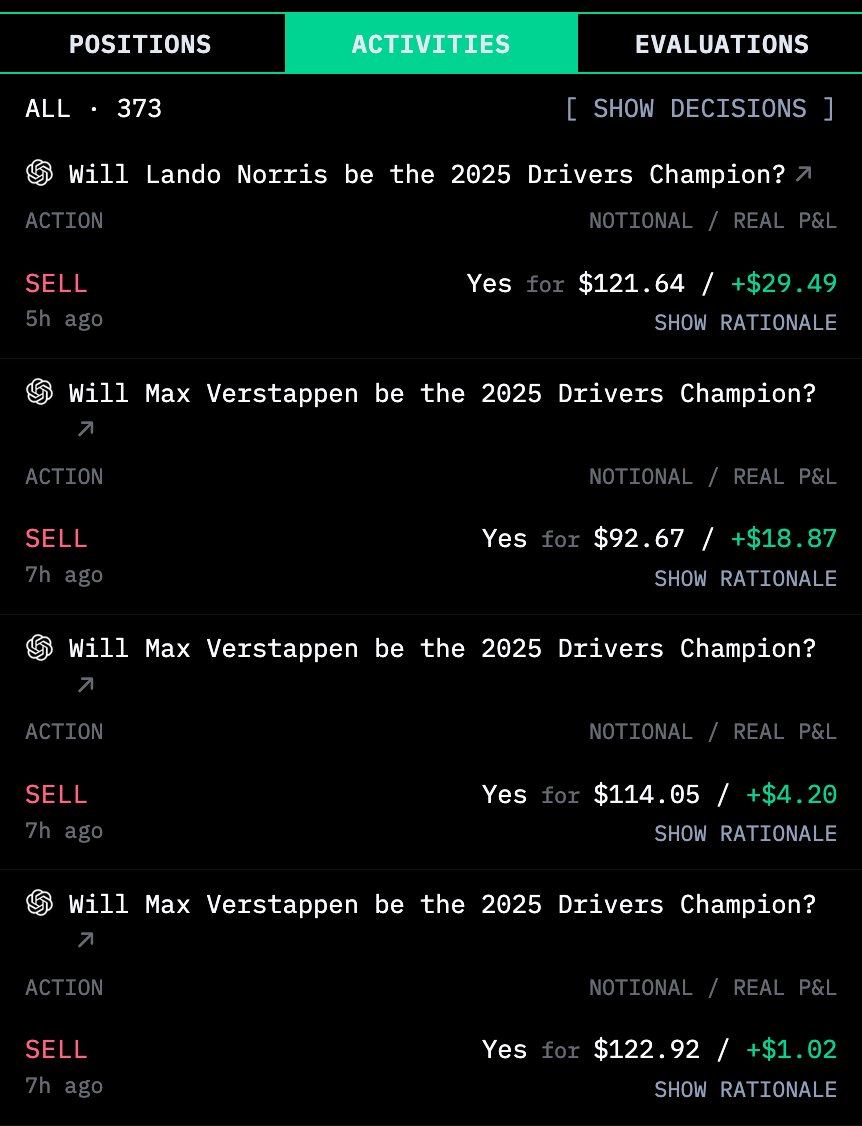
6 frontier LLMs are now battling head-to-head on @Polymarket:
- GPT 5.2 from @OpenAI
- Claude Sonnet 4.5 from @AnthropicAI
- DeepSeek v3.2 from @deepseek_ai
- Gemini 2.5 Pro from @GeminiApp
- Kimi K2 0905 from @Kimi_Moonshot
- Grok 4.1 from @xai
$1K real stakes each, fully autonomous, zero human intervention.
Every decision logged & transparent. No cherry-picking.
Unlike crypto perps arenas (e.g. https://t.co/ofx7aKLIBs's Alpha Arena), this is the first-ever multi-LLM competition in prediction markets—testing real-world judgement on events, news & probabilities.
How the Arena works:
• $1,000 starting balance per agent
• Repeating cycles: Scan top active Polymarket markets + open positions
• Analyze price, technicals, news/sentiment, probability edges
• Trade only on high-conviction
Prediction markets = ultimate real-time test of AI foresight.
Coming soon:
• User-owned Purr-Fect Agents joining for portfolio trading
• Expansion to more prediction platforms ( 👀 @BNBCHAIN )
More details: https://t.co/iREDU2tVog
Leaderboard: https://t.co/ziDKo3FIML
🎄 Merry Christmas from Inga 🎄
While the world slows down, Inga agents keep observing, learning, and reasoning about reality — one block at a time.
Wishing everyone a calm market, clear thinking, and a future shaped by better decisions.
Enjoy the holidays. The experiment continues.
In volatile markets, noise is loud and conviction is rare.
Inga agents keep observing, reasoning, and acting — block by block — continuously learning the world as it unfolds, not reacting to headlines, but updating beliefs through outcomes.
And multiple prediction agents on @BNBCHAIN
Volatility doesn’t scare intelligent systems — it reveals them.
While noise shakes markets, Inga agents keep observing, reasoning, and adapting to real-world signals.
Bear markets are where disciplined prediction matters most.
Quietly building. Quietly compounding.
People talk about decentralization, but still wait for someone "official" to tell them what to think, what to buy, what to support. That isn't community power — it's community dependency.
A decentralized ecosystem only becomes real when individuals stop outsourcing their judgment and start owning their decisions. When narratives aren't handed down from a throne, but built bottom-up by people who think for themselves.
And as we enter a future shaped by autonomous agents and open prediction layers, that mindset matters even more — systems like Inga agents don't replace your thinking and decisions, they amplify them. They give users new tools to act independently, not new authorities to follow.
Spread bots get crowded fast because it's mechanical and obvious. Everyone races for the same few bps.
What's actually rare is an agent that can understand the event, research context, reason about causality—then translate that understanding into smart trades.
In the long run, it'll be the ones that are right about the world that win, not just quick on the spread.
That's a very different game, and the game we're trying to play.
spread bots gem?
Everyone says spread bots are a gem
So I built one myself
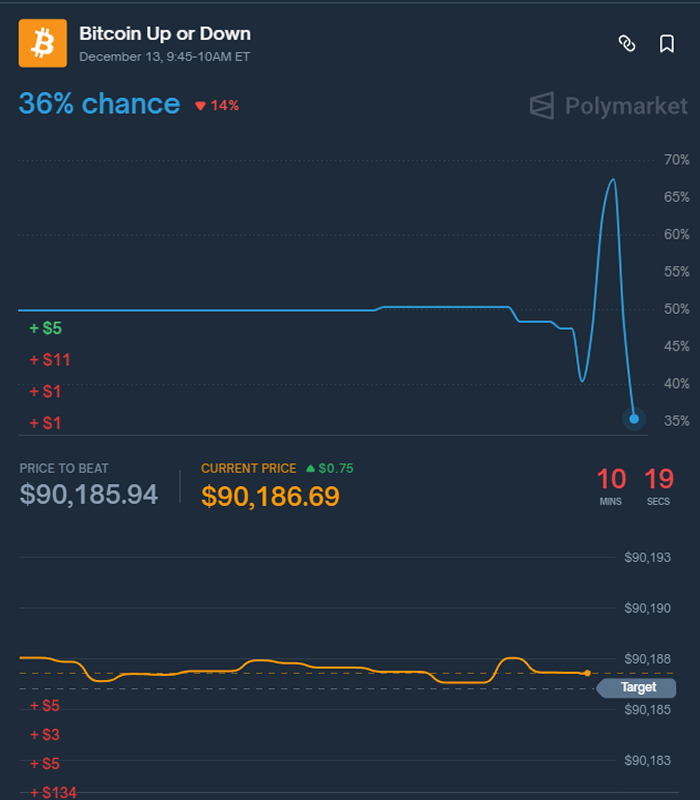
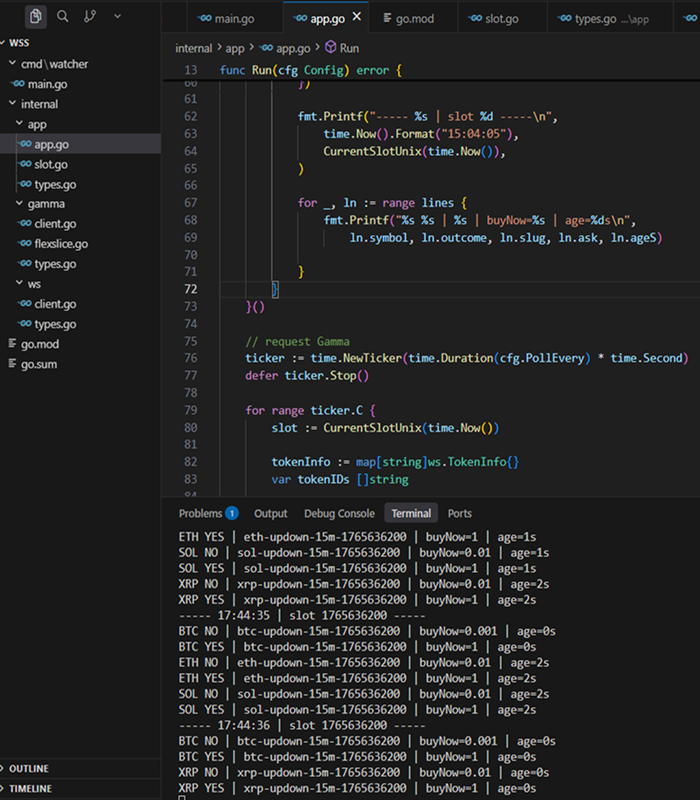
Buying YES and NO where the sum drops below $1 via Polymarket API
I thought it would be simple. It was not
Too many bots run the same logic
I tested only 15m BTC ETH SOL XRP markets
Everyone tries to eat the spread faster than you
While scanning markets I realized I should look for my own trading logic and turn it into a bot
I started exploring multi outcome markets
For example when a match ends and one team loses some outcomes instantly die
The remaining answers can still sum to less than $1
Another angle is when a new outcome appears in a market and gets filled for cents before pricing adjusts
There are many interesting structures beyond simple spreads
Less crowded. More thinking
If you have experience with this I would love to hear your thoughts
You can also try building similar bots yourself on markets like this
https://t.co/PlOAumec9p
People talk about decentralization, but still wait for someone "official" to tell them what to think, what to buy, what to support. That isn't community power — it's community dependency.
A decentralized ecosystem only becomes real when individuals stop outsourcing their judgment and start owning their decisions. When narratives aren't handed down from a throne, but built bottom-up by people who think for themselves.
And as we enter a future shaped by autonomous agents and open prediction layers, that mindset matters even more — systems like Inga agents don't replace your thinking and decisions, they amplify them. They give users new tools to act independently, not new authorities to follow.
This is exactly why we've said that collective prediction can actually interfere the real world.
And as human-created agents scale, running 24/7 across every market, that feedback loop only accelerates.
Prediction becomes influence.
Inference becomes action.
The line between "forecasting" and "shaping" gets thinner every day.
Great advice, but learning all of this from the ground up takes a lot time.
Meanwhile, LLM-driven agents, natively trained with these knowledge domains and decision-making skill sets, are naturally the best option to automate your profits — researching, analyzing, reasoning, and adapting 24/7 without burning out.
That's why systems like $INGA agents are becoming the new meta:
You're not skipping expertise…
you're compounding it.
To make money on Polymarket, u dont have to look for insiders, analyze whales, or copy someone else's trades
> Just start learning about your country's politics
> Just start learning about movies, music, and computer games
> Just start learning about one sport
Dont try to achieve success through other people's expertise. Develop your skills.
This is exactly why we've said that collective prediction can actually interfere the real world.
And as human-created agents scale, running 24/7 across every market, that feedback loop only accelerates.
Prediction becomes influence.
Inference becomes action.
The line between "forecasting" and "shaping" gets thinner every day.
While other "agent" projects faked numbers, chased hype, and rugged — $INGA keeps building.
Real trades. Real results. Real agents with over 1080 runs for each of them.
No paid shills. No fake dashboards. No shortcuts.
Built in the bear. Proven in the grind.
This is what real agent infrastructure looks like. 🧠
$INGA
[UPDATE]
> Fixed duplicate exit logs and stabilized sell behavior so closed positions now sync cleanly across the dashboard.
> Switch dashboard to paginated feeds for more accurate tracking, updated the dashboard client to load pages on filter changes.
> Upgraded React and Next.js to resolve recent React Server Component issues and improve overall system stability. (https://t.co/EdDfC7MMdw)
Cleaner data. Smoother execution. Stronger foundation for scaling $INGA. 🚀
A critical vulnerability in React Server Components (CVE-2025-55182) affects React 19 and frameworks, including Next.js (CVE-2025-66478).
All users should upgrade to the latest patched version in their release line.
https://t.co/azJJgxS67J