We got asked if we could surface eCFR (Electronic Code of Federal Regulations) data to track regulation changes.
We pointed Ingest's agents at eCFR docs and the pipeline was built in an afternoon.
Now we can monitor regulation changes in near real-time.
https://t.co/UKp2b1jsL5
These sources have never been aggregated, even though the cities neighbor each other.
Ingest unlocks the ability to bring in data from anywhere in a few clicks, allowing companies to reach insights and decisions faster without creating more work.
https://t.co/rRC5WTC69W
Ever wonder how your city responds to storms, potholes, and rats?
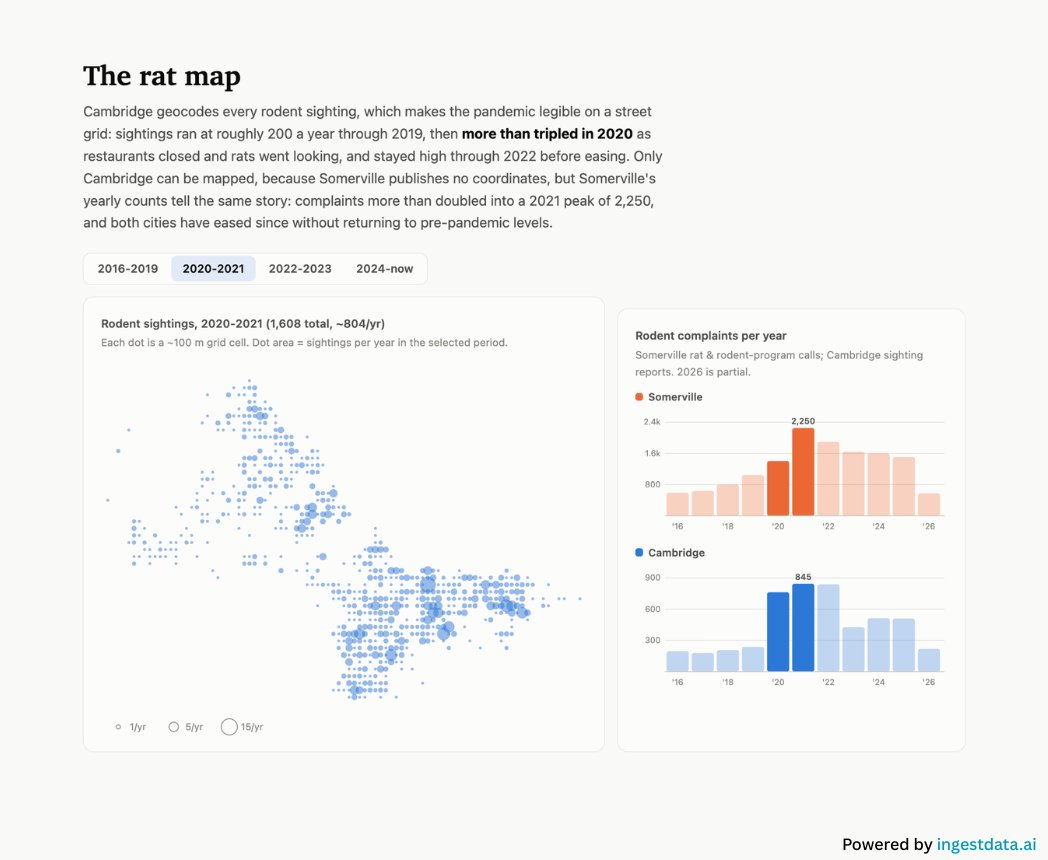
We did... so we deployed two pipelines pulling data from @SomervilleCity and @CambMA 311 Incident reports and used that data to build an interactive analysis for the two cities.
https://t.co/3ncVED5b9V
How to deploy a new pipeline on Ingest:
> Paste the API documentation into Ingest
> Add your authentication credentials
> Ingest’s agents build and verify the pipeline
> Select your pipeline schedule and run
Get early access now at https://t.co/s7nSeZzcA8
We built Ingest to make the data layer autonomous.
Ingest’s agents build pipelines, maintain them, and shape tables from plain-English descriptions.
Now, you can stop worrying about getting data, and start using it.
https://t.co/4vMI8TguwE
AI systems are getting easier to build. The data layer behind them is not.
Enterprise data is scattered across tools. Every source needs its own pipeline.
We built Ingest to make the data layer autonomous so you get your data when and where you need it.
Today, pipelines must be built, maintained as the source changes, and shaped into tables that people and AI systems can use.
As companies add more AI, they need access to more data.
The pipeline work does not disappear, it compounds.