Why is it so hard to vet contract software in APAC? According to our research, there are 156 tools, but they hold 258 sub-category slots between them, because most do more than one job. CLM, review, drafting, and negotiation overlap, so a single tag does not narrow your shortlist. The only way to compare is tool by tool. See our market map for a complete view of legal tech tools serving the APAC market:
@ConsilioGlobal Cross-border risk in APAC now carries a direct-fine number. Japan passed an amendment on 10 July 2026 introducing the first direct fines under its data protection law. The fine equals the financial benefit from the violation, times 1.5 for repeats within ten years.
@Exterro Governance is where legal AI earns trust now. Singapore's IMDA published an agentic AI governance framework in January 2026: four dimensions and one accountability rule. In-house buyers can hold a claim of "defensible AI" against that written standard.
@GT_Law The exposure is wider than discovery alone. In QTR v BXD [2025] NZERA 716, the NZ Employment Relations Authority accepted a filing's em dashes as an indicator of AI authorship. The employer won its compliance order through ordinary policy drafting: https://t.co/dhFv0SeoJz
@goclio A tool that plans the steps of a legal task and runs them itself is agentic AI in the regulatory sense. Singapore's regulator IMDA published the world's first governance framework for agentic AI in January 2026. One of its four dimensions is human accountability.
@ConsilioGlobal@CCBJournal The mandate-strategy gap has a funding number. Axiom's 2026 survey found 78 percent of legal departments were mandated to implement AI with no dedicated funding, and legal-specific tool use fell from 58 to 40 percent as unfunded teams switched to general-purpose assistants.
@JacobRobinsonJD@zackbshapiro That median output is now identifiable enough to count as evidence. In QTR v BXD [2025] NZERA 716, a New Zealand employment tribunal accepted em dashes among five indicators that a worker's filings were AI-generated, alongside case law that did not exist.
@davidneckstein@WeAreLegora From the APAC buyer's side, the in-house shift has a data consequence. Most legal tech vendors selling into APAC are headquartered outside it, so adoption starts with a cross-border transfer question, and the legal team itself owns that question.
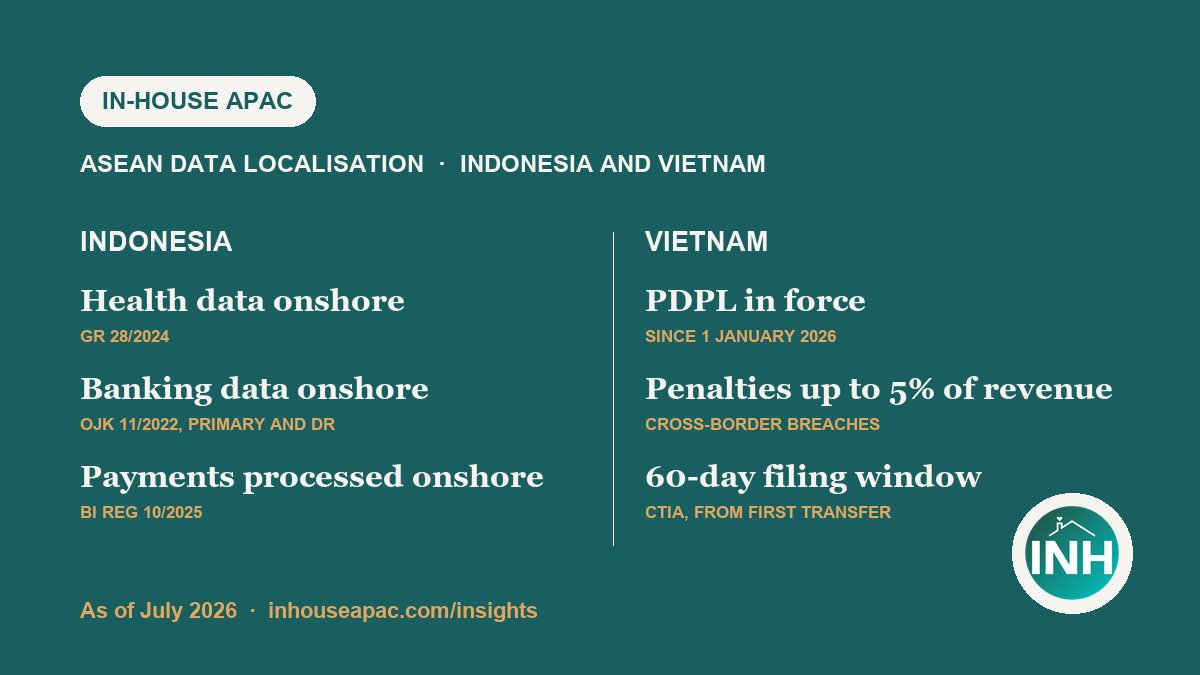
@hebbia An AI teammate handling APAC data meets a residency question before deployment: where the model runs and where the data sits. Vietnam requires a cross-border transfer filing, and several ASEAN regimes add local-storage rules that decide the answer.
Applied Materials settled 56 export-control violations in February 2026, the second-highest civil penalty on record at the enforcement agency. The year-end checklist for APAC teams is in the full article: https://t.co/8gg7CHVxzu
US authorities dismantled a smuggling network in December 2025 that moved restricted Nvidia graphics processors to China through Hong Kong.
Export-control diligence now reaches AI procurement in APAC, and buyers ask where a vendor's compute sits and who supplied it.
A US court in Tremblay v OpenAI treated counsel's investigation prompts to ChatGPT as potential opinion work product.
Protection follows the form of use: prompts counsel directed and documented on an enterprise tier qualify, and undirected consumer-tier use does not.
@LegalTechStrtUp Demo volume is one demand signal, and adoption gives it a baseline: active AI use among in-house counsel went from 23 to 52 percent in a year. A seasonal demo surge can sit on a steep adoption curve. The full numbers sit in our AI Trends Outlook: https://t.co/pAOjjuBzTV
Japan's adequacy whitelist covers the EEA and the UK only, so transfers to Singapore or Hong Kong need opt-in consent. The 24-month checklist and the transfer map are in the full analysis: https://t.co/tgbOpksCjm
Japan's Diet passed an amendment on 10 July 2026 introducing the first direct fines under its personal data protection law.
The detail that sets the exposure: the fine equals the financial benefit from the violation, multiplied by 1.5 for repeats within ten years.
@ReutersLegal Singapore's infocomm regulator released the first governance framework for agentic AI in January 2026, written for AI systems that act without step-by-step human approval. The questions counsel should ask before deployment are in our analysis: https://t.co/yrJV8vgEMl
A public database of court filings containing AI-fabricated citations, quotations, or case names reached 1,227 entries by early 2026.
Vendors selling drafting tools now compete on verification, because buyers ask how the tool shows its sources before signing.
Vietnam's PDPL also requires a cross-border transfer filing within 60 days. The full ten-jurisdiction map, with the sectoral rules and the 2026 reforms: https://t.co/zemO0cHwzw
Indonesia requires health, banking, and payment data to stay onshore under three sectoral rules: GR 28/2024, OJK 11/2022, and BI Regulation 10/2025. Vietnam's PDPL, in force since 1 January 2026, sets breach penalties up to 5 percent of annual revenue.