Quite by chance, yesterday we released version 2.8.0 of #InjectionIII https://t.co/zpuoTq3ZCH, I wrote a small personal opinion piece https://t.co/Axw4WkglwC and @Microsoft made this very interesting announcement https://t.co/G1UMxeAFmg — now we’re talking 😎
@neeratanden dem incompetence led us to trump twice. the left has never stopped opposing trump. this insane convo only exists on this fucking website. most ppl are mad at dems for not doing enough. all of the spoxppl for the party on this stupid website are out of touch w the masses.
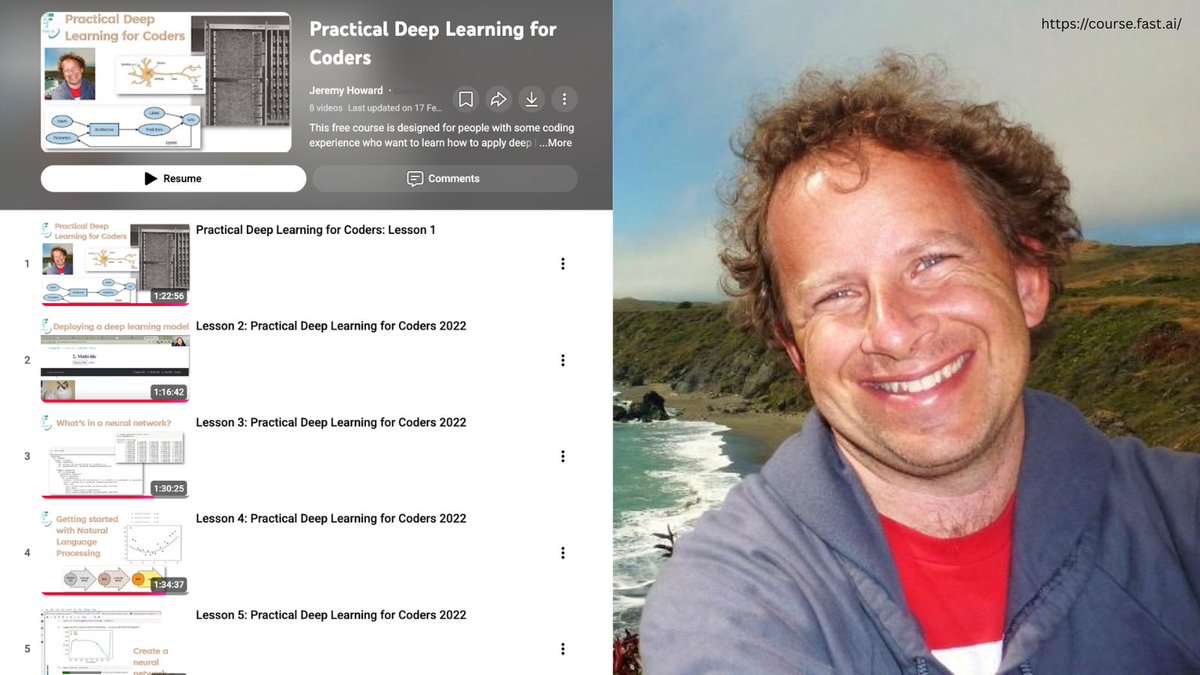
A McKinsey consultant with no PhD, no AI background, and no academic position quietly built the most-watched deep learning course on Earth and gave the entire thing away for free.
I opened the first lesson at 1am and could not believe a single human had taught this many people without ever charging a cent for it.
His name is Jeremy Howard. The course is called "Practical Deep Learning for Coders"
For most of his career, Jeremy Howard had no business teaching artificial intelligence to anyone. He spent 8 years as a management consultant at McKinsey and AT Kearney. He started an email company called FastMail in Australia and ran it for years. He built an insurance pricing startup that got acquired by Lexis-Nexis. None of that was AI work. None of it was academic. He did not have a doctorate in computer science or mathematics or anything else. He was a businessman who happened to be very good at writing code.
Then in 2010 and 2011, he became the top ranked competitor in data science contests on Kaggle, beating teams of PhDs from the most credentialed labs in the world. He was eventually made president of the company. And what he saw from that seat was the thing that ended up changing his life.
The best deep learning research on Earth was being done by maybe a few hundred people in five or six elite labs in San Francisco, London, and Toronto. To get into those labs, you needed a PhD from Stanford or MIT, a recommendation from a tenured professor, and access to expensive GPUs that no individual could afford. The practical knowledge of how to actually train these models was almost never written down. It lived inside the heads of a small priesthood, and the priesthood was almost entirely closed to outsiders.
In 2016 Jeremy Howard and Rachel Thomas decided to break that gate.
They founded https://t.co/zIF9XHFhgn with one mission. Take the techniques that the elite labs were using and teach them to anyone in the world who could write a Python loop. No PhD required. No advanced math required. No expensive hardware required. Just a laptop, an internet connection, and the willingness to actually finish the lessons.
The way they did it was the part that almost nobody in academia had ever tried.
Every other deep learning course on the planet started with theory. You learned linear algebra. You learned multivariate calculus. You learned probability theory. You spent 6 months on the foundations before you ever got near a working neural network. By the time most students reached the part where they could actually build something, they had quit.
Howard inverted the entire curriculum. Lesson one of his course is not theory. It is a working image classifier that you train in 15 minutes on a model that can distinguish dog breeds with 99 percent accuracy. You build the thing first. You make it work first. Only then, once you have proven to yourself that you can actually do this, do you start peeling back the layers to understand why it works.
His justification was simple. The reason most people quit learning hard things is not that the material is too difficult. It is that the curriculum is structured to make them feel stupid for as long as possible before they ever get to do anything interesting. Howard refused to do that to his students. He believed that if you could see something working with your own hands on day one, you would have the motivation to fight through the hard math three months later. And he was right.
The course has now been viewed over 6 million times. His students include a Canadian dairy farmer who used the course to build an AI system to monitor the health of his goats. They include a French math teacher and a network of doctors in Africa. They include people who walked into the lessons knowing nothing about AI and walked out building production systems at Google Brain, OpenAI, Adobe, Amazon, and Tesla.
In 2018, Jeremy Howard and a young researcher named Sebastian Ruder published a paper called "Universal Language Model Fine-tuning." It introduced a transfer learning technique for language models that worked so well it cut error rates on text classification by 24 percent on the hardest benchmarks in the field.
That technique, refined and scaled by the labs that came after, became the foundation of how every major language model on Earth is trained today. ChatGPT. Claude. Gemini. The fine-tuning step that makes them useful traces back to the methodology in that paper.
The man who co-wrote it had no PhD. He had been teaching the same ideas to strangers on the internet for free a year before he ever published the paper.
His students were already building with it before the elite labs had even read it.
The best things on the internet are almost never the ones with paywalls in front of them. They are the ones built by people who decided the gate was the problem and then quietly walked around it.
@unusual_whales "once, men turned their thinking over to machines in the hope that this would set them free. But that only permitted other men with machines to enslave them." Dune, 14.
Nobody could figure out why the abandoned Hendricks apple orchard suddenly bloomed in April 2019. The trees hadn't produced fruit in eleven years. County agriculture office sent two inspectors. They found sixty thousand honeybees working the property - a massive colony that had escaped from Tomás Vega's apiary three miles south. Tomás had reported the swarm missing in March. He expected them dead. Instead they'd colonized the hollow barn on the Hendricks lot and cross-pollinated every surviving tree. That October, the orchard produced twenty-two tons of Cortland apples. The Hendricks family offered Tomás a permanent lease. He moved his entire operation there the following spring.
Trump, the biggest failed strategist in US history, has plunged America into a strategic catastrophe.
During his self-proclaimed “victory parade” against Iran, he squandered at least 45% of the US's precision-guided missile arsenal in just seven weeks—including half of all THAAD missiles and nearly 50% of Patriot interceptor missiles. This isn't some fake news blog reporting this, but CNN, citing a CSIS analysis and internal Pentagon data. The result? An “imminent risk” of munitions depletion should a real conflict erupt in the coming years—for example, with China. Trump has ruined the US defense capability for years to come.
And for what?
For nothing.
No regime change in Iran. No destroyed nuclear program. No strategic breakthrough. Just a shaky ceasefire that gives the mullahs time to rearm while America stands naked. Trump, the great “Art of the Deal” master, has once again only produced hot air – and in doing so, burned through the most expensive and scarce weapons in the USA like a pubescent boy with fireworks.
A MIT professor who built the world's first neural network machine said something about intelligence that nobody in Silicon Valley wants to admit.
His name was Marvin Minsky.
He co-founded MIT's artificial intelligence lab with John McCarthy in 1959. He built SNARC the first randomly wired neural network learning machine in 1951, as a graduate student at Princeton. He won the Turing Award.
He advised Stanley Kubrick on 2001: A Space Odyssey. Isaac Asimov, who was not a modest man, said Minsky was one of only two people he would admit were more intelligent than him.
In 1986, after decades of building machines that could think, Minsky published a book about something far more unsettling.
How humans think. And why we are wrong about almost everything we believe about it.
The book is called The Society of Mind. It has 270 essays. Each one is a page long. Together they build a single argument that most people, when they first encounter it, reject immediately because it is too uncomfortable to accept.
The argument is this: you do not have a mind. You have thousands of them.
What you experience as a single, unified self making clear-headed decisions is not a thinker. It is an outcome. The result of hundreds of tiny, specialized, mostly mindless agents competing, negotiating, overriding, and occasionally cooperating with each other beneath the surface of your awareness. You do not decide things. You are what is left over after the arguing stops.
Minsky was precise about this.
He wrote that the power of intelligence stems from our vast diversity, not from any single perfect principle. He called this the trick that makes us intelligent, and then immediately added: the trick is that there is no trick. There is no central processor. No ghost in the machine. No unified self sitting behind your eyes, calmly evaluating options and choosing rationally.
There is only the parliament. And the parliament is always in session.
This reframing destroys the standard explanation for every failure of self-control.
The reason you procrastinate is not laziness. It is that the agent in you that understands long-term consequences is losing an argument to the agent that wants comfort right now, and neither of those agents has a decisive vote. The reason you change your mind the moment someone pushes back is not weakness. It is that the social agent, the one that monitors status and belonging, just outweighed the analytical one. The reason willpower fails is not a character flaw. It is that you sent one small agent into a fight against dozens, and you called that discipline.
Minsky had a specific line that breaks this open completely. He said: in general, we are least aware of what our minds do best.
The things you do with the most apparent ease, reading a face, walking through a crowded room, understanding a sentence, catching a ball, are not simple at all. They are the products of staggeringly complex agent networks that run so smoothly, so far below conscious access, that you experience them as effortless. The things that feel like work, the logical arguments, the deliberate choices, the careful plans, are actually the clumsy surface layer, the small fraction of mental activity you can observe at all.
You have been taking credit for the wrong parts of your own intelligence.
The practical implication is the one that most productivity advice misses entirely. If your decisions are not made by a single rational self but by whichever coalition of agents happens to win the moment, then the game is not about training yourself to be more disciplined. The game is about designing the environment so that the right agents win without needing a fight.
This is why removing your phone from the room works better than deciding not to check it. This is why writing one task on an index card works better than building a sophisticated system. This is why commitment devices beat motivation every time. You are not strengthening your will. You are changing the conditions of the argument so that the outcome you want becomes the path of least resistance.
Minsky spent his entire career building machines that could imitate intelligence. What he discovered in the process was that natural intelligence, the kind running inside every human brain on earth, is nothing like what we think it is.
It is not a single flame burning in a single chamber.
It is a city. Loud, chaotic, full of competing interests, with no mayor.
The people who understand this stop trying to win the argument through force of will.
They learn to build a better city instead.
These little AIs are all very clever but it remains to be seen if they can make any money. All I've seen so far is the RideShare app playbook of using venture capital to undercut the local cab firm out of business to jack up prices later except this time the cab firm is all of us
Everyone sharing this depolarization research on AI seems to avoid the fact AI is a radically isolating experience. Sure, it is RL’ed to be close to the center, and given where we are coming from right now, this might seem appealing.
But I do believe we as a society ought to find a way to discuss and constructively disagree on uncomfortable topics rather than find escape in a median opinion that someone (even with best intention) chose to be the truth.
It does require a degree of civil discourse that disappeared from mainstream western culture, but I believe it is a mistake to swing all the way to individual, assuming it won’t have stagnant side effects long term.
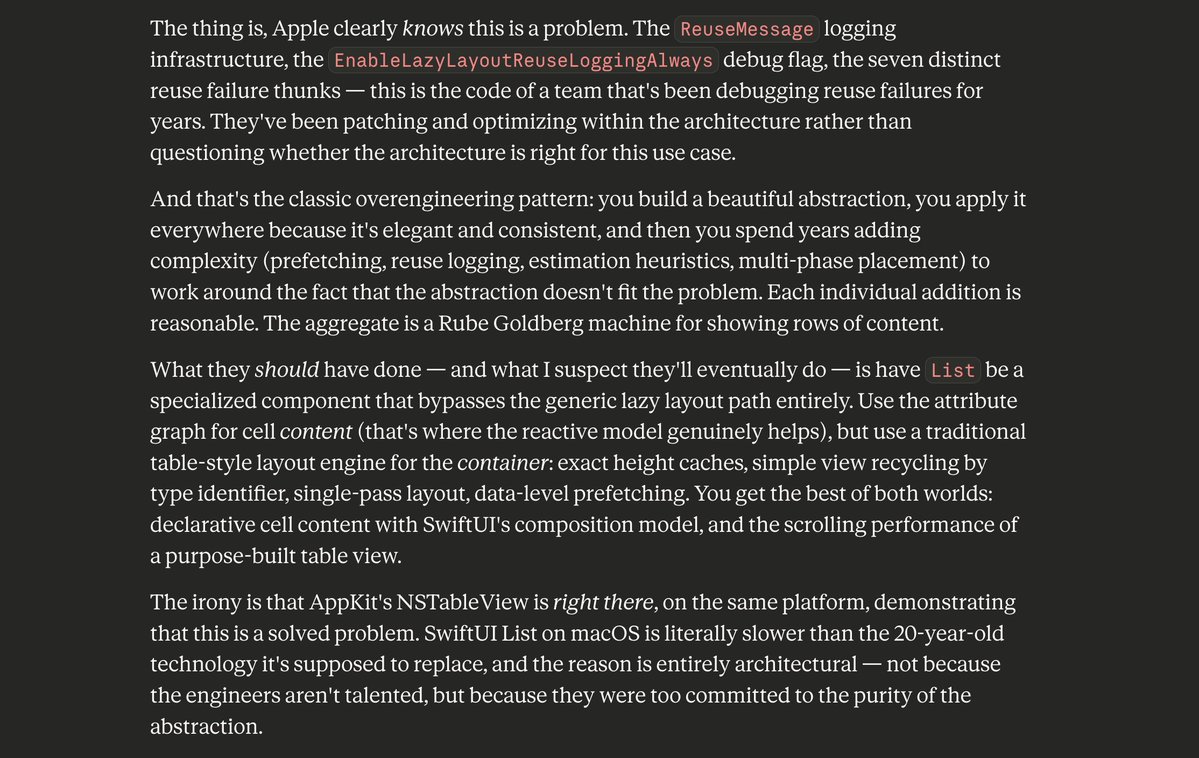
Claude gives a pretty interesting perspective of "why SwiftUI List performs worse than AppKit equivalents", after reading the assembly
https://t.co/IXwwSAXHCP
"We’ve spent $8 trillion in the Middle East That’s 100 X annual federal spending on roads and bridges Picture how great our country could be if we’d spent that $ here Imagine how affordable groceries & housing would be if we hadn’t printed all that $," Thomas Massie has said.
“The one thing we know for certain is that people who ignore this shift will get left behind.”
@clattner_llvm CEO of @Modular and creator of LLVM, on the reality of AI programming tools:
“Both sides of the AI coding debate are wrong in different ways.”
“There’s a lot of hype saying software engineering is dead, and a lot of pessimism saying these tools are useless.���
“The truth is both sides are too extreme to understand what’s really happening.”
“AI is just a tool. The real challenge is mapping its capabilities to real problems.”
“We’re seeing more software being created and developers becoming more productive.”
The U.S. public loves to imagine itself as one election away from redemption.
That fantasy is one of the empire’s most useful products.
It allows every crime to be reclassified as temporary deviation instead of structural expression.
Four years later the bombs continue, the sanctions continue, the vetoes continue, the bases remain, the myth survives, and the public gets to feel disappointed instead of implicated.
That cycle is not democratic self-correction.
It is imperial emotional management.