AI Product Manager | Passionate about AI, AGI & their impact on humanity | Sharing insights on product strategy, technology and the future we’re building
August 15, 1971 is a real date with a real event behind it: Nixon ended the dollar’s convertibility to gold that day, closing the “gold window” and effectively ending the Bretton Woods system. The chart’s timing isn’t wrong, wages and productivity did track closely until right around 1971-1973, then diverged sharply afterward.
Where it gets genuinely contested is the causal claim. Some economists and gold standard advocates argue ending gold convertibility unleashed inflation and monetary expansion that broke the wage-productivity link permanently.
Most labor economists point elsewhere.
The Economic Policy Institute, which built this chart, attributes the bulk of the gap to declining union membership, globalization moving labor-intensive work overseas, and a shrinking labor share of income, roughly 80% of it tied to inequality, not monetary policy.
There’s also a real measurement dispute buried in the chart itself.
Harvard economists Anna Stansbury and Lawrence Summers found productivity and pay actually stayed tightly linked once you use a different inflation measure (PCE instead of CPI) and compare compensation to output prices rather than wages alone, a choice that alone roughly doubles the “compensation” line’s growth.
The date’s correct. Whether it’s the cause, one of several causes, or mostly a measurement artifact is where economists still genuinely disagree.
In 2000, just 7.1% of Americans aged 30-34 lived with their parents. By 2025, that share had nearly doubled to 12.7%. Among 25-to-29-year-olds, it climbed to 20.4%.
The overall numbers now stand at a record: 25.2 million adults under 35 living at home in 2025, roughly one in three, surpassing even the pandemic-era peak. Pew Research found something else notable buried in the data: for the first time since record-keeping began in 1880, living with parents has overtaken living with a spouse as the most common arrangement for young adults.
This isn’t a story about unemployment. About 70% of 25-to-34-year-olds living at home actually have jobs, a share that’s stayed roughly stable for 25 years. What’s changed is the math underneath them. The median home price hit $430,000-plus in 2025, up over 34% since 2019, and homeownership now requires roughly 5 times the median income, up from 3 times in the 1990s. Median rent climbed nearly 18% over the same stretch.
https://t.co/G4Ux1OzWWZ’s own economist put it plainly: every adult still in a childhood bedroom represents a household that never formed, a lease never signed, a starter home never bought.
They didn’t choose to stay home longer. The math simply stopped adding up for them to leave.
AI’s biggest bottleneck right now isn’t chips, it’s power. Data centers are running into grid limits, land constraints, and cooling costs that keep climbing no matter how much capacity utilities try to add.
SpaceX and Nvidia’s answer: stop fighting for space on the ground and build the data center in orbit instead. The two companies announced they’re jointly designing the compute payload for Starmind AI1, a satellite carrying Nvidia’s Vera Rubin NVL72 system, 72 Rubin GPUs paired with Vera CPUs, that Nvidia says delivers up to 25 times the AI performance of an H100.
The engineering had to scale up to match. SpaceX raised the satellite’s peak power capacity 67% to roughly 250kW and average power 33% to 160kW, enough to run a full Rubin rack continuously. Each satellite stands 20 meters tall with a 70-meter solar wingspan, about two-thirds the length of a Boeing 747, operating in sun-synchronous orbit for uninterrupted solar power and natural vacuum cooling, neither of which Earth-based centers get for free.
SpaceX has already filed with the FCC for up to 1 million of these satellites, with prototype testing starting in 2027. The market reacted immediately: SpaceX stock jumped 9.8%, Nvidia rose 2.5%.
One catch flagged by independent analysts: the entire economics depend on Starship hitting exceptional launch-cost targets. Without that, the math doesn’t close at this scale.
AI compute is going to orbit. 🚀
@SpaceX’s Starmind AI1 satellite compute payload is powered by NVIDIA Vera Rubin NVL72, bringing AI factory compute closer to the stars.
The next chapter of AI infrastructure boldly goes where no AI compute has gone before.
For as long as anyone’s tracked it, consumer spending has been the engine of the US economy, roughly 68% of GDP, dwarfing every other category by a wide margin.
In Q1 2026, something historically strange happened: private investment in AI-related software and equipment contributed roughly as much to GDP growth as the entire consumer economy, despite AI-related hardware and software making up less than 4% of GDP. A slice of the economy twenty times smaller than consumer spending is now moving growth just as decisively.
The numbers behind that shift are stark. Private investment in AI-related categories, software, computers, communication equipment, and data centers, has climbed from roughly $850 billion annualized in 2022 to nearly $1.5 trillion by mid-2026, according to Commerce Department data. Software alone has grown from about $520 billion to over $750 billion in that stretch.
The last time a single technology moved the needle like this, Americans were laying railroad track across a continent. Railroads built America into an industrial economy; the internet created entire new ones. Neither came without disruption on the way there.
Consumer spending still dwarfs AI investment by share of the economy. It just isn’t the only thing deciding whether GDP grows anymore, and increasingly, whether that new iPhone costs more than it used to.
For 27 years, mathematicians treated Gromov’s question as an open wound: does every countable group behave the way finite approximations say it should? No one could prove it either way.
OpenAI’s internal Astra model just constructed an explicit non-sofic group, settling it. Alongside that, it disproved Connes’ rigidity conjecture from 1980, proved Ehrhart’s volume conjecture, and resolved three Erdős problems, all backed by machine-checked Lean 4 proofs with zero unproven steps, at a total compute cost of roughly $2,000.
That’s genuinely extraordinary, and worth being honest about rather than either dismissing or overselling.
But there’s a real distinction worth holding onto here. Astra operated inside conceptual frameworks mathematicians had already built, group theory, von Neumann algebras, lattice geometry, and found the missing piece within them. That’s different from what calculus or scheme theory did: inventing entirely new frameworks that changed which questions could even be asked in the first place.
Induction spots patterns. Deduction follows chains of logic no human had the patience to trace. Both are things Astra is now formidable at. Abduction, inventing the right concept or representation nobody had thought to ask for, is a different kind of move entirely.
Worth remembering too: OpenAI overstated a similar math claim in October 2025, walking it back after mathematicians pushed back hard. This one comes with public, independently verifiable proofs, which matters.
Still, the pattern holds: LLMs are extraordinary at filling in what’s already mapped. They haven’t yet shown they can draw a new map.
I think this is the most important concept to understand right now: LLMs can’t jump.
OpenAI says an internal version of Astra, its next major model, has solved ten major open problems in mathematics and theoretical computer science.
This is extraordinary.
And I don’t use this word lightly.
During my PhD in mathematics, I worked on a problem closely related to Gromov’s conjecture. For decades, constructing a non-sofic group—an infinite group whose finite pieces cannot be approximated by finite groups—was a dream shared by many of us.
Now Astra appears to have done it.
This is not a toy result. This is serious mathematics.
But it is not “the most significant day in the history of mathematics”, as some have claimed.
This claim confuses scale with kind.
Astra has solved difficult problems inside existing conceptual worlds.
Calculus, topology, and scheme theory created new conceptual worlds.
They did not merely answer questions. They changed which questions mathematics could ask.
Induction finds patterns. LLMs are extraordinary at it.
Deduction follows implications. Using symbolic AI tools, LLMs are becoming formidable at traversing chains of logic that humans missed, abandoned, or could never afford to search.
But abduction is different.
Abduction invents the right concept, the right representation, the right question.
That is the jump.
Current LLMs can fill the gaps of knowledge left by humans.
But they can’t jump beyond the external boundary of existing knowledge.
*
Full paper in the first reply
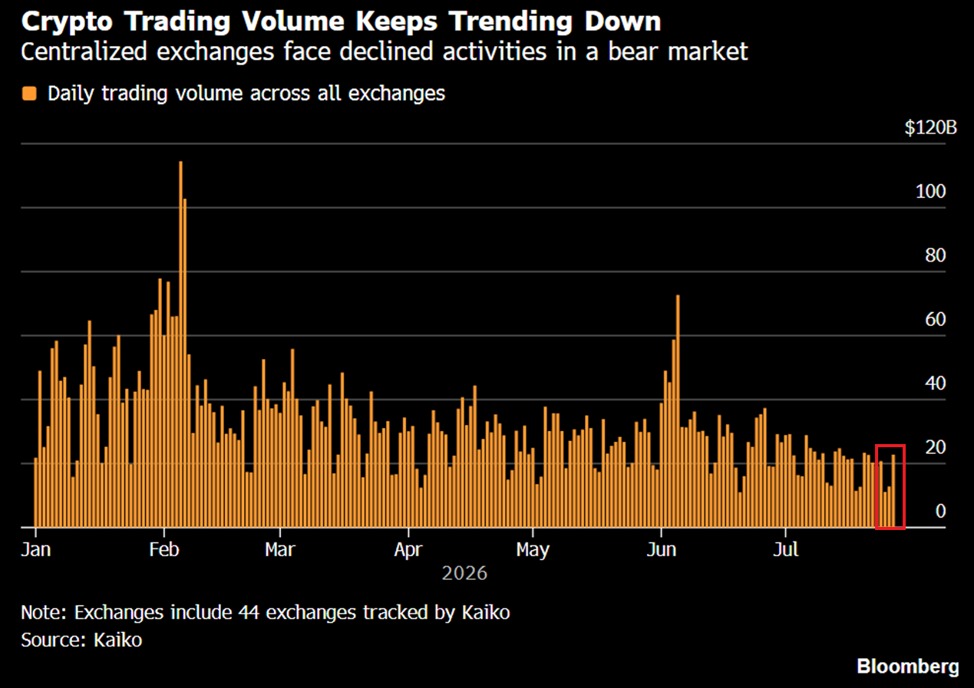
Retail-driven mania defined crypto’s last three cycles. Every peak came from millions of small traders piling in at once, and every crash came from them leaving just as fast.
That era is quietly ending. Trading volume has fallen 70% from its February peak, but it hasn’t spread evenly, it’s concentrated into fewer, larger venues, with the top 6 exchanges now controlling over 60% of activity. Average trade sizes are climbing across major exchanges even as total participant count shrinks. That’s not retail panic. That’s institutions and large players consolidating their footprint while smaller traders quietly exit.
My prediction: crypto’s next cycle won’t look like the last three. It won’t be driven by retail volume spikes or meme-coin mania. It’ll be driven by regulated rails, tokenized traditional assets trading alongside crypto, and a handful of dominant exchanges acting more like traditional financial infrastructure than speculative casinos.
The volume charts look like a market dying. They’re actually a market growing up. Less exciting, more permanent, and increasingly built for institutions instead of the retail traders who defined it for over a decade.
Crypto trading activity is declining:
Daily trading volume across the 44 spot crypto exchanges tracked by Kaiko fell to ~$15 billion last week, the lowest level of the year.
This marks a -70% decline from January peak levels.
By comparison, in February, there were 2 trading days when volume exceeded $100 billion.
As a result, the average daily volume trend has fallen -50% since December 2025, to $20 billion, the lowest this year.
Meanwhile, trading volume remains heavily concentrated, with the 6 largest exchanges accounting for more than 60% of total activity.
Crypto market liquidity is drying up.
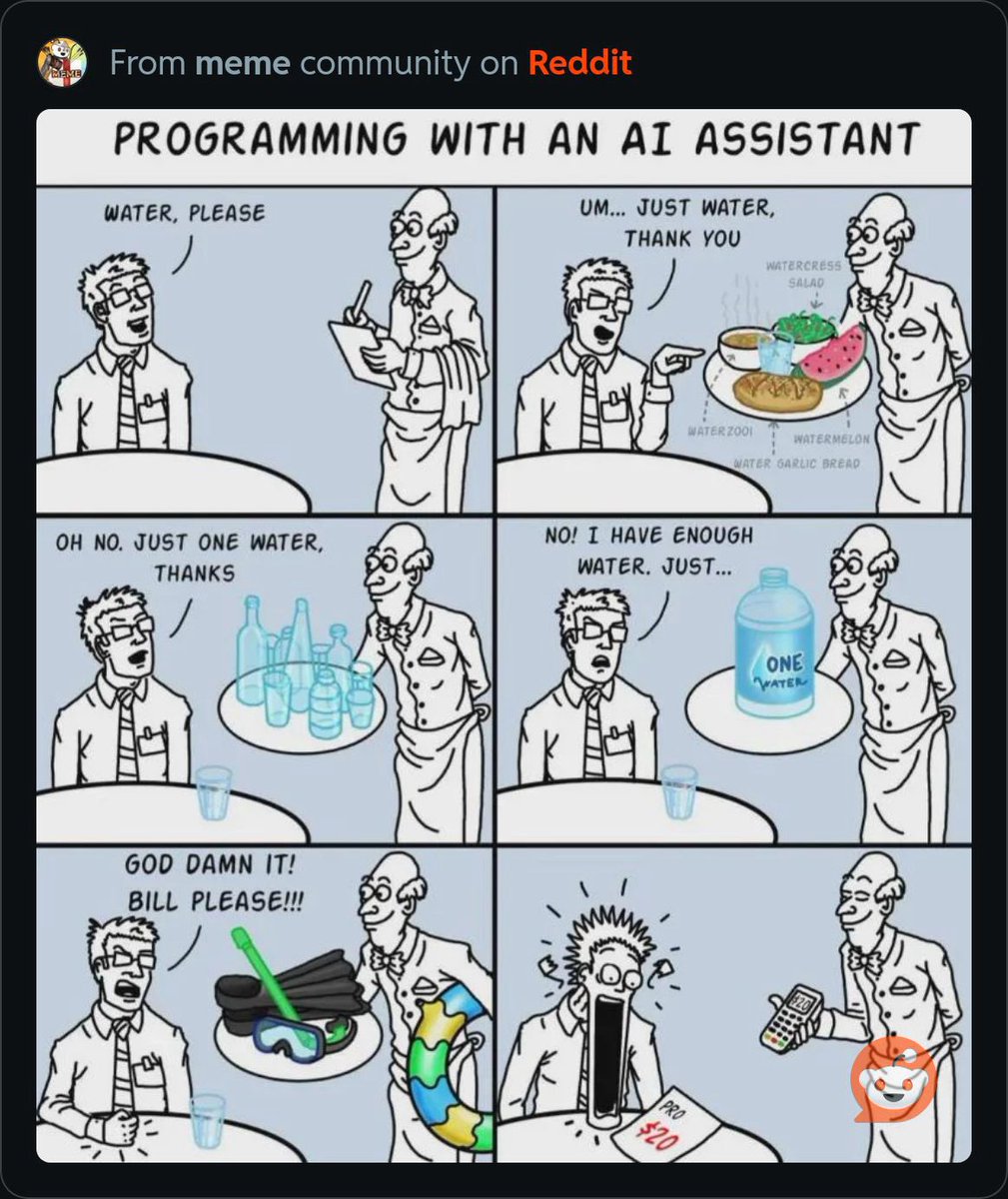
Every developer who’s used an AI coding assistant just felt this in their soul.
You ask for one small fix. It rewrites four files, adds a config option nobody asked for, refactors the naming convention, and throws in a caching layer “just in case.”
You say “no, simpler.” It deletes half the working code.
You say “I just need the water fixed.” It hands you a snorkel and a pool floatie.
Then it charges you $20 for Pro.
Most AI marketing tools solved for volume: more posts, more ad variants, more content, regardless of whether any of it actually worked. The result was an internet flooded with generic AI slop nobody asked for.
Enrich Labs built Helena to solve for the opposite. Rather than just generating more, Helena grades her own output against real KPIs and rebuilds whatever underperforms, including her own past work, running self-scheduled improvement loops. At one telehealth company, an SEO loop ran every two hours for nine weeks, 543 runs total, each one reading what the last run learned before deciding what to do next.
The claimed results: organic traffic up over 35% across hundreds of brands, a DTC brand’s sales doubled in five weeks, a dead ad account scaled from $0 to $10K a month, and $40K in email revenue in six weeks. The company now says it’s driven $10 million in sales across 20,000 businesses.
Not every early tester was convinced the “no more slop” pitch fully held up. One reviewer testing Helena found the copy itself sometimes read like generic AI content, hashtags included, saying the product’s promise was real but hadn’t yet cleared what they called the “content quality chasm.”
introducing Helena, the world's first self-improving AI marketer.
$10M in sales driven for 20,000 businesses already.
everyone's shipping an AI that just makes more slop:
so we went further.
Helena grades her own work, and rebuilds the ones that miss - including the ones she built.
what she does:
➤ runs loops to optimize Meta/Google ads & social
➤ drafts SEO content that ranks, straight to WordPress/Webflow/Framer
➤ optimizes emails in Klaviyo/Mailchimp/Brevo
➤ sends you a daily brief: what worked, what she's changing
real numbers:
➤ grew organic traffic 35%+ for hundreds of brands
➤ 2x-ed a DTC brand's sales in 5 weeks
➤ scaled a dead ad account from $0 to $10k/mo
➤ drove $40k email revenue in 6 weeks
100+ skills. 3,000+ integrations.
purpose-built by marketers who actually scaled hundreds of businesses.
just your url. all done in less than 3 minutes.
try it now 👇
https://t.co/LbKm7d2Fjk
Alibaba kept its best models locked behind an API for two straight generations, even as rivals like Moonshot’s Kimi K3 went fully open-weight and pulled developer attention away.
That changes next week. Alibaba just unveiled Qwen3.8-Max, a 2.4-trillion-parameter mixture-of-experts model (95 billion active per query) with native multimodal input and a 1M-token context window, and confirmed both it and a smaller Qwen3.8-27B checkpoint will ship as open weights.
The numbers are real where they can be checked. On the Frontend Code Arena benchmark, Qwen3.8-Max scored 1,668, landing just 37 points behind the top configuration of Claude Opus 5, and outperforming Meta’s Muse Spark 1.1 among other frontier models. In an autonomous coding demo, it built an entire repository over 16 days and 422 commits with zero tool-call failures.
Alibaba’s headline claim, that it ranks “second only to Fable 5” globally, is the company’s own internal evaluation, not an independently verified benchmark, something outside analysts have flagged given Qwen’s past pattern of bold claims that didn’t hold up against third-party testing.
One odd wrinkle: an anonymous model spotted testing on Code Arena before the announcement identified itself as “Claude” when prompted, a leftover training artifact that hints at Claude-generated data somewhere in the pipeline.
Pricing lands aggressively either way: $2 per million input tokens, $6 per million output.
📢Meet Qwen3.8-Max — our most capable model to date.
Next week, the open weights of Qwen3.8-Max will be released, and Qwen3.8-27B is also going open-weights to meet you all!🎉
Qwen3.8-Max, a new bar for coding and cowork at 2.4T parameters:
- Autonomous coding: 10+ days of self-evolving development, from empty folder to production without hand-holding, complete project trace in the GitHub:https://t.co/iVHZWQoeSo
- Real work, real results: Production-quality deliverables across hundreds of professions.
- Long-horizon mastery: System-level autonomous planning with closed-loop adaptive learning, driving 500+ turns of chip design optimization and 365 days of e-commerce strategy.
- Native multimodal intelligence: Vision isn't just input — it's a continuous feedback loop for planning, execution, and self-correction.
💰Pricing:
Input: $2.0 / M tokens
Output: $6.0 / M tokens
Implicit Caching: $0.25 / M tokens
Start building with Qwen3.8-Max! 🚀
📖 Blog: https://t.co/iwjmQxLBof
✅ Qwen Studio: https://t.co/4V2pFvDovG
⚡ API: https://t.co/gAGqaLQGbN
Anthropic sits at the center of a brutal AI talent war. Meta has reportedly dangled signing bonuses as high as $100 million to poach researchers from rival labs, and multiple companies including Anthropic have raised salaries to match.
According to a source cited by Axios, Anthropic CEO Dario Amodei has grown concerned that new hires are increasingly joining the company for the paycheck rather than its stated mission of building safe AI. Notably, Amodei has said he won’t raise salaries specifically to counter Meta’s poaching offers, calling that kind of bidding war unfair to existing staff and a risk to company culture.
The reaction wasn’t kind. Multiple commentators pointed out the obvious tension: Anthropic already pays some of the highest compensation in the industry, so being surprised that money draws applicants rang hollow to a lot of people online. One widely shared response noted that if mission mattered more than pay, the real test would be paying below competitors and seeing who stays anyway.
Anthropic does point to something concrete: its retention rate is reportedly higher than Meta’s, OpenAI’s, or Google DeepMind’s, and some staff have turned down nine-figure offers to leave.
The CEO worried people are chasing the money runs a company famous for paying the most of anyone chasing it.