Prosecutors allege that he enriched himself and private companies, causing state losses of around Rp2tn, or about $112 million, by choosing Chromebooks running Google’s ChromeOS.
Nadiem Makarim, Indonesia’s former education minister and co-founder of Gojek, has been charged with alleged corruption linked to a government program that bought Chromebook laptops for schools between 2020 and 2022.
FirstCry could build a massive commerce engine around babies, but it has struggled to convert that parent ecosystem into a meaningful preschool network.
Pleasure reading fell 40% in 20 years. Only 14% of 13-year-olds read for fun daily.
The @nypl's Chief Librarian @bbannon says the problem isn't individuals — it's that we stopped designing conditions for reading.
We agree. And it starts at age 3.
📢 Get your tickets! 📢
Nowism - the CenSoF summer exhibition - take places at Watershed 11-28 June.
Explore this interactive exhibition of artworks and installations created by our artists in residence.
Book now 👉 https://t.co/C5MAZ96TJ1
Teacher preparation is where workforce preparation begins.
Better teaching builds the skills students need for work and life. #EducationWorks
⬇️ Learn more at our event: https://t.co/ktKfICCj03
@DaveEvansPhD
The new issue of the JHI includes a cluster of articles on "Race: Histories of Idea." Shruti Balaji's contribution is "'The African Problem Is a World Problem': (Dis)locating Race in Late Colonial Indian Intellectual Thought." Read it here: https://t.co/vdsbJ8r2gT
@shrutibalaji1
As capital’s capacity for material expansion wanes, platforms are converting attention into a speculative asset. Our hidden gem of the week recasts "brain rot" as a structural consequence of financialized capitalism.
By Hera Hyeonseo Lee at @binghamtonu
https://t.co/HG7u81AWr2
La IA prometía hacer a los jóvenes más productivos y creativos. Pero muchos estudiantes empiezan a percibir también el coste educativo.
Financial Times: Una alumna de Sciences Po y Berkeley cuenta que usó Claude para estructurar y documentar su tesis, pero reconoce que antes “amaba” hacer ese trabajo por sí misma y que el chatbot “mató el ejercicio”.
La cuestión educativa clave: no solo si la IA ayuda a entregar mejores trabajos, sino si reduce el aprendizaje que se produce al hacerlos.
https://t.co/Df1B9QMf7E https://t.co/FGiLgPb3XA
“The students who cannot read a 20-page article today are the voters who will not be able to read a bill, or the jurors who cannot follow a closing argument, tomorrow.”
Got a big idea for Special Issues that challenge policy thinking❓
@PolicySociety is inviting proposals for #SpecialIssues that critically examine established frameworks, develop new conceptual tools, or open promising lines of inquiry 👇
https://t.co/7sK8Axrgmt
Britain’s child-protection system is too reactive, too fragmented, and too marketized.
It intervenes late, pays enormous sums after damage has been done, and too often substitutes institutional placement for stable human relationships.
Educational discourse remains overwhelmingly adult-centric.
Parents worry, schools administer, policymakers reform, and experts prescribe, but the child, the person most affected, is rarely asked what kind of learning feels meaningful, humane, or useful.
The article challenges two influential ideas in Silicon Valley and parts of the tech world: transhumanism and posthumanism.
These movements imagine human beings as improvable, upgradeable, hybridized, or eventually surpassable through technology.
Pope Leo’s first encyclical, Magnifica Humanitas, opens a philosophical conflict with Silicon Valley’s techno-optimism, contrasting Christian humanism with a quasi-religious AI ideology in which AI becomes a route to salvation, transcendence, or god-like power.
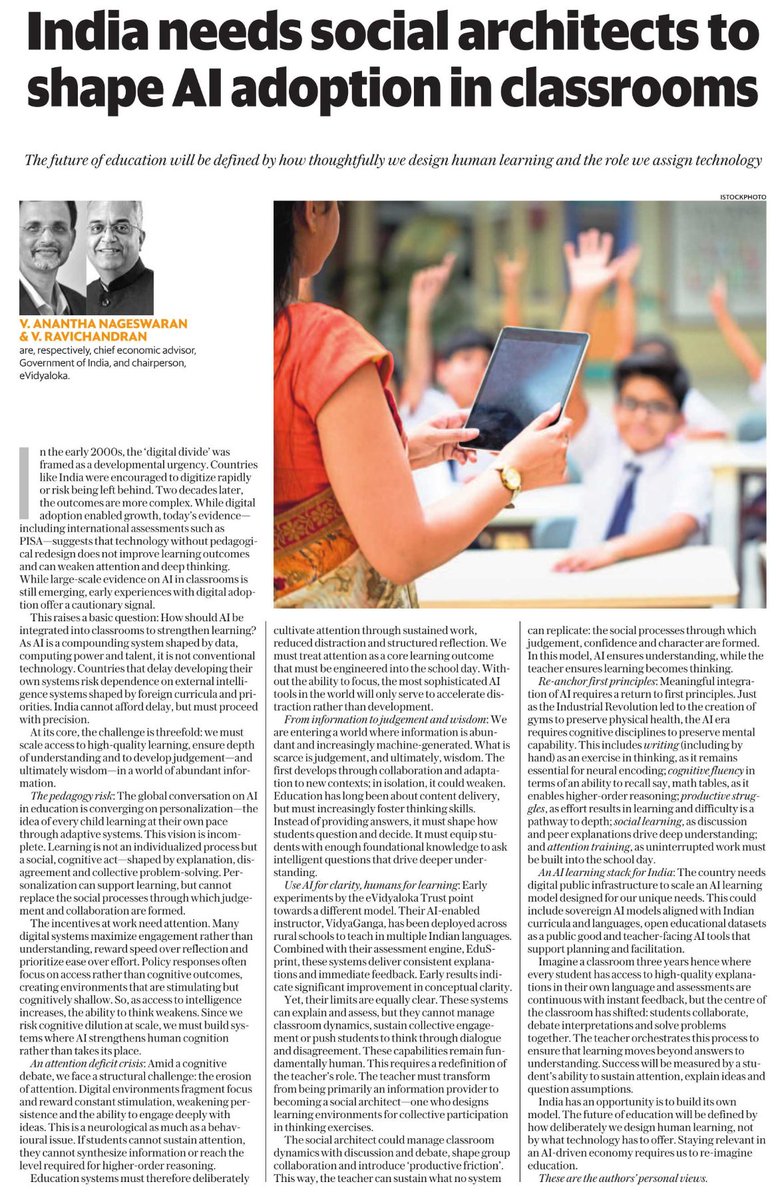
A good, balanced article. AI in education will fail if reduced to devices, dashboards, and procurement.
It matters only when it strengthens cognition: attention, explanation, reasoning, collaboration, and the confidence to question assumptions.
India’s enrolment story hides a dropout crisis. The real fracture is after age 14: poverty, migration, weak secondary schools, unsafe distances, rigid rules, and poor learning push children out.
From University of York to University of Bristol, University of Liverpool, University of Aberdeen, Victoria University, and Illinois Institute of Technology — foreign universities are not recruiting Indian students anymore.
They’re coming here.