Find me on the internet
Mastodon: https://t.co/4l0bv0VFe7
YouTube: https://t.co/KhtoTgFwci
Newsletter: https://t.co/Dua3OclGNs
Discord: InsiderPhD
Bluesky: https://t.co/cDbUQlckgF
LinkedIn: https://t.co/uKsqmrTITM
Having trouble getting developers to implement best security practices? Use carrots, not sticks, says @InsiderPhD at OWASP Global AppSec USA https://t.co/IejoY1vYzD
react2shell is truly react to shell. you take a payload, spray it across vulnerable next.js or other affected applications, and get shells.
i think we need to tone down the hype around every new 2shell and 4shell. when every vulnerability is portrayed as impending doom but little actually happens in the wild, it dilutes the discussion around what ai is capable of.
java4shell and nginx2shell are not react2shell. the bugs are cool, but what is the actual impact? do we seriously think a threat actor can spray a payload across thousands of servers and get shells? absolutely not.
you need a frontier model, a shit ton of tokens, and significant target specific exploit development. even then, getting a working exploit can be extremely difficult, sometimes impossible. there's potential, but exploitation is far from guaranteed.
we used php2shell to exploit cloudflare waf and get flags, but that took a solid amount of tokens and host specific grooming. the exploit wasn't trivially portable between targets. i'm even more skeptical about java4shell and nginx2shell, given their additional exploitation requirements.
these bugs absolutely need to be patched, but there's a huge difference between a vulnerability that can theoretically lead to RCE and one that can be reliably exploited at scale.
You know it’s possible to report a vuln, get it patched and *not* make a giant firework show about it? If you care about defensive outcomes it’s perhaps even a better way of doing it.
Twenty ß characters in a Ruby app: nothing happens. Twenty-one: Ruby writes one byte past the end of a heap buffer. Ruby2Shell has been in Ruby since 2.4.0, and a default Rails app reaches it before login.
https://t.co/S0TrJmOaHu
Java4Shell dropped today and the patching advice is easy: update Java. Working out whether you're actually exposed is not.
Runtime bugs are business as usual now. But this one comes with a twist: it only fires on x86-64 CPUs with AVX-512 VBMI. The same app on the same Java version can have completely different exposure depending on what hardware it runs. Your dependency scanner won't flag it, because it's not a dependency. Your version inventory won't settle it, because the version is just a part of it.
To actually answer "are we affected?" you have to check every JVM, including the ones bundled inside Jira, Jenkins and Keycloak. You need the flags it was really started with, the CPU features that JVM can see, and the node it's running on.. it’s a right mess. Most orgs don't have anywhere close to that kind of view.
IMO This is where agents earn their keep. My colleagues wrote a read-only runbook prompt you can hand to an agent with infra access. It inventories the runtimes, reads the effective flags, checks the CPU, and comes back with a table of affected, mitigated, unknown, and the evidence behind each.
I think this is how incident response goes now. Humans decide yes this matters, and agents do the legwork of finding out what's true across the estate. And the job of a detection engineer is now to figure out scale, agent harnesses, and what they need access to.
Weird times to be living in for sure, check out the full blog:
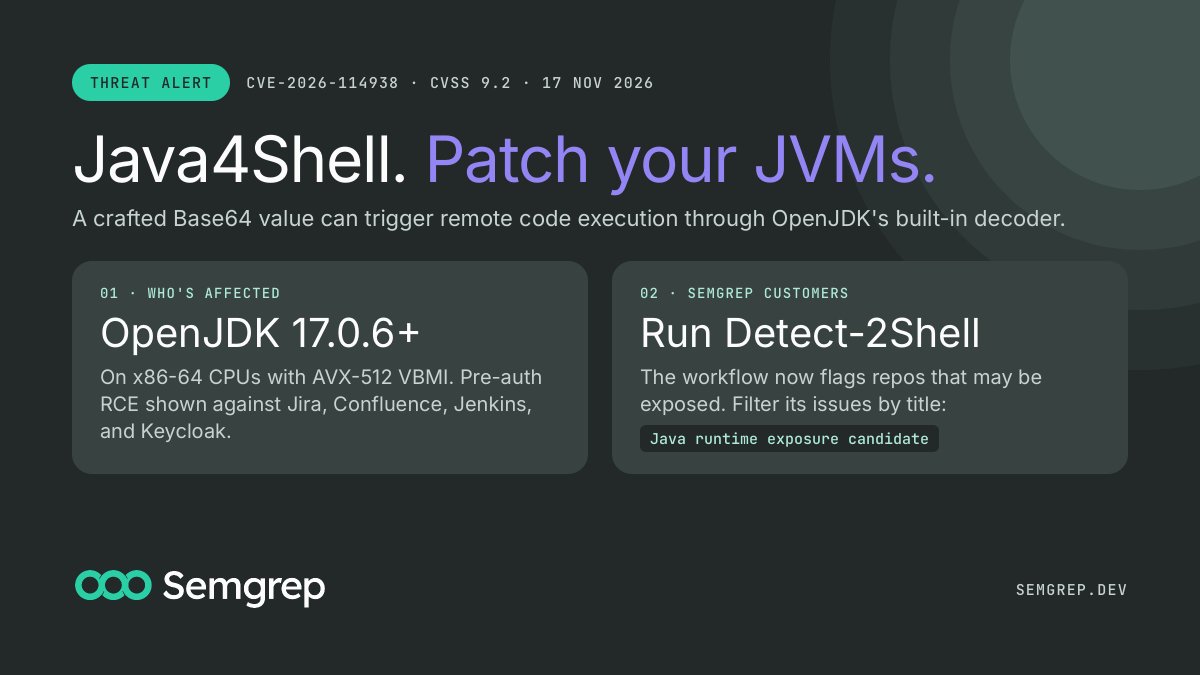
Java4Shell (CVE-2026-114938, CVSS 9.2): a crafted Base64 value → RCE via OpenJDK's built-in decoder. Affects 17.0.6+ on x86-64 with AVX-512 VBMI. Patch, or use -XX:UseAVX=2 on x86-64 only. Semgrep customers: run Detect-2Shell workflow.