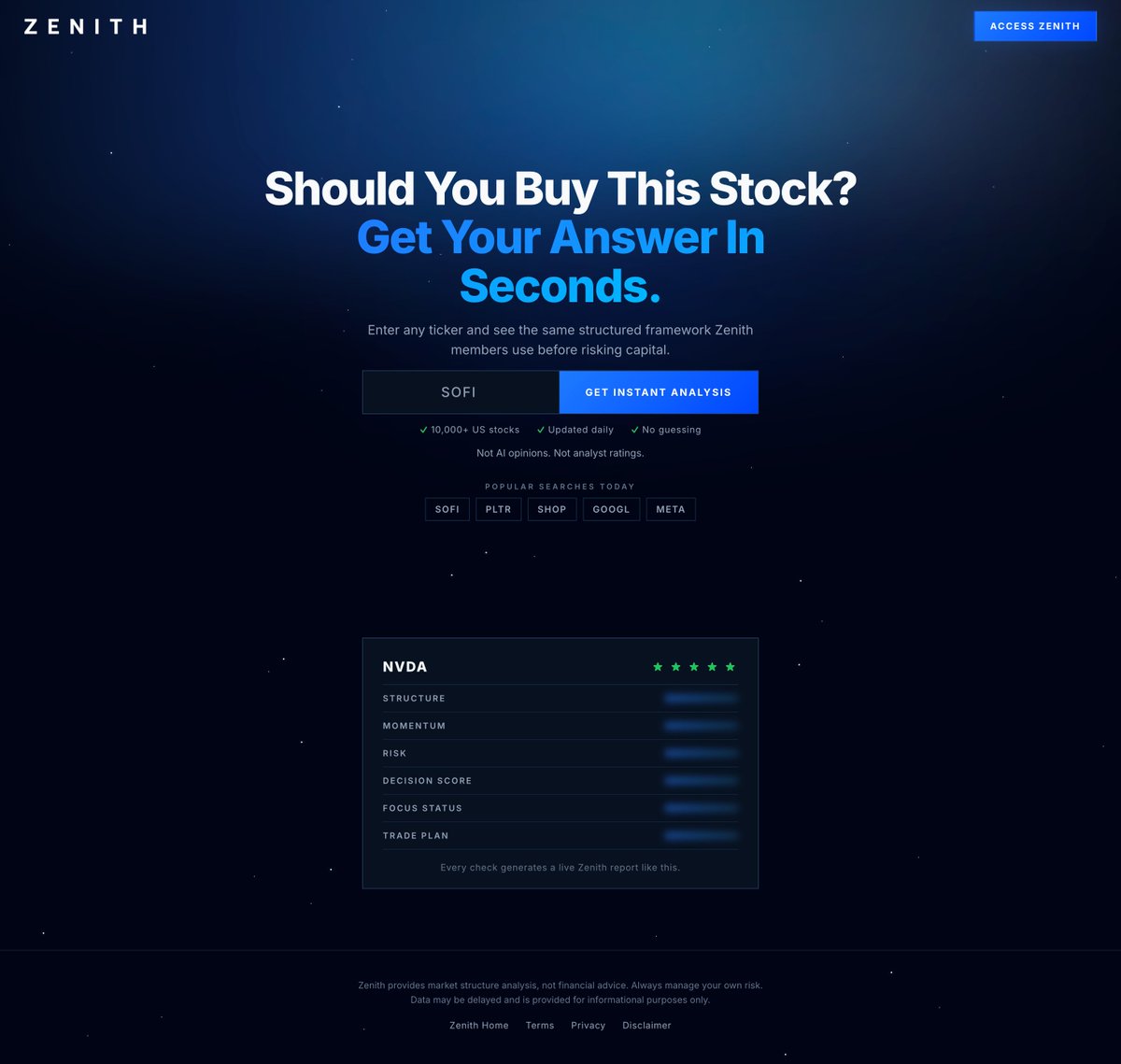
Should you buy this stock?
Wrong question.
Ask if it deserves your capital.
Analyze any US stock in seconds.
Clarity Before Capital.
https://t.co/RciOU2V71K
@JUSTIN_DTrader When the firm moves the goalposts, the only lever left is yours.
Keep the same daily stop and setup list anyway.
If size needs the challenge to work — it was already wrong.
@Mr_Derivatives Skipping the exciting print is process.
The close still has to prove the gap meant something.
Invalidation first — then decide if risk still deserves capital.
@FxChoudhary Trying to win it back is usually size talking.
Would you take this size on a cold open with nothing to fix?
If not — pause. The last loss is negotiating.
@Jamestrade_01@Topstep@Tradeify Near a payout is when rules feel optional.
Write the daily stop where you can see it before the open.
If you need this session to rescue the month — size is already wrong.
@HeyAliux More lines usually means fewer decisions.
Hide everything except the one rule that would invalidate the trade.
If nothing left changes Buy / Wait / Stay Out — the chart was decoration.
@Barchart Reading the rate line twice beats owning the first spike.
Headline ≠ tape. Ask whether your setup, invalidation, and size still hold after the print — not whether the candle looked exciting.
@Bblythe_Gr Giving some back after a big green is often size negotiating with confidence.
Before the next add: would I take this size cold, with nothing to protect?
If no — protect the day, not the high-water mark.
@_Miebaka_ Boredom trades are attendance, not opportunity.
If you need something to do, the chart already looks better than it is.
Ask: do I need this one to work? If yes — sit out.
@Megumipd Seeing it is the hard part. Changing the next action is the job.
Write invalidation before you open another chart.
If it isn't clean — Stay Out is already the decision.
@FxChoudhary Winning it back is a size problem wearing a setup costume.
Before the next click: would I take this size on a cold open with nothing to fix?
If no — the last loss is negotiating.
@Leeshhh_ Different names, same order.
Structure + market state first — who is winning, what weather you're in. Fundamentals only if they change Buy / Wait / Stay Out.
If it doesn't flip the decision, it's research — not a vote.
https://t.co/Hcw2LQGMCo
@Gioroero If analysis needs a laptop but the click happens on a phone, the decision and the execution are already split.
Write Buy / Wait / Stay Out on the big screen first. If it isn't clear there, the phone shouldn't get a vote.
@ggusa_stocks Up big, then blown on bad sleep, is size negotiating with fatigue.
Before the next session: would I take this size cold, rested, with nothing to fix? If no — rest is the trade.
@Unstoppable1106 Beat + dump is the vote, not the speech.
Cutting before the print was process. Re-entry only when your setup is true again — not when the quarter "deserves" a bounce.
@ponta_kokemomo Unclear tape isn't a puzzle you owe an answer.
If you can't name the conditions you're willing to trade, Stay Out is the process working — not you missing out.
@karaoke_andi Can't pull the trigger usually means the rules aren't written yet.
Before the next almost-click: invalidation, target, time window. If any of those are fuzzy — Wait is already the answer.
@Leeshhh_ Watching for a base is the right job. A cheaper print isn't a green light.
What must be true before it deserves capital — structure holding, or just a lower number?
@jaysyx One clear idea beats ten half-watched names.
Finish: "I'll only risk capital when _____ is true." If the blank stays empty, you're still researching — not deciding.
@iambroots Fear at the high and love at the new ATH are usually the same mistake: treating location like a verdict.
Ask whether demand is still paying up with a stop you'd honor — not whether the crowd went quiet.
@LoremeSK@skyshark0 Mixing swing with 4H–1H "unless it's clean" is how FOMO sneaks back in.
One timeframe for the decision. If the daily isn't clean — Wait. Don't let a lower chart reopen the trade.