Author, Journalist, Columnist. With interest in Democracy, Secularism, Human Rights, Law.
Author of The Fearless Judge. Link in pinned post.
@KingsCollegeLon
Not many ppl know that when my grandfather passed away last year, he was in the process of writing a book - his atma katha as he lovingly called it. Sadly, his time on earth ran out before he could finish.
Today, it is here.
Available on pre-order now. https://t.co/NpJVibbwVf
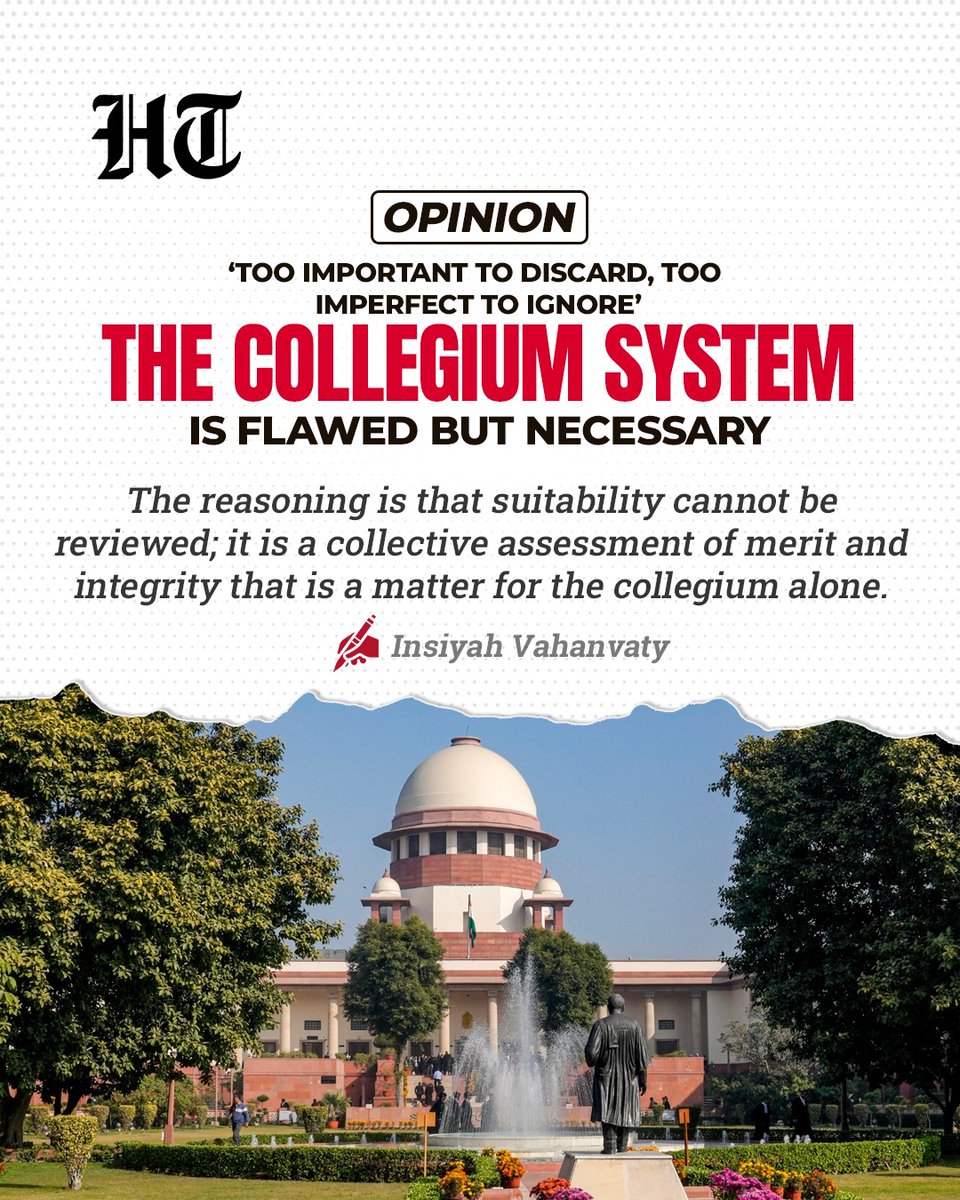
#HTOpinion | "Historically, the collegium system itself is a judicial creation rather than a constitutional mandate. It emerged out of institutional anxiety over executive interference in judicial appointments in the years after the Emergency."
@insiyahv ✍️
#SupremeCourt#India #CollegiumSystem
Know more 🔗 https://t.co/lI05s4osVS
I have a VOTER ID card, but NO, it is not proof of citizenship.
I have a AADHAR card but NO, it is not proof of citizenship
I have a PAN Card, but NO, it is not proof of citizenship.
I have a PASSPORT but NO, it is not proof of citizenship.
So who will give me a CITIZENSHIP CERTIFICATE? A govt bureaucrat?
My question is simple: is the problem with the citizen, or with the Mai Baap State itself?😡
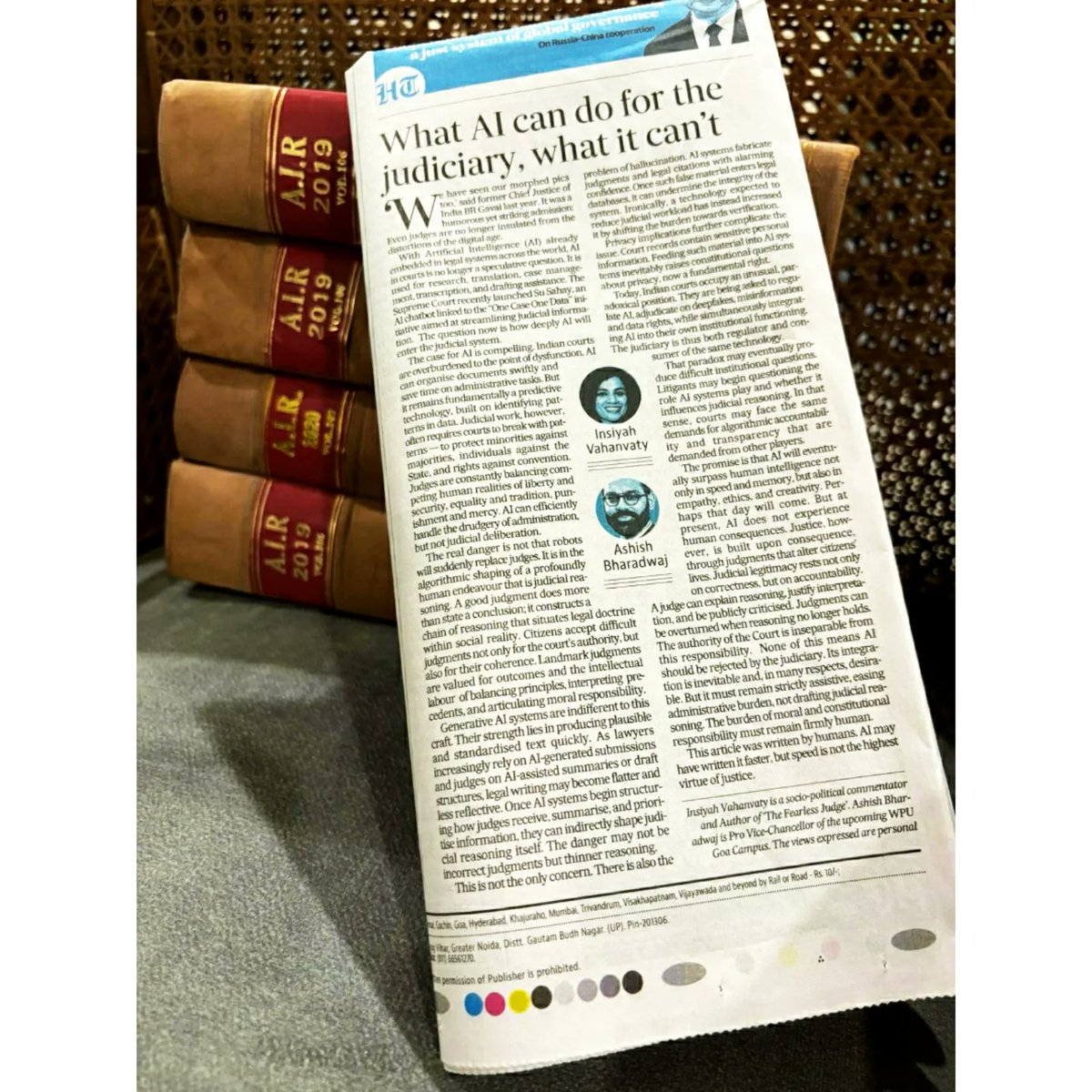
‘We have seen our morphed pics too,’ said former Chief Justice of India BR Gavai last year. It was a humorous yet striking admission: Even judges are no longer insulated from the distortions of the digital age.
With Artificial Intelligence already embedded in legal systems across the world, AI in courts is no longer a speculative question. The question now is how deeply AI will enter the judicial system.
AI can organise documents swiftly and save time on administrative tasks. But it remains a predictive technology, built on identifying patterns in data. Judicial work, however, often requires courts to break with patterns — to protect minorities against majorities, individuals against the State, and rights against convention. AI can efficiently handle the drudgery of administration but not judicial deliberation.
The real danger is not that robots will suddenly replace judges. It is in the algorithmic shaping of a profoundly human endeavour: judicial reasoning.
A good judgment does more than state a conclusion; it constructs a chain of reasoning that situates legal doctrine within social reality. Citizens accept difficult judgments not only for the court’s authority, but also for their coherence. Judgments are valued for the intellectual labour of balancing principles, interpreting precedents, and articulating moral responsibility.
There is also the problem of hallucination. AI systems fabricate legal citations with alarming confidence. Ironically, a technology expected to reduce judicial workload has increased it by introducing the burden of verification.
Today, Indian courts occupy an unusual, paradoxical position. They are being asked to regulate AI, adjudicate on deepfakes, misinformation and data rights, while simultaneously integrating AI into their own institutional functioning. The judiciary is thus both regulator and consumer of the same technology.
The promise is that AI will eventually surpass human intelligence not only in speed and memory, but also in empathy, ethics, and creativity. Perhaps that day will come. But at present, AI does not experience human consequences. Justice, however, is built upon consequence, through judgments that alter citizens’ lives.
Judicial legitimacy rests not only on correctness, but on accountability. A judge can explain reasoning, justify interpretation, and be publicly criticised. Judgments can be overturned when reasoning no longer holds. The authority of the Court is inseparable from this responsibility.
None of this means AI should be rejected by the judiciary. Its integration is inevitable and, in many respects, desirable. But it must remain strictly assistive. The burden of moral and constitutional responsibility must remain firmly human.
This article was written by humans. AI may have written it faster, but speed is not the highest virtue of justice.
Hindustan Times, 21 May 2026.
https://t.co/nGlaH6CDbT
What began as a dispute over women’s entry into the Sabarimala temple has expanded into a wider inquiry into essentiality, equality, and the limits of judicial intervention that are not confined to one faith. This means the Court is no longer resolving a localised dispute but laying down a meta-framework for how religious practices will be tested across faiths, one that could reshape the architecture of religious freedom jurisprudence.
All eyes are now turned to the Court.
https://t.co/7X9OHjAYOH
#sabarimala #SupremeCourt #essentialreligiouspractice #religionandlaw #ReligiousFreedom
The recent banning of a civics textbook by the Supreme Court has snowballed from a school lesson into a question of judicial authority and temperament.
The facts are, by now, well known. The Supreme Court took suo motu cognisance of a chapter in a class VIII NCERT textbook that acknowledges widely recognised judicial challenges — pendency, shortage of judges, and corruption.
To the extent the chapter is criticised for bias, omission or substantiation, a reasoned critique and a directive for revision would have been sufficient. Instead, the SC responded with unprecedented force. Its remarks invoked malicious intent, spoke of the judiciary “bleeding,” and warned that “heads must roll”. It also blacklisted three academics from publicly funded curriculum work. It was an unusually muscular response to a schoolbook.
Equally urgent is the question of what such action communicates. When courts display disproportionate fury, it creates ripple effects. Even when unintended, they mirror the very executive overreach that they are meant to check. Academics, universities and citizens self-censor out of fear. Disagreement and dissent are stifled. In one instance, a student who wrote a blog post critiquing the judiciary was asked by his university to delete it. That he did not oblige was the young man’s exercise of his democratic right — and to his credit.
Ironically, a careful reading of the chapter does reveal one genuinely objectionable element. But it lies elsewhere. It is in the odd and unnecessary inclusion of Hindu mythological references used to illustrate constitutional ideas.
In a plural, secular republic, weaving religious narratives into State-sanctioned education corrodes the very wall that the Constitution erects between faith and State. Yet, curiously, this breach has barely raised an eyebrow.
There are other aspects too — gratuitous emphasis on some former judges over others skews what ought to be an even-handed introduction to constitutional function. The side-trip into a judgment on Sanskrit education is as puzzling as is the elevation of environmental law over core foundational doctrines. These are all editorial misfires that demand serious revision.
But critique of the chapter need not be at the expense of the court’s dignity or the rights of its authors. Judicial authority, painstakingly built over decades of principled restraint and legal rigour, is earned not by the weight of its hand, but by the steadiness of its balance.
For if even the highest court speaks the language of intimidation, as the State often does, to whom, then, shall the citizen turn?
As the court now examines affidavits filed by the blacklisted academics, it must preserve both, justice and public trust.
The chapter’s flaws too, must be examined in their entirety.
Hindustan Times, 10 April, 2026.
https://t.co/Eykz7YMTd4
India’s Strategic Silence Is Testing Its Moral Voice | Insiyah Vahanvaty
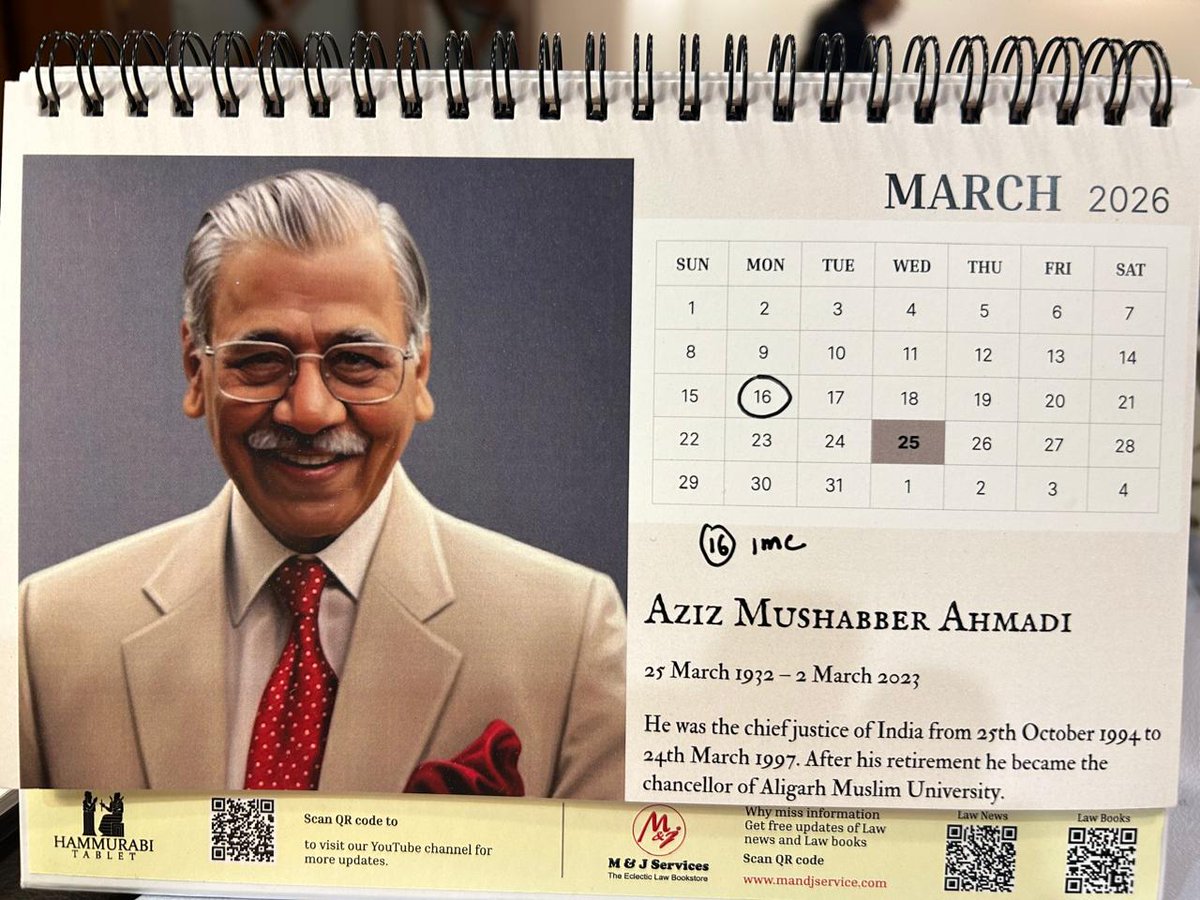
@insiyahv is a socio- political writer, commentator and scholar. She is the author of The Fearless Judge: The Life and Times of Justice A. M. Ahmadi.
https://t.co/fzdziOYO4g
Article 21 guarantees us Right to Life. But what happens when artificially preserving life contradicts the principle of dignity enshrined in the Right to Life?
The Court has sanctioned passive euthanasia, but legal ideals often collide with social realities. In rural areas, hospitals lack medical boards to conduct assessments. The number of trained doctors and palliative care infrastructure are limited. When the burden of emotional and financial care falls on the next of kin, consent may not always be free. Living wills may be misunderstood, coerced, or violated.
And yet, to reject passive euthanasia altogether would be a mistake. Modern medicine can prolong dying through ventilators, feeding tubes, and endless interventions long after the person is gone. To insist on continuing such treatment regardless of prognosis or suffering is not the protection of life; it is cruelty.
This is where Harish Rana becomes significant. The judgment does not grant a sweeping right to die; it only allows the refusal of futile medical intervention.
Ultimately, passive euthanasia acknowledges that life preserved at all costs may not be a life worth living. When death is approached with respect, it is the final act of dignity.
Hindustan Times, 26.03.2026
https://t.co/q9e5X1Z8yV
#passiveeuthanasia #harishrana #commoncause #arunashanbaug #righttolife
The war on Iran may come to be remembered not simply as another West Asian conflict but as a symptom of something much more serious — the gradual collapse of the post-1945 international order and, with it, the re-emergence of a colonial mindset in global politics.
Washington and Tel Aviv’s rhetoric surrounding the military campaign on Iran, demanding Tehran’s “unconditional surrender” and regime change, evokes an older era of imperial politics. Unconditional surrender historically means that the defeated State must submit completely to the political terms set by the victor. It assumes that powerful States can decide when another government has become unacceptable and can, therefore, be compelled (or replaced) through military pressure. This is especially alarming as it signals how easily the language of modern international law can give way to the older logic of empire.
For decades, the US and its allies have insisted that the world operates under a “rules-based international order.” The phrase appears endlessly in speeches, communiqués, and summit declarations. It is invoked to condemn Russia, discipline smaller States, and justify sanctions regimes.
The war on Iran suggests that this aspiration is fading. By the time the world realises what has been lost, it will be living in a system where international law no longer restrains war at all. Perhaps we are already there.
HINDUSTAN TIMES, 12.03.26.
https://t.co/UiSQr6rHqs
You'd think this eventually gets old. Let me tell you, it doesnt.
To be able to help young minds discover and contextualise the world we live in.. is a gift that keeps on giving.
Moments like these ❤️
#thefearlessjudge#lawandpolitics#lawandjustice#babrimasjid #JusticeAhmadi
Your data should work for you, not control you.
But in today’s digital world, is that really true?
The Supreme Court is now examining a crucial question involving WhatsApp and India’s Digital Personal Data Protection (DPDP) Act.
Who actually controls your data? You, Big Tech, or the State?
When WhatsApp rolled out its 2021 privacy update, users were told to accept new data-sharing terms with Meta, or lose access. But “take it or leave it” isn’t meaningful consent.
Now, with the DPDP Act in force, the debate has expanded. Is India’s new data law strong enough to protect citizens? Or does it give wide powers to the government while limiting accountability?
Because in the digital age, data is power.
This landmark case won't be just about one app. It will ultimately decide the future of privacy in a time when the lines between our online and offline lives are blurred.
#supremecourt
#dataandprivacy
#dpdpact
https://t.co/LH62yRbqx3
What does ethics in governance look like? Can it be divorced from our democratic institutions? And how does impunity work?
These questions are particularly urgent in these times of deep societal divisions and polarisation we live in. Yet, in the country's oldest document, the Constitution, is the quiet audacity to unite us anyway.
The morning of 21 February 2026, the Taj Lands End Hotel buzzed with energy as a packed hall came together to hear leading experts speak on Ethics and Sustainability— its significance, its practice, and its real-world impact.
I had the opportunity to speak on democracy, governance, and the state of our country; the role of the media and the responsibility we have to the next generation: building sustainable institutions, fostering ethical governance, and embedding constitutional values in everyday life.
#ethics #annualethicsseminar #tajlandsend #mumbai
To understand Ethics as simply the difference between right and wrong is only a starting point. In truth, it is the pulse of civilization. It defines how we treat one another. How we govern. How we uphold societal & constitutional principles. How we steward our shared resources, and how we understand personal morality.
Societies do not endure by accident, they do so by deliberate intention. The decisions we make today shape the systems our children will inherit.
Join us for an engaging discussion on ethics, legacy, and responsibility.
📅 Saturday, 20 February 2026 | ⏰ 11:45–12:45 PM
📍 Taj Lands End, Bandra, Mumbai
@cfbp66 #ethics #sustainability #paneldiscussion
Religious rights, the Courts and the State.
In recent months, Uttar Pradesh has been in the news for troubling reasons. The latest incident comes from Bareilly, where police detained 12 Muslim men for offering namaaz (prayers) inside a private home, with the permission of the homeowner. Citing Section 170 of the Bharatiya Nagarik Surakhsha Sanhita (which permits warrantless arrests on suspicion of a serious offence) the police justified the action on grounds of “public order” after a secretly recorded video of the prayers surfaced on social media. Evidence pointing to intent or actual threat to public order, however, remains absent.
In September 2025, a controversy began in Kanpur, where police filed FIRs against citizens displaying banners reading “I love Muhammad”, sparking widespread protests. In Bareilly, the state escalated matters with violence, shop closures, and FIRs for rioting. Most alarming, however, was the open defiance of judicial authority. Despite the Supreme Court’s order in In Re: Directions in the Matter of Demolition of Structures and clear Allahabad High Court directions expressly prohibiting punitive demolitions, properties linked to protesters were bulldozed.
And so, before we proceed further, we must first confront the nature of the failure. The law on this is settled, so this is not a crisis of legal ambiguity. Nor are these one-off breaches or the work of a few rogue officers. So, the broader question we must ask is why the system allows, and in some cases facilitates, the differential treatment of communities.
When the rule of law is flouted, it doesn’t just harm those immediately targeted, it erodes accountability across the board. Police act with impunity, administrations ignore rules, even courts risk being sidelined. And once this precedent is set, the genie cannot be put back in the bottle. When laws are bent against some, they will inevitably be bent against others. Ultimately, the rule of law is the spine of modern civilisation; break it and the whole body collapses.
Hindustan Times, 12.02.2026.
https://t.co/F1uIlQ79kz
India’s media landscape is vast, loud, and deeply influential. Initial reporting is breathless, speculative, and framed through an ideological lens built from years of consuming content delivered in echo chambers.
And in polarised societies, speed is not just a professional advantage; it is power. This dynamic is no accident. Political actors understand it well – and operate within it deliberately. Millions of dollars are spent worldwide each year on carefully shaping narratives and leveraging rapid media dissemination to steer public opinion. Public opinion hardens around half truths, while institutions - courts, police, governments - frequently respond to public pressure rather than verified evidence. In these moments, the media does more than report news. It shapes perception, policy, and power. By the time the confusion clears, the damage is often done.
And so, perhaps the most uncomfortable question is this: who benefits when misinformation spreads?
#mediainindia #speedandmedia #mediaresponsibility #misinformation #disinformation
https://t.co/458kvoUeeE
On January 26, 1950, India adopted its Constitution and two days later, the first hearing of the Supreme Court was held with a total strength of eight judges led by the first Chief Justice of India, Justice HJ Kania.
Within a few short weeks, the first storm broke, in AK Gopalan v. State of Madras. At the heart of the dispute was a provision that still sparks debate today: Preventive detention. The government, armed with the Central Preventive Detention Act, 1950, had detained Communist leader Gopalan. The Court was faced with a question that still matters today: How far can the State go in curbing personal liberty in the name of security? Ultimately, and regrettably, the Court upheld the Preventive Detention Act, but it did strike down the provision that allowed the State to hold people without disclosing why.
Ironically, just a week later, the Court confronted two more cases of State overreach, involving free speech. In Romesh Thappar v. State of Madras and Brij Bhushan v. State of Delhi, two publications critical of the government had been banned on the grounds of threatening public order.
Deciding both cases on the same day, the Court tore down the censorship, holding that freedom of speech cannot be curtailed except under narrow grounds. It was a powerful affirmation of dissent that prompted a panicked Parliament to swiftly enact the Constitution (First Amendment) Act, 1951.
The first year of the Court’s life proved uncannily prophetic. It was neither uniformly heroic nor consistently timid. It faltered in Gopalan, even as it quickly steadied itself to defend free speech in Romesh Thappar and Brij Bhushan. The 76 years since have followed the same jagged rhythm — eyes occasionally cast downward as freedoms fell, punctuated by flashes of rare, startling courage.
For every judge that has bowed to political power, there has been another willing to forego personal ambition to defend citizens’ rights. The Court is not a neutral umpire; it exists because the citizen and the State do not stand on equal footing. Its role is to act as a bulwark when power overreaches, and to do so in time.
In recent years, the Court has often appeared hesitant. Dissent has been punished, preventive detention laws have been invoked casually, and speech has been chilled through arrests, internet shutdowns, and prolonged trials. With constitutional questions left undecided, the Court occasionally retreated into cautious distance.
And yet, behind those same doors once sat the Kesavananda Bharati bench of 1973. They stared down the might of Parliament itself, some at great personal cost, to give us the basic structure doctrine that may well be the reason any of our rights survive at all. Freedoms are neither won nor guaranteed, they are defended. Today, the Court is both a monument and a mirror.
Hindustan Times, 30.01.2026
https://t.co/HtGfyBwdYy
Over the last year, the Supreme Court reversed eight of its own judgments, a tally rare in recent memory. Several others were recalled, reopened, or substantially modified. Many of these did not emerge from the slow grind of doctrinal reconsideration. Instead, they occurred sometimes within weeks or months, often following waves of media outrage, street-level anxiety, and political discomfort. While each may be defensible on its own, the cumulative effect raises a troubling question: Are judicial course corrections being driven by legal reconsideration, or by public unease?
The court too has acknowledged this. Justice BV Nagarathna spoke plainly: A judgment once rendered must hold its anchor in time for it is “written in ink, not sand”. Judgments cannot be tossed out just because the faces on the bench have changed.
In the long-run, the legitimacy of the Supreme Court will rest on its ability to balance urgency with restraint. The greatest courts are not those that never err, but those that err less because they speak more carefully.
Hindustan Times, 15.01.25.
https://t.co/JvHM4bWlAj
#supremecourtofindia
#aravallijudgment
#reversedjudgement
#straydogsmatter
#vanashakti