We are hiring! 🎉 Join our team as a Scientific Data Curator. If you are excited to leverage AI tools to enhance data curation and want to help build open biological resources like IntAct and Complex Portal, we'd love to hear from you.
Apply here: https://t.co/U1oqUi28Pd
🤖 Bring molecular interaction data into your AI workflows!
Our new MCP server allows your AI assistant to securely connect to IntAct and DisProt data. You can query curated records, validate protein identifiers and apply precise filters.
Get started: https://t.co/ehl1EXqv2G
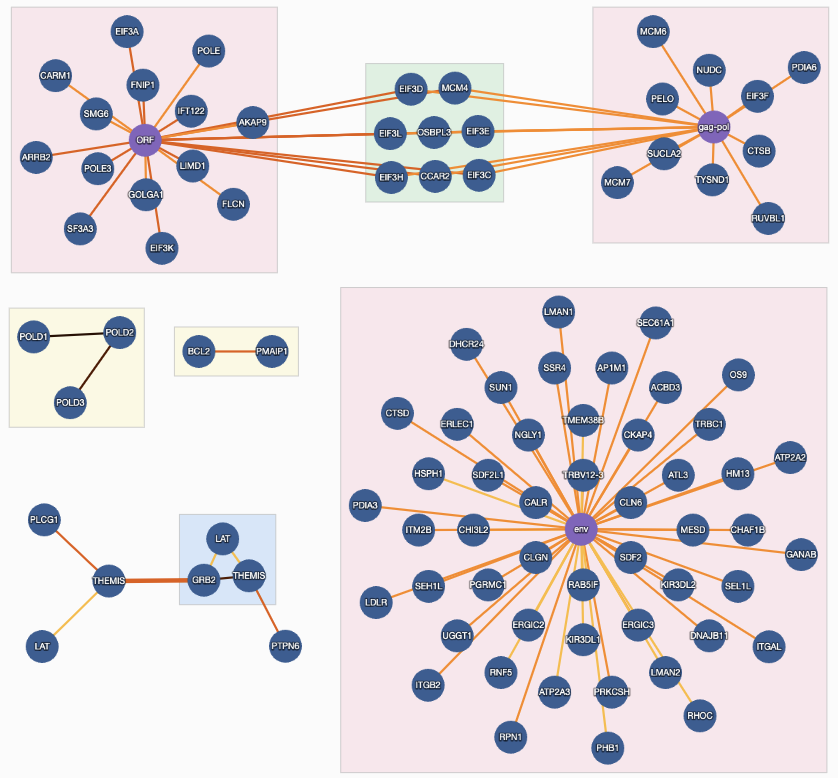
Say goodbye to network hairballs! 🕸️ Introducing LUMINA, a new force layout by Shutan Xu & the IntAct group. It brings clarity to interaction data by highlighting cycle, chain, star & parallel topologies. Live on IntAct & as a Cytoscape package!
https://t.co/DKxo76PKJy
IntAct release 253 is out! 1,814,919 binary interactions from 24,076 manually curated publications https://t.co/79WofBX3iQ (in sync with UniProt release 2026_02)
Freely accessible via IntAct: https://t.co/e4K7DwwD7u
👏 A big thanks to Élodie Monsellier @emonsellier.bsky.social
and the team for their collaboration in bringing this integration to IntAct!
#IntActEBI#PPI#NetworkBiology
🔬✨New in 𝐈𝐧𝐭𝐀𝐜𝐭!
Quantitative fragmentomics data (Nat Commun 2022) now integrated into IntAct - bringing high-quality, quantitative protein-protein interactions to the database.
📌 Each interaction includes 𝐛𝐢𝐧𝐝𝐢𝐧𝐠 𝐚𝐟𝐟𝐢𝐧𝐢𝐭𝐲(𝐊𝐝), so you can see not just if proteins interact, but how strongly.
🚀 Enabling better network biology, pathway modeling, variant interpretation & drug discovery.
IntAct release 252 is out! 1,787,152 binary interactions from 23,889 manually curated publications https://t.co/79WofBWvti (in sync with UniProt release 2025_04)
👏 Huge thanks to UniProt for integrating the isoform information! 🤝 This was a joint curation effort by IntAct & UniProt - a great example of collaborative science! Here’s to an exciting year ahead! 🚀🧬 https://t.co/qydcRo7fBO
#EMBLEBI#IntActEBI#UniProt#Proteoforms
📷
IntAct
@intact-ebi.bsky.social
🎉✨ Happy 2026! ✨🎉 We’re excited to kick off the year by sharing the integration of the work “N-terminal proteoforms may engage in different protein complexes” from the Kris Gevaert lab (VIB, Ghent, Belgium) 🎓🔬
Study beautifully demonstrates how N-terminal proteoforms can reshape protein interactomes - gaining new interactions and/or losing others compared to their canonical counterparts - highlighting the power of proteoform diversity in cellular networks.
From a farm in the north of England to the frontiers of bioinformatics, our Group Leader Sandra Orchard reflects on a career building the data foundations of modern biology:
“AI is showing how vital data curation really is.”
https://t.co/x5TLvFmYn8
#biocuration#FAIRdata
Would you like to learn more about molecular interactions & to explore them across organisms? Join us next week for an introductory webinar where we walk through the IntAct's approach to molecular network modelling & show how this is implemented within the IntAct Cytoscape app.
🧫 Explore the curated dataset in IntAct ➡️ https://t.co/aPCDfX7IlK
🎨IntAct Cytoscape visualisation:
Candida albicans ECE1 peptides (orange) and their human protein targets (blue)
✨🧬New on IntAct! ✨
Interaction data from the study
📖“Global fungal–host interactome mapping identifies host targets of candidalysin” - from Shanghai Jiao Tong University, Tongji University, and the Chinese Academy of Sciences. 🎉
Maps the interactome of all eight Candida albicans ECE1 propeptides and their specific human protein targets, revealing both unique and shared host interactions that provide new insights into fungal–host communication.