Here are TEN questions that I have for any climate alarmists reading, and I hope I can get some honest answers down in the comments:
1️⃣ You have asserted that the planet is dangerously overheating. So, what exactly is the correct globally averaged surface air temperature supposed to be and why? I want an exact value to the nearest tenth of a degree Celsius.
2️⃣ What is the correct atmospheric carbon dioxide (CO₂) level to optimize life on Earth? Give me your answer as an exact value in mole fraction or volume percentage, then explain why in detail. A range would suffice too, but you still need to explain.
3️⃣ What makes CO₂ “air pollution”?
The pre-Trump 2.0 EPA considered CO₂ as an air pollutant under the legal framework of the Clean Air Act, and their justification was that it “contributes to greenhouse gas pollution that threatens public health and welfare.”
But that seems pretty ambiguous if you ask me.
By that arbitrary standard, water vapor (H₂O) should also be classified as harmful “air pollution” because it also is a GHG and is a byproduct of combustion. But we don't classify it as pollution because, well, H₂O is necessary for life on Earth. But so is CO₂. Without it, we would all die.
4️⃣ Why are global average temperatures measured in reference to the 1850–1900 baseline? While many of our modern instrumental weather records begin within that timeframe, we know that climate conditions pre-1900 were much harsher than they are today as we were coming out of the Little Ice Age. Winters were harsher. Summers could be harsher. Droughts, floods, and famine were just as, if not more common relative to today. So, why should the end of the Little Ice Age be seen as the ideal baseline for human welfare?
5️⃣ The estimated cost of net zero in the U.S. by the year 2050 is ~$6 trillion (though estimates I have seen widely vary). And with ~165 million taxpayers in the nation, using that $6T figure, it would cost each of us a little more than $36,000 to achieve. That's a lot of money per individual. How many of you activists are willing to shell out that kind of money just to see what happens?
6️⃣ If we spent that $6T to decarbonize the economy by 2050, by how much will such measures reduce the global mean surface temperature by the year 2100? Please provide your answer to the nearest tenth of a degree Celsius and show your math (I actually know the answer to this theoretically, but I want to see you do the math).
7️⃣ What does the perfect climate look like? Just how much extreme weather should there be? How many floods? Tornadoes? Category two hurricane landfalls in Florida? What should temperatures be? How many droughts should occur per century in Cambodia? How will we get there and how do we know when / if we get there? By what scientific measure will we know?
8️⃣ If “combating climate change” is really a global concerted effort, then why do you always give China and India a free pass to continue emitting without bound? Why are they never criticized? And don't tell me it's because they are “the world's factory.” The U.S. is the second largest industrial manufacturer in the world. Don't give me the “per capita emissions” BS either; the atmosphere does not care about that. So, why is it that the U.S. is always dunked on?
9️⃣ Why do most of (not all) you vehemently oppose nuclear power? It's the best alternative to coal and natural gas, and statistically it is the cleanest and one of the safest forms of “carbon-free” energy.
🔟 Lastly, if you truly believe climate change is an urgent problem, why do you continue to use social media? After all, it has a large carbon footprint because it is powered by those data centers you hate. Also, why do demonize fossil fuels, but use them to keep the lights on in your home or apartment? Why use running water and indoor plumbing, which often require fossil fuels? Why not give up modern luxuries and live off grid to lead by example? I really want to know why you are still here.
@DVSignals@garysavage1 Why not have the lower line of your channel intersect with the bottom of the wicks of the lows from the mid - end Nov and also the very end of Dec?
Isabella, let’s strip away the dollar funding abstractions. Forget the debates about whether there were enough dollars, or whether there’s enough transparency in the lease rate mechanism. Let’s call this what it is: a crowded trade that’s finally blowing up in the faces of those who’ve profited from it for thirty years.
As traders and risk managers in precious metals (people who sit at the intersection of financialization and physical reality) it’s their job to know. It’s their job to remember that limited collateral in a system with unlimited money carries dislocation risk. It carries collateral crisis risk, as Zoltan Pozsar has pointed out. And that risk can only be kicked down the road so many times.
Financialization works until it doesn’t. It works until someone steps in and says they want the gold or the silver regardless of whether you think they should or not. That’s a real risk. And a risk manager’s job is to see that potential, to understand that someday he won’t be able to kick the can down the road or buy time to get his collateral back.
The blind spot lies with the people who knew this and kept doing the trade anyway, hoping to be bailed out or for it to fix itself. The blind spot is greed—failing to see the end of the road for a carry trade that’s outlived its logic. The blind spot is the complacency of those who knew and did nothing, because it wasn’t their problem.
It’s also in the custodians of these markets who dismiss gold and silver as relics of an ancient time. Even if they are relics, they remain the fallback when fiat is distrusted. Treating something monetary like a trinket in your grandmother’s closet worked for a while. But that era is over.
Neokeynesianism is dead, and with it, the carry trades. Mercantilism has taken its place. And mercantilism says (right or wrong) that there is no future, only spot. The world has become a sumzero game in the mercantilist mind, and the mercantilists are increasingly the ones running it.
Any bullion trader who didn’t see that deserves to be fired. Any bullion bank manager, strategist, or “expert” who didn’t see it should be fired too. And anyone who did see it and said nothing is a bad trader. Anyone at the regulatory level who saw it and did nothing is worse—they are a traitor to the West and to the effort to preserve our wealth
@DaveHcontrarian@pinnacledigest Sincerely appreciate the very informative interview David. You mentioned that you potentially see gold dropping back towards $3,200 before continuing higher - so will this likely drag silver down with it towards $31 / $32 again before the GSR resumes its march lower?
@jk_rowling@ForWomenScot It would be more believable if this was a comedy sketch - it took the highest court in Scotland to correctly define the meaning of “woman”. Peak madness.
In honor of International Women’s Day, here is one of the best bits of all time by @billburr
Ladies, let’s turn off the reality shows and root for each-other
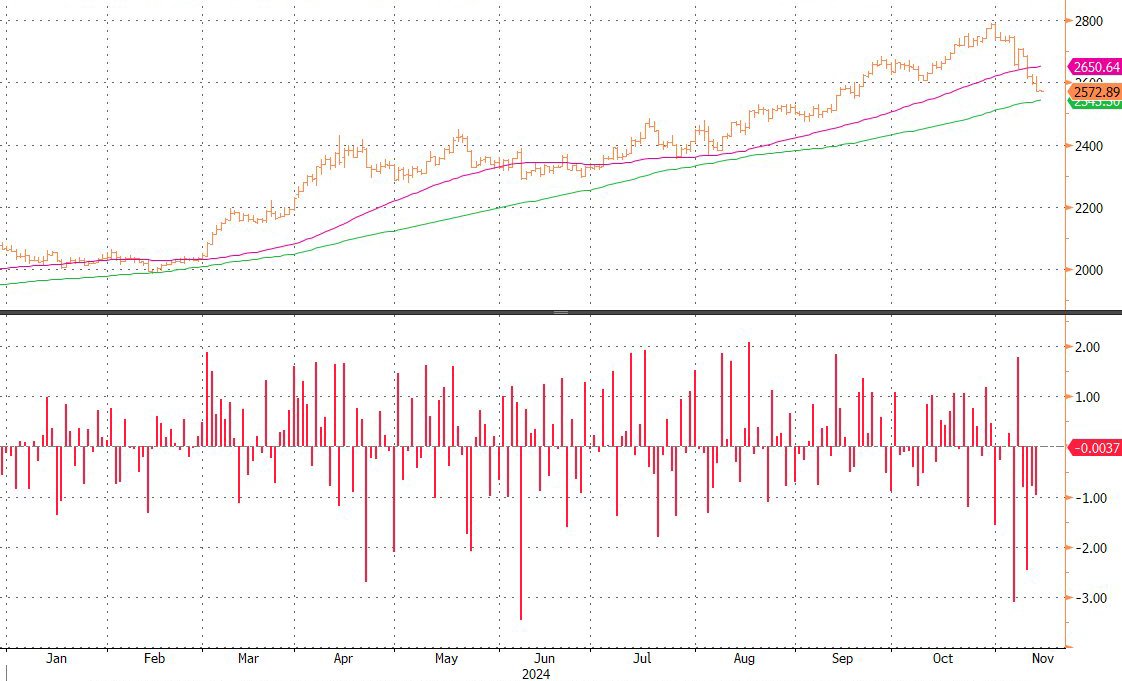
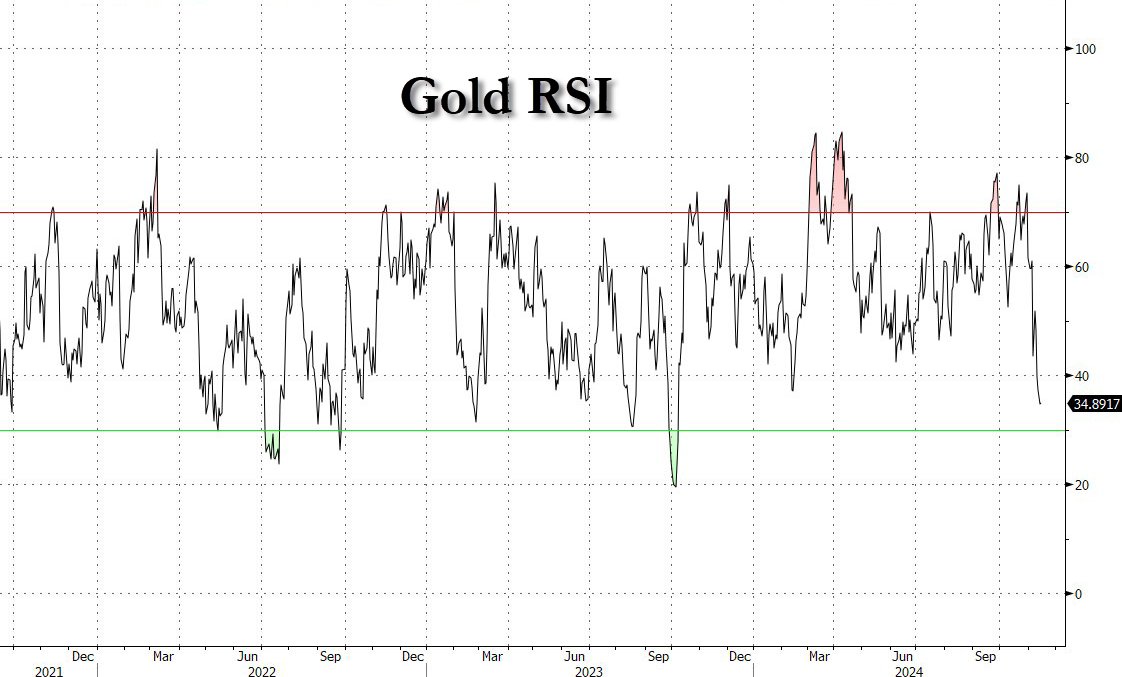
Gold sold for 4th day in a row, drops to 2 month low and approaches 100DMA. Most oversold since Oct 2023 as traders continue to lift yields, US dollar on expectation of aggressive Trump stimulus, tariffs. Meanwhile, US debt hits new record high just under $36 trillion
**Tether Alert**
The idea that Wall Street is embracing Tether and Bitcoin is much clearer.
The more Tethers are being bought, the higher Bitcoin goes. The higher Bitcoin goes the more Tethers are being bought.
As Tether grows in size the more US Treasury debt is being purchased by Tether. Tether is now holding over $84 Billion in US T-Bills up from $28 Billion in 2022, Tether is becoming a substantial buyer and funder for US Government debt.
Oddly as the Bitcoin community is heralding the digital asset space as the price is surging, what they may not realize is that bitcoin is being used to attract funds to Tether which is funding and backed by US Treasury debt.
The idea that the new Presidential administration is supporting Crypto is in essence to find another buyer for US Treasury debt. By attracting investors, Wall Street makes money and fees by creating a new digital industry which adds depth and liquidity for this digital asset class.
At the end of the day, this industry is being born to help support US government deficit spending and Treasury issuance.
Is there any wonder why a large entity has had a free pass by not providing Audited Financials over the years?
If Tether is a growing buyer of US government debt and one of the largest funding vehicles for Bitcoin, then any material price decline/volatility in US Treasuries may have a direct impact on Bitcoin's price.
Is Bitcoin really an alternative asset or dependent on the US Legacy system?
Do not take my word for it, the video below adds much more clarity.
Please repost.