In 1943, the Gestapo finally caught Raymond Aubrac — one of France's most wanted Resistance leaders. He was sentenced to death. His execution was days away.
His wife Lucie was six months pregnant.
Most people would have hidden. Would have grieved quietly and prayed for a miracle. Lucie Aubrac did something else entirely. She obtained forged identity papers, constructed a cover story, and walked straight into the office of Klaus Barbie — the man history would remember as the Butcher of Lyon — and convinced him to grant her a visit with the condemned man.
She wasn't there to say goodbye.
She was memorizing guard positions. Counting minutes. Mapping the route the prison truck would take.
On October 21, 1943, that truck rolled through the streets of Lyon carrying Raymond and other prisoners toward what should have been the end. Lucie had spent weeks quietly assembling a team of Resistance fighters, planning an ambush with the precision of a military operation. When the truck reached the ambush point, the team struck — fast, coordinated, and without hesitation.
In the chaos of gunfire and confusion, Raymond Aubrac was pulled free.
Lucie — visibly, unmistakably pregnant — had organized every detail of his liberation.
They went into hiding. Weeks later, Lucie gave birth to their daughter in a safe house while German forces searched for them across France. When liberation finally came, the Aubracs didn't merely survive — they rebuilt.
Raymond became a celebrated engineer and entered public life. Lucie became a historian, pouring decades into ensuring that the women of the French Resistance — so often unnamed, so easily forgotten — were written permanently into the record. They raised three children. They traveled the world. They argued and laughed and grew old together.
When journalists asked Lucie, years later, what had compelled her to risk everything that October day, she didn't hesitate.
"He was my husband. What else would I do?"
Lucie Aubrac passed away in 2007 at the age of 94. Raymond — who had once needed a commando team to be freed from a German prison — lived on until 2012, reaching 97 years old. In his final years, he continued speaking publicly about the Resistance, about memory, about the obligation to tell the truth.
They had been married for 64 years.
Not a love story built on grand gestures or perfect circumstances. A love story built in occupied France, in safe houses and forged documents and a prison truck ambush on a Lyon street — forged in fire, and never broken.
True love doesn't wait for rescue. Sometimes, it does the rescuing
@maroonajambo@IamMonster86 Let’s try this stat..again. How many pence in the pound did Hearts creditors get? Was it 3p in the pound? Or was it less? After all, Andy, you, saved your club
2,300 years ago, a Greek astronomer sailed to the edge of the known world 🇬🇧
His name was Pytheas.
He sailed from Marseille through the Strait of Gibraltar and turned north.
He was looking for the source of something the entire ancient world depended on.
Tin.
Without tin, you can't make bronze.
Without bronze, there's no Bronze Age. No weapons. No tools. No armour.
And the richest source of tin in the ancient world?
Cornwall.
For over a thousand years before Pytheas arrived, Cornish tin had been reaching Egypt, Turkey, and Greece. Tin ingots chemically matched to Cornish earth have been found in ancient tombs across the Mediterranean.
Britain was connected to the ancient world 1,000 years before Rome set foot here.
Pytheas visited the mines. He described a tidal island where tin was loaded onto ships at low tide. Most historians believe that island is St Michael's Mount. Still there. Still beautiful.
But here's what matters most. Pytheas didn't find savages. He found a civilisation. Hospitable people. Grain farmers. Beer brewers. Kings with trade networks spanning the known world.
He wrote the first ever description of Britain and its people.
His book "On the Ocean" has been lost for 2,000 years, but fragments quoted by later writers tell us something extraordinary.
Britain wasn't at the edge of the world. It was at the centre of it.
Every bronze sword in Greece. Every bronze shield in Egypt. Cornish tin inside every one. 🏴🏳️🏴
They taught you Greece was the cradle of civilisation. They didn't mention who supplied the metal.
You can walk that causeway today. The same path they carried tin across two thousand years ago. And nobody's teaching it.
We are 👇
👉 https://t.co/rih7iKwnvf
Be proud of us.
Be proud of us. 🇬🇧
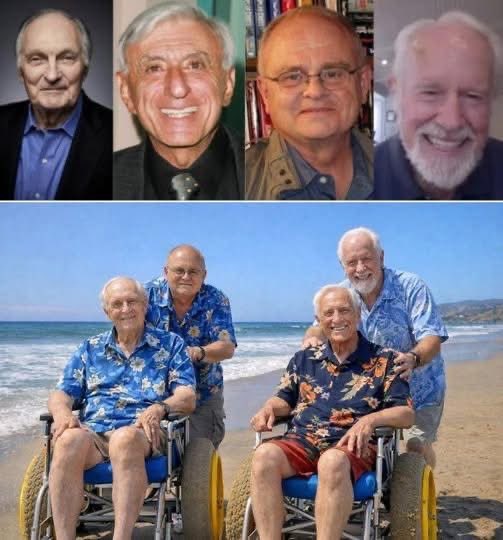
Four Old Men. Two Wheelchairs. One Beach. Alan Alda’s 90th Birthday
January 28, 2026.
Alan Alda turned 90.
His family planned a safe celebration at home.
Cake. Balloons. Grandkids.
Alan said no.
“I don’t want a party,” he said.
His daughter frowned.
“Dad… you’re turning ninety. This is a big deal.”
“I know,” Alan said.
“But I don’t want to celebrate here.”
“Then where?”
Alan didn’t hesitate.
“I want to go to the beach.”
The room went still.
“The beach?”
“Dad, you’re in a wheelchair.”
“You can barely stand.”
Alan smiled.
That smile.
The Hawkeye Pierce smile — the one that always meant something stubborn was coming.
“So?”
By that afternoon, he had already decided who was coming.
“The four of us,” he said.
“The last four.”
Gary Burghoff.
Jamie Farr.
Mike Farrell.
And himself.
The final survivors of the 4077th.
“No cameras. No interviews. No speeches,” Alan said.
“Just us.”
The phone calls began.
Gary answered first.
“Happy birthday, old man! Ninety!”
“Thanks. I need you to drive.”
“Drive where?”
“To the beach.”
A pause.
“Alan… you’re in a wheelchair.”
“So are facts. They don’t stop me either.”
Gary laughed.
That Radar laugh Alan had known for over fifty years.
“Fine. But I’m not pushing you through sand.”
“I’ll crawl if I have to.”
“You’re insane.”
“I’m Hawkeye. Same thing.”
Jamie Farr was next.
“The beach?” Jamie said.
“I’m ninety-one and in a wheelchair.”
“Then we’ll have two wheelchairs at the beach.”
“Like a parade?”
“Like a victory lap.”
Jamie laughed until his voice cracked.
“You haven’t changed since 1972.”
“And you’re still Klinger.”
“Fine. I’m in.”
Mike Farrell sighed the moment he answered.
“Let me guess,” he said.
“You want me to push your wheelchair.”
“Yes.”
“I’m eighty-six. I use a cane.”
“BJ Hunnicutt once saved a man with dental floss,” Alan said.
“You’ll manage.”
Long pause.
“…Fine.”
January 28. 6:00 a.m.
Gary arrived in a rented van.
Two wheelchair spaces.
He was wearing a Hawaiian shirt.
At Alan’s house, his daughter hovered.
“Dad, are you sure?”
“I’ve never been more sure of anything.”
“What if something happens?”
“Something is always about to happen at ninety,” Alan said.
“Might as well happen at the beach.”
Jamie was waiting outside his house.
Wheelchair. Sunglasses.
Hawaiian shirt.
“You coordinated outfits?” Gary asked.
“It’s tradition,” Jamie said.
“The 4077th always matched.”
Mike showed up next.
Also in a Hawaiian shirt.
Four old men.
One van.
Heading west.
On the drive, memories filled the air.
Harry driving too fast.
Larry bringing his own wine.
Radar making everyone cry.
Klinger never sleeping.
When the MASH* theme song came on, no one spoke.
After it ended, Alan said quietly,
“That song used to annoy me.”
“Now?”
“Now it just reminds me how lucky we were.”
At Malibu, reality hit.
Wheelchairs don’t work on sand.
Jamie grumbled.
Mike rubbed his back.
Alan stared at the ocean.
Gary disappeared.
Fifteen minutes later, he returned with two lifeguards and two beach wheelchairs.
One lifeguard whispered,
“My grandmother watched MASH* every night.”
It took time.
Transfers were slow.
Hands trembled.
Bones protested.
But they made it.
To the water.
Alan closed his eyes.
The sound of waves.
Salt in the air.
Sun on his face.
“I forgot what this felt like,” he said.
They talked about the ones who weren’t there.
McLean.
Wayne.
Larry.
Harry.
Bill.
David.
Loretta.
Jamie finally broke the silence.
“Let’s race.”
Two wheelchairs.
Two pushers.
One rock.
They raced.
They tied.
People on the beach stared.
A teenager asked, “What are those old guys doing?”
His mother said, “Living.”
As the sun set, Alan spoke.
“This might be the last time.”
No one argued.
“That’s why it matters,” he said.
“Because we know.”
He made a wish.
“One more year.”
“One more adventure.”
“Korea. Together.”
They promised.
You could move to the Scottish Highlands and get a job looking after sheep and cows to start, ride a heavy bicycle for 22 miles across the Lairig Ghru to visit a woman, drinking heavily as you go, only to arrive and find no one home, then ride back home, but you will not do it.
My name’s Daniel, I’m 45, and two weeks ago I learned something about my mother that I’m still ashamed I didn’t see sooner.
She’s 80, lives alone in the little tan house she’s been in for half a century. The one with the peeling shutters and the mailbox she still refuses to replace because “it works just fine.”
Last Wednesday, she called and said:
“Danny… I need help with my grocery list. Can you come? I think I’m forgetting things.”
My first instinct?
Annoyance.
I had deadlines.
Kids’ activities.
Bills on my desk.
A hundred things pulling me in every direction.
So I said, “Just tell me what you want. I’ll order it all online.”
But she was quiet for a long moment before whispering:
“I’d rather you come.”
So I did.
When I walked into her kitchen, three grocery bags were already sitting neatly on the counter.
“Mom… you already shopped,” I said, confused.
She waved her hand. “Those are just basics. I still need a few things.”
She opened her notebook — the same spiral-bound one she’s used for years — and handed it to me.
The list said:
• grapes
• paper towels
• coffee creamer
• company
And suddenly everything inside me went still.
She looked embarrassed, like a kid caught doing something wrong.
“I just… didn’t know how else to ask you to come,” she whispered. “You’re always so busy, and I didn’t want to bother you.”
That sentence —
those ten quiet words —
hit harder than anything I’ve felt in years.
My mom, the woman who worked two jobs and still made every school concert…
the woman who saved every drawing I ever made…
the woman who put herself last for decades…
felt she had to pretend she needed groceries
just to feel worthy of a visit from her own son.
I hugged her so tightly she laughed and said, “Oh goodness, you’ll break me.”
We never went to the store.
Instead, we sat at the tiny kitchen table covered in little sunflower placemats she’s had since the ’90s.
We talked about the neighbor’s new dog.
About her tomato plant that refuses to grow.
About my dad, and how she still forgets he’s not coming through the door sometimes.
I stayed longer than I planned.
Drank terrible instant coffee.
Listened — really listened — the way she used to listen to me.
Before I left, she walked me to the door and held my hand for a moment longer than usual.
“You made my week, sweetheart,” she said softly.
Driving home, I couldn’t shake one thought:
How many times did she wait by the window, hoping my car would turn into the driveway?
How many afternoons did she tell herself,
“He’ll come when he has time,”
while the house echoed with loneliness I didn’t notice?
I realized that somewhere along the road of adulthood —
work, kids, obligations, noise —
I started treating her like an errand.
Someone to “fit in” when life allowed it.
But to her?
I was never an errand.
I was her world.
And all she wanted
was an hour with her son
in the home where she raised him.
💛 THE LESSON
Your parents won’t always tell you they’re lonely.
They won’t always say they miss you.
They won’t always ask directly.
Sometimes they’ll hide it behind a grocery list.
Behind a broken lamp.
Behind a request that doesn’t really need doing.
Go anyway.
Sit at their table.
Drink the bad coffee.
Let them tell you stories you’ve heard a thousand times.
Because one day the chair will be empty.
The notebook will be closed.
The porch light will be off.
And you’ll wish you had treated an ordinary Wednesday
like the priceless moment it truly was.