More Ukrainian military confirming that Musk stopped Ukraine's drones mid-flight last night.
This was exactly during Russia's massive missile and drone barrage on Kyiv.
The US is fully joining Putin's war.
From Sergei Flash:
You thought utilitarianism was repugnant, wait until you realize that "ordinary discount rates" imply that we should torture galaxies of future people in exchange for an extra lollipop today...
In their book ‘Abundance’, Ezra Klein and @DKThomp argue that we have less—and more expensive—goods and services (especially housing) than we would if we regulated industry less. They blame ‘blue states’ in particular, citing the association between left-leaning cities, more regulation, less housing supply, and high prices.
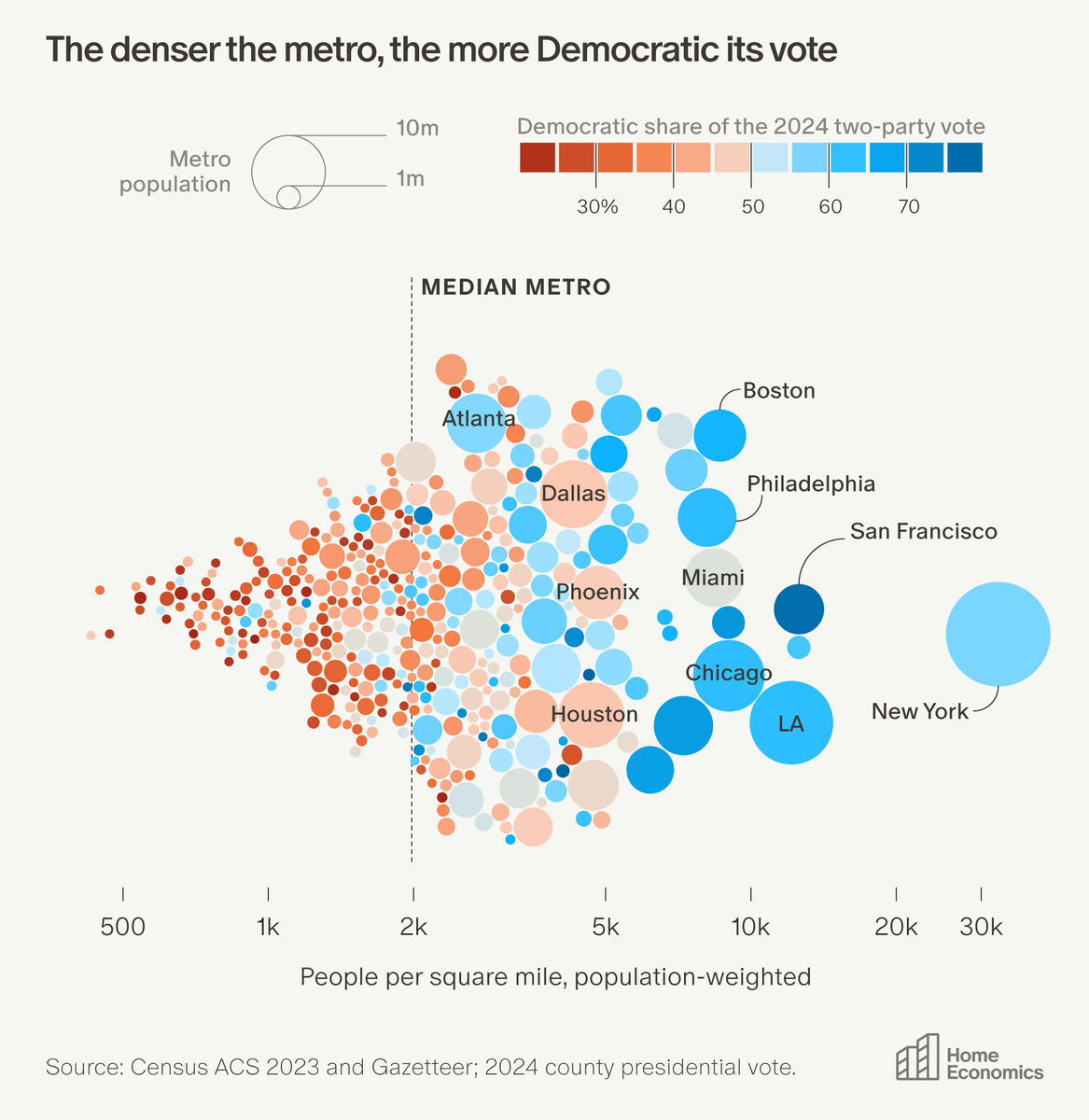
I think what Klein and Thomson are mostly picking up on is the nature of dense cities: they require more regulation than sparsely populated places, and they are more costly and difficult to build in. They’re also predominantly left-leaning.
But the causal association is between density and the difficulty of building, not democratic politics and the difficulty of building. As the chart below shows, the two are easily confounded because there is a strong association between density and politics.
https://t.co/dGpKPOa09S
Progressive urbanists have various attitudes toward cars, but the thing that unites them is that cars (whether electric, driverless, or whatever) are a wildly inefficient use of scarce urban space. So if you want a dense city to succeed, transit, cycling etc must succeed. 6/
I have long been very interested in the question of whether men like smart women. As in romantically like. What a pleasure that very kind people at @the_point_mag allowed me to muse on this--at length.
"they’d love to see the US frontier labs immolated by the industrial strategy of America’s principal geostrategic rival"
Once again, the main AI companies in China have so far been financed almost entirely by private capital and the Chinese authorities still seem distinctly not AGI-pilled, so what exactly is this even about?
I just asked ChatGPT and, even taking a broad view of subsidies, subsidies for model development seem to be similar in China and the US in absolute value. It's larger in relative terms in China, but that's just because US companies spend a lot more on model development.
That's not even taking into account export controls on advanced chips, which are a massive implicit subsidy to US companies, while it takes into account Chinese subsidies that were only put in place in response to export controls.
To the extent that Chinese open-weight models threaten capital expenditures by US companies, there is no evidence that it's driven by any "industrial companies" at the moment.
The evidence suggests that Chinese companies just adopted the open-weight model because they're still lagging behind and, given this fact, they see it as a good commercial strategy.
We don't know whether they are right and whether they will be able to get a return on their investment with that strategy or even whether they will continue to release open-weight models if/when they catch up anymore than we know whether the closed model will be economically successful.
But there is no reason why US companies should be protected from competition by Chinese companies on the ground that we have to protect their capital expenditure.
People seem to think that AI companies somehow have a right to preserve their economic model even if it turns out not to be viable, whether because of Chinese competition or for some other reason, but I don't see why they should.
The truth is that AI is a new technology and we don't know who will be able to capture the value it will generate or how they will do it and, in the absence of evidence that a particular economic model is only failing due to unfair competition, the state shouldn't step in to protect a particular economic model that for all we know could simply not be viable.
If people who invest in AI companies can't earn a sufficient return for whatever reason, they will stop investing in them and those companies will fail, which is exactly as it should be and the same as what happens in any other industry. That's just how capitalism works.
The technology will not be lost and even R&D will not stop, though it will likely slow down unless people find another economic model that is better able to generate returns, but again that's how it should be because continuing to pour money into investments that can't earn a sufficient return is just resources misallocation and will harm the rest of the economy.
Maybe there is a market failure argument that the state should finance R&D on AI, similar to how people argue for public support for fundamental research, but that's not an argument for reducing competition by imposing legal restrictions on Chinese open-weight models and protecting the returns of private investors.
Investors don't have a right to have their returns guaranteed by state intervention if they invested in companies with a non-viable economic model, should it turn out to be non-viable, on the ground that their returns are threatened by China's "industrial policy" when so far there is no evidence that such a policy exists, let alone that it explains the inability of US companies to generate a sufficient return for their investors.
I don't know what people in the Bay area tech industry think, but I for one don't hate AI. In fact, quite the contrary, I absolutely love it and think it's the greatest thing ever. I'm just tired of this kind of lazy arguments.
The simplest possible fact is this: China has broken a number of theoretical economic taboos, shown that they are wrong, and economics will have--whether it likes it or not-- to adjust to that & revise what it currently holds and teaches.
You cannot treat the most successful economic growth in the history of the world as an exception to the generally valid rules of economics.
Two important facts to keep in mind on China’s mercantilism/trade imbalance
1. Mercantilism delivered (contra the consensus) the highest & longest rate of per capita *consumption* growth (7.6% b/w 1978-2024) of any country in post-war history (@ProSyn piece attached)
1/
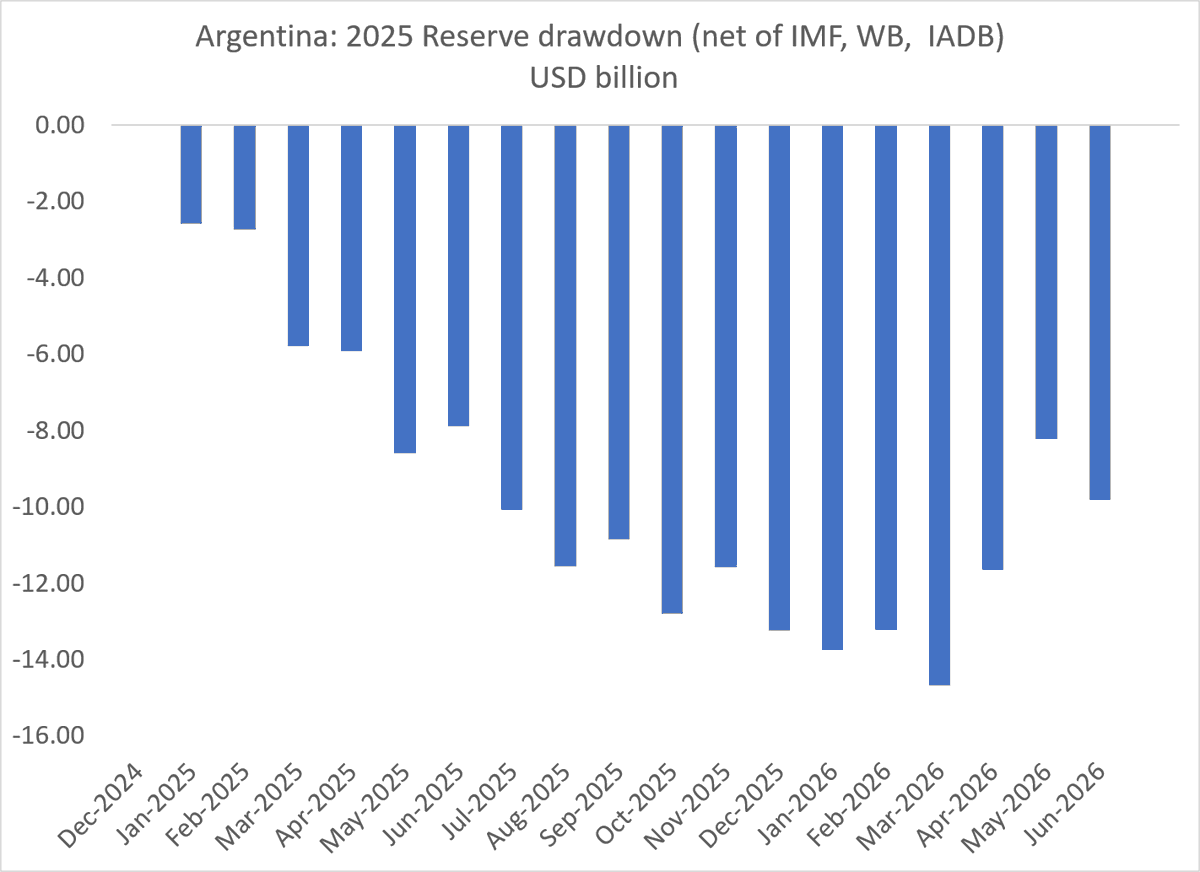
This measure -- reserves net of official flows (what in the old days would be called a bailout but old terms aren't applied to Milei by his friends :) ... ) -- should be back to zero by the end of the year, as election years always tend to generate pressure
5/
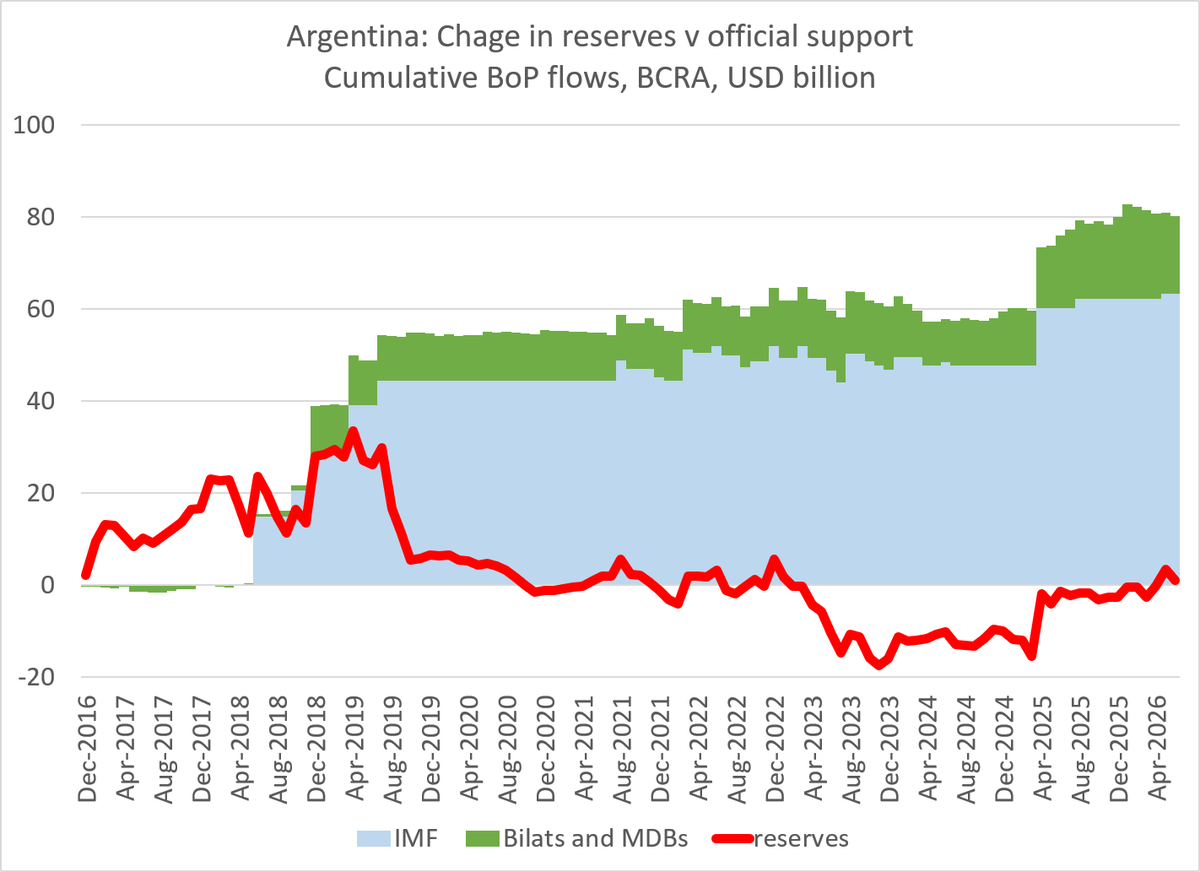
But Argentina for now -- even under a "free market" president -- has been surviving on the largess of the official sector.
Since the end of 2016 Argentina has borrowed $80b from official creditors -- and reserves are unchanged (not good)
2/
New from me:
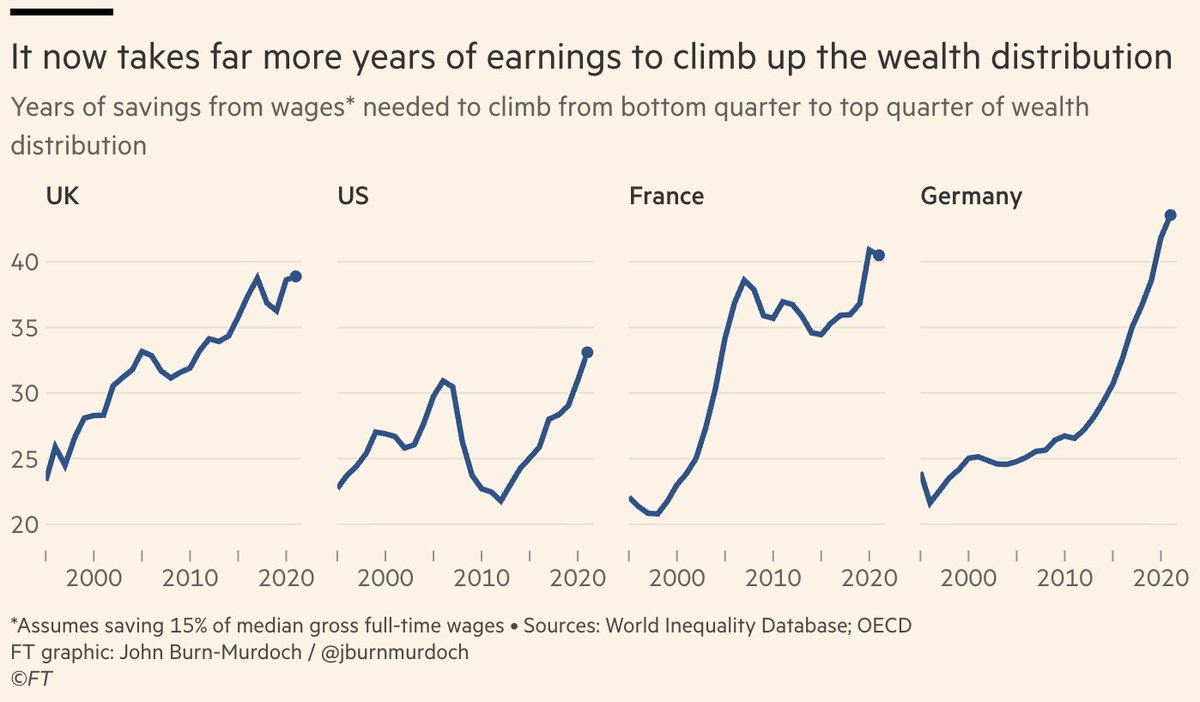
Until recently, the gap between comfortably-off and just-getting-started could plausibly be crossed in a decade or two of hard work.
Growth in asset prices means that’s no longer true.
My column on moving from income world to wealth world: https://t.co/UDmzA8tmPA
The IMF finds “China is backing strategic businesses, like green tech, while the west props up old sectors with political clout, like agriculture.”
In the west, capital disciplines the state to prop up high profits in old industries.
In China, the state creates markets and steers capital towards new strategic industries.
State-capital relations are key in understanding the China-west competitiveness divergence. Real industrial policy is not throwing subsidies at corporations but leveraging and creating public and private capacity towards goals like a green transformation.
Important point that mainstream economists still have trouble understanding. If ROW saves by purchasing US assets, the US must adjust with a higher fiscal deficit or it must adjust in some other way, most likely either in the form of higher household debt or in the form of an economic contraction with higher unemployment.
Rather than try to force down the fiscal deficit, in other words, it would be far more effective (and intelligent) for the US to limit the ability of ROW to save by purchasing US assets.
China's imports of gold knocked 1.4-1.5 pp of its trade surplus in q2!
Net that out, and China's surplus is basically within shooting distance of its pre GFC highs as a share of China's GDP (it will be far bigger as a share of WGDP)
1/
Soon after the war began, I predicted in this article that it would be hard to stop it, because the Iranians would have strong incentives to establish deterrence by exacting a high price on the world economy while the Americans would no want to lose face and are less exposed than most to the consequences of the war.
The main reason why the Iranians think it's important to establish deterrence by imposing a high economic cost is that they can't trust any security guarantees Trump might be willing to give them to end the war and they can't trust them because it's very difficult to trust guarantees by people who murdered your entire leadership in the middle of negotiations and abducted another head of state in the middle of the night.
I say that because, at the time, many very intelligent people explained to anyone complaining about those actions that they didn't understand that foreign policy is easy if you simply refuse to abide by made-up norms and don't hold back. But it turns out that the norms in question were created for a reason and that it's not because people were pussies.
Setser is right when he argues that to get a meaningful understanding of the the balance of payments, gold purchases (when made for investment purposes rather than for jewelry, decoration or art) should be excluded from the trade account and redirected into the capital account.
I had no idea that Brazil has its own central bank-created payments system, used by over 80% of the population, where merchants pay 0.33% per transaction, compared to 1%-4% for Visa / Mastercard / Amex.
If a government can save its businesses a few percent per transaction, and keep the fees in-country, why wouldn't they do it?
"Open-weight models are inherently decelerationist"
You young people do not know, but we went through exactly the same kind of bullshit when linux started to get market shares.