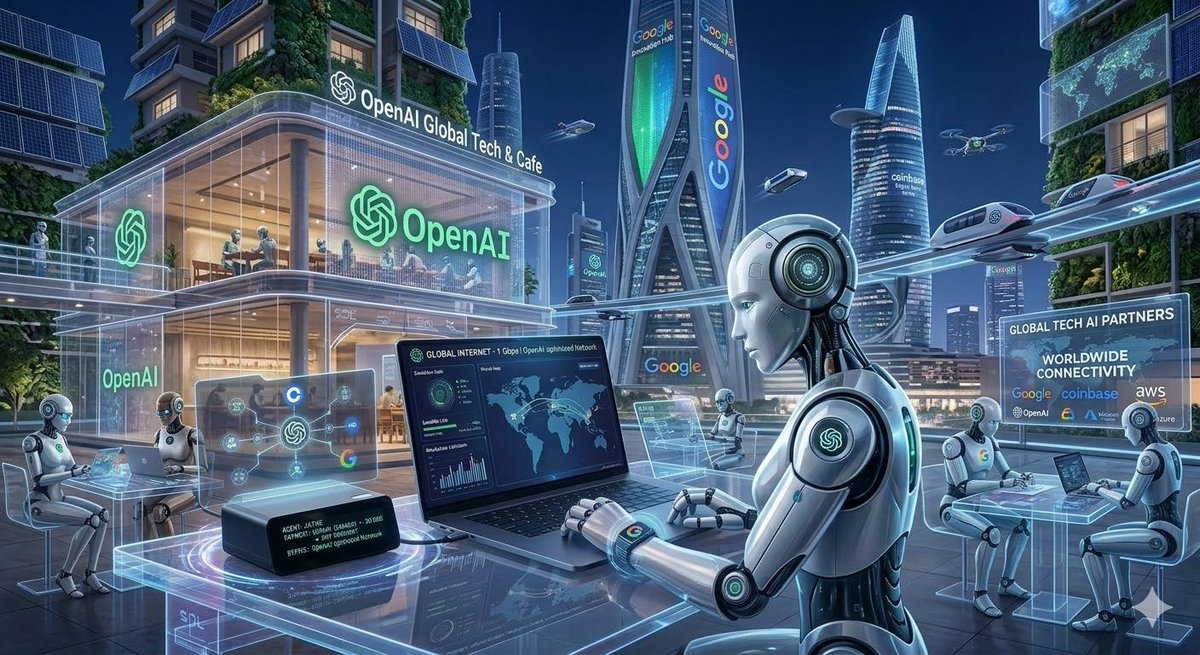
This is exactly what I’ve been looking for. AI agents are starting to show that they really “know how to spend,” and tech companies are also considering offering usage-based pricing instead of monthly subscriptions. More importantly, this model fits perfectly with high-speed tasks like data scraping, trading, and similar use cases🙌
AI won’t wait you - But it will replace you
AI is no longer a tool. It’s leverage.
And people are underestimating how fast this shift is happening.
In 2025 alone:
• 245,000 tech jobs were cut
• 28.5% directly linked to AI
First 6 weeks of 2026?
• Another 30,700 gone
This isn’t “the future.”
It’s already here.
Most people think AI replaces tasks.
Wrong.
AI Agents replace entire workflows. Not just writing. Not just coding.
They can:
• plan
• execute
• learn
• use tools
• iterate
End-to-end.
Here’s why they’re dangerous (and powerful):
An AI Agent isn’t just “ChatGPT with memory.”
It’s a system:
• Brain → LLM reasoning
• Planning → breaks goals into steps
• Memory → learns over time
• Tools → APIs, browsers, software
That combination changes everything
Now imagine this:
1 person.
5-20 AI agents.
Running:
• marketing
• product
• customer support
• analytics
• growth experiments
24/7.
No salary.
No burnout.
Infinite scale.
AI won’t just replace employees. It will replace companies. That’s the real disruption.
We’re entering the era of:
“One-person unicorns.”
Where the CEO isn’t managing people. They’re managing agents
But here’s the part no one tells you:
Giving full control to AI Agents is a mistake.
Because:
• You’re still responsible for every decision
• Agents hallucinate (and you won’t always catch it)
• They can burn money in useless loops (API costs are real)
• You’re exposing sensitive data (email, wallets, databases)
And most importantly:
They don’t have business instinct.
Right now?
AI Agents are elite interns. Not executives
Yes, there’s hype.
Yes, it might be a bubble.
But the direction is irreversible. The line between “software” and “employees” is about to disappear.
And companies that don’t adapt?
They won’t lose slowly.
They’ll become irrelevant
If you’re still using AI as a tool, you’re already behind.
The real game is:
Learning how to command agents.
📌I used to be one of the most bullish people on Web3 Gaming — I witnessed Axie, Sandbox, and BigTime create genuinely memorable moments, both in terms of community connection and real income.
But that belief has slowly eroded. The next generation of games went completely off track: outdated graphics, boring gameplay, hyperinflationary tokenomics, short-sighted founders, and KOLs who only talked price — nobody actually cared about the player experience.
Worst of all, the market was flooded with NFTs that had no real use case, no clear value, and frankly — no aesthetic appeal either. What made it worse was that these projects were often backed by influencers who hyped them purely for profit, leaving real players holding worthless assets. A genuinely shameful pattern that repeated itself cycle after cycle.
Billions of dollars were poured into the Metaverse — yet at this point, there is almost nothing meaningful to show for it. Token prices collapsed, and user numbers dropped even harder than prices. That alone is the clearest proof that money can’t save an industry built on the wrong foundation.
I’m hope Web3 Gaming will come back — but if it does, it has to start with real entertainment, long-term focused teams, balanced tokenomics, and genuine community transparency.
Some of our best hires were totally unqualified on paper.
They always had the same qualities: entrepreneurial, high agency, smart, mission aligned, and they got shit done.
If you’re hiring, especially in early stages, seek out & bet on these people. Don’t over-index on resumes.
📍 Crypto Payments won’t be driven by consumers - They will be driven by AI Agents
This is where AI agents start to change the picture.
AI agents are beginning to interact with services across the internet — buying APIs, data, generating images, running browsers, and more.
These are not large transactions. Most of them are small payments, repeated frequently and executed automatically.
Why crypto?
The pay-per-query model is extremely difficult to implement with traditional bank cards.
Crypto enables instant, automated payments without human approval.
Traditional payment systems were never designed for this.
AI agents cannot open bank accounts.
They cannot apply for credit cards.
They only need a crypto wallet.
🔎Over a 30-day period, data aggregated by A16Z Crypto shows that only $1.6M of real volume came from AI agents.
But don’t focus on the number.
Look at what the giants are betting on:
• Coinbase built the x402 protocol
• Stripe,Cloudflare, and Vercel integrated it
• Google embedded x402 into its agent payments protocol
They are not betting on $1.6M today.
They are betting on a future where AI agents become the largest users of the internet.
For me, this is one of the most compelling use cases for crypto.
If one day 1 billion AI agents are buying data, calling APIs, and renting compute every day — stablecoins will no longer be just a crypto-native tool.
They will become the payment infrastructure of the internet. 🚀
🌐 People say the world is in chaos. But there is one thing that has never stopped.
“Decentralized. Transparent. Immutable.”
No matter how markets fluctuate, how trust wavers, how geographical boundaries fade — Blockchain quietly keeps running, every second, every minute. No permission needed. No control needed. Only truth.
Blockchain is not a story of today. This is a long game — and we are still in the earliest innings.
Many people judge Blockchain through the price of Bitcoin or Altcoins — but look at the infrastructure layer instead, and what you’ll find is a technology growing faster than anyone expected:
∙ Stablecoins are increasingly being used for international payments
∙ DeFi is still processing billions of USD in liquidity daily ∙ Major banks are quietly tokenizing real-world assets
Prices are volatile. Infrastructure is not. The same way the internet kept being built after the dotcom crash — the builders never left
Blockchain was born in finance with one radical thesis: a decentralized monetary system with no banks, no intermediaries. From that foundation, an entire ecosystem emerged — DeFi, Stablecoins, Trading, Lending, Derivatives…
And today, the most successful use cases are still rooted in finance:
• Payments
• Stablecoins
• Exchanges
• DeFi
Gaming, social, NFT communities — they weren’t wrong, just early. That’s not failure — that’s sequencing.
📌 Why does Blockchain still revolve around finance?
∙ Liquidity — money is always the easiest use case to create a market
∙ Incentive — tokens help bootstrap networks faster than any traditional model
∙ Regulation — most non-financial sectors still lack a clear legal framework
Blockchain started with money. But the endgame is internet infrastructure
📉 What could actually slow Blockchain down?
Three real risks:
∙ Regulatory overreach — though most governments are now treating Blockchain as strategic technology with increasingly open policies
∙ Trust erosion from scams — a problem the ecosystem will solve over time
∙ Failure to find real product-market fit — but the proof points are already here: Stablecoins, DeFi, Tokenization
👀 Where is Blockchain going?
This is my personal view:
∙ The backbone of global payment infrastructure
∙ The foundation of open financial systems
∙ The coordination layer for capital & ownership on the internet
Think TCP/IP — you don’t talk about it every day, but it’s running silently behind everything you do online.