Remember that we have continued to reiterate our view that $NBIS ARR will likely come in double current street estimates (maybe more)
Price action over these weeks has nothing to do with the current demand environment or continued rapid execution from management.
Due to popular request to bring our 2030 models in closer before earnings, we will be dropping our full year 2027 Nebius model and targets soon.
We were the first to view hyperscaler deals as anchor contracts for financing and that Nebius should be modelled through a capacity first ground up view point.
If you follow street estimates and models, the vast majority now use that same framework to model Nebius and they continue to adjust their near and long term capacity forecasts to the numbers we were publishing as early last year.
We may not have the distribution of some of the big banks, but we have thousands of pages of reports and thousands of hours of research that is now aiding the street to catch up.
Most of these analysts reactively adjust their models to replicate short term price action, meanwhile our forecasts have only been revised up as Arkady and the team continue to execute at a higher level that we could have imagined.
We aren’t bothered by corrections, we research and display our conviction publicly, even as our targets grow farther apart from near term valuations.
Despite recent market volatility and the AI selloff, $NBIS remains my highest-conviction investment and is once again the largest holding in our portfolios.
It’s rare to find a generational opportunity at the intersection of seemingly insatiable demand, low-cost financing, and management execution that continues accelerating despite the company’s growing scale.
The Street expects roughly $16B in exit ARR for 2027. Following Q2, our full-company model projected approximately $31B. I increasingly believe even that may prove too low.
Management has discussed short-term capacity deals approaching $50M in annualized revenue per MW. If Nebius can capture more of this demand through short-term auctions rather than locking capacity into lower-priced multiyear agreements, revenue per MW could meaningfully exceed our assumptions.
Combined with accelerating capacity deployment, $NBIS could potentially exit 2027 at more than 2x current Street expectations.
I’ve been deploying significant cash from our flagship and active Growth portfolios during this selloff.
Looking beyond 2027, our models suggest $NBIS could surpass $100B in annual revenue by 2030. I increasingly believe even that extraordinary forecast could be exceeded.
Two developments are changing my expectations.
First, Vera Rubin could materially increase the revenue potential of newly deployed capacity, particularly in short- and medium-term contracts. Alongside Nebius’s expanding software stack, including Token Factory and zero-day model support, the company is moving further beyond commodity GPU rentals.
Second, capacity acquisition is accelerating. Much of our original forecast depended on greenfield developments across the US and Europe coming online in 2028 and 2029. Management’s hybrid approach, incorporating brownfield acquisitions, colocation, and faster near-term deployments, could pull substantial revenue forward.
Higher revenue per MW combined with faster capacity deployment creates enormous upside to our existing scenarios. New management announcements continue strengthening the probability of our bull case.
Of course, none of this comes cheaply. Our CapEx forecasts are also substantially above Street expectations. But unlike the financing concerns recently surrounding $CRWV , Nebius benefits from a strong cash position, attractive debt terms, and significant flexibility across debt, convertibles, equity, and potential subsidiary monetizations.
Management has demonstrated an impressive ability to balance these financing sources without compromising growth.
I suspect the upcoming Q3 earnings could be a major catalyst if management provides formal 2027 ARR and CapEx guidance. Both figures could catch Wall Street badly off guard.
The market continues to underestimate not only the scale of infrastructure Nebius is building, but also the increasingly valuable software platform sitting on top of it.
$NBIS remains my highest-conviction long-term holding, and recent volatility has only strengthened that conviction.
Our AST SpaceMobile $ASTS Base forecast has 503.5 Gbps of requested busy-hour traffic in 2030 against 465.8 Gbps of usable capacity. The regional breakdown is more revealing than that global gap.
The U.S. requests 129.0 Gbps against 84.0 Gbps available. The U.K. requests 23.5 against 13.5. Canada has spare capacity in the same calculation, with 12.6 requested against 22.4 available.
We do not assume the Canadian surplus can simply erase the U.S. shortfall. The capacity has to be usable in the right place and at the right time.
After allowing some revenue to remain billable despite constrained usage, our forecast still carries a roughly $717M annual service-revenue gap from these regional limits in 2030.
These are planning assumptions, not an orbital simulation. Their purpose is to keep the revenue forecast connected to what the network could actually serve. Strong demand is valuable, but it only becomes the full revenue opportunity when enough usable capacity reaches those customers.
Our initial results from our $NBIS 2027 modeling are pretty shocking. We really think the street is getting this wrong by one of the largest margins we've ever seen.
Pulling in a lot of recently announced colocation and greenfield capacity.
2027 and 2028 demand environment is looking very certain with the larger owned sites beginning to come online in chunks.
A lot of commentary from GTC Berlin is changing how we look at and model near term and long term capacity allocation.
We think there are real cases where prepayments could pay almost 100% in GPU cost in exchange for lower end of the spectrum revenue per MW pricing (still very high in 6-12 month contracts).
Don't underestimate the importance of this pricing power as capital needs are set to explode higher over the coming years.
Additionally, in light of recent price action and to celebrate the first full year of Northwise Premium and memberships we are considering a sale for new signups.
Members have full access to all of our price targets across the AI infra buildout, our full downloadable models, our full data center tracker features and integrated modeling, as well as both of our portfolios (flagship and newer active growth strategy)
Let me know if there's an interest in this and we will make it happen.
Expect an update and new report soon on Nebius in 2027 before Q3 earnings.
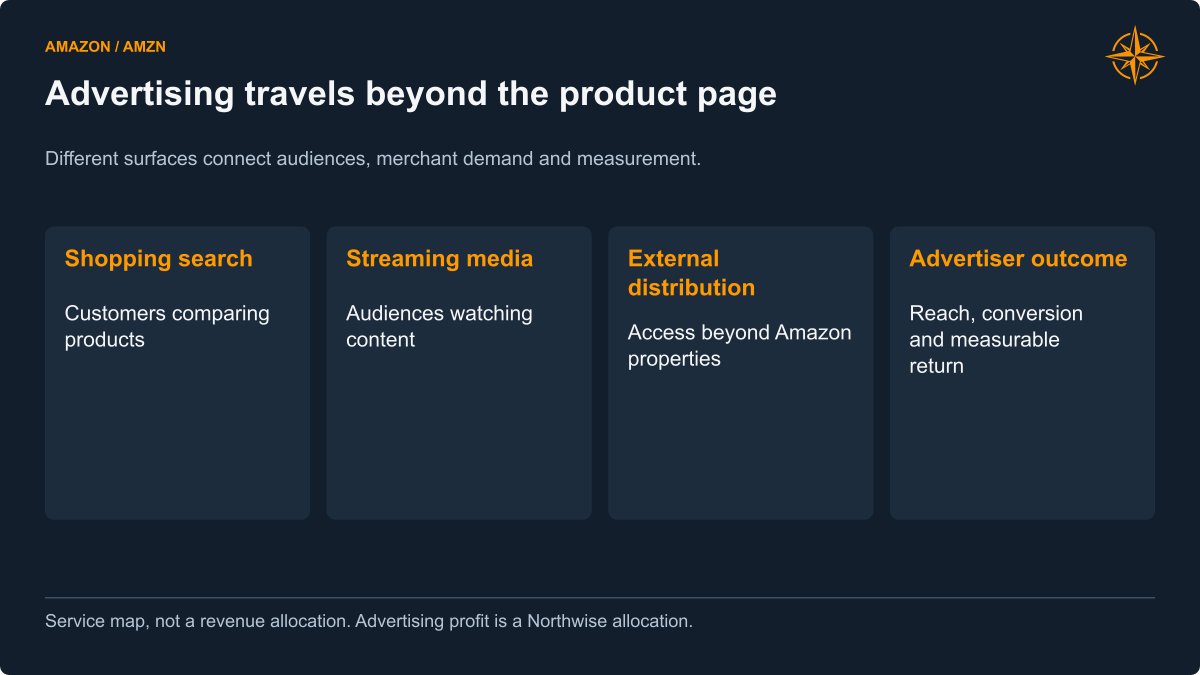
Amazon $AMZN has an advertising advantage when a customer is already comparing products in its store. The advertiser is reaching someone close to a purchase. As Amazon expands across video and external distribution, it reaches more people, but each setting comes with different costs and evidence of effectiveness.
A video audience requires content. External distribution can require sharing economics with a partner. Better campaign tools still have to help the advertiser earn a return. It would be easy to overstate advertising profit by leaving those costs in another part of Amazon.
Our September forecast reaches $185.6 billion of advertising revenue and $81.0 billion of operating income in 2030. Both are Northwise estimates; Amazon does not disclose the standalone margin we use. The attraction is the scale of earnings this business could support alongside a far more capital-intensive cloud buildout. The assumption to keep testing is what Amazon must spend to earn each additional advertising dollar.
Our free operating report follows advertising alongside AWS, commerce, Leo and Zoox:
https://t.co/aSkGoIoXVh
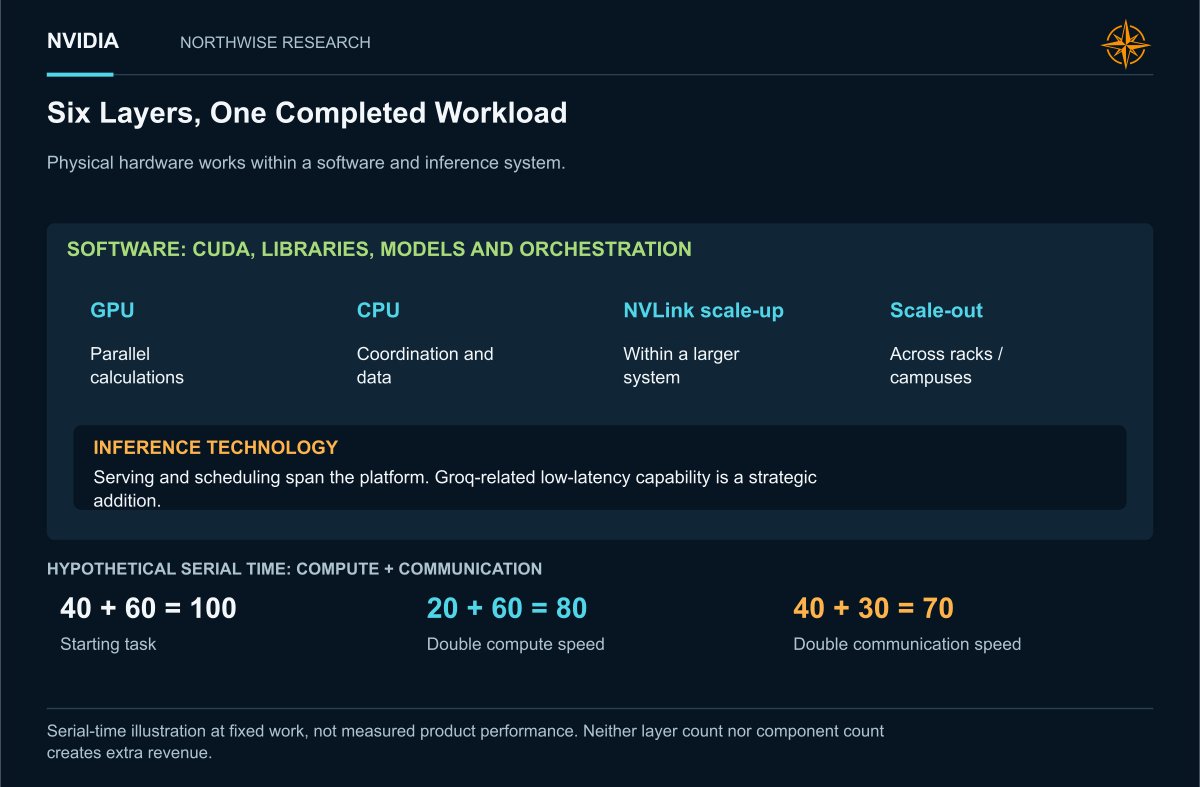
An expensive AI chip earns its keep only when the rest of the system can keep it working.
NVIDIA $NVDA also supplies CPUs, connections between accelerators and networking between servers. Those pieces matter to operators such as Nebius $NBIS and IREN $IREN because time spent waiting for data consumes an expensive asset's earning potential.
We think this is an underappreciated source of NVIDIA's opportunity. Solving the next bottleneck can let the company capture more of a data center's equipment budget, even when a competing chip looks attractive in isolation.
The purchasing test is the cost of completing useful work across the whole system. A faster accelerator alone cannot answer it.
I have been doing some thinking on $NBIS management commentary coming out of GTC Berlin this week.
I think many are hyper focused on the announcement that Nebius plans to bring online a GW of Vera Rubin capacity in 2027. (this is obviously very exciting news for the company.
However, I see it as highly unlikely that this is the only capacity Nebius will be bringing online with the pricing power that other chips are still retaining and with demand remaining insatiable across the board.
Nebius not only appears ready to shatter 2027 ARR and capex expectations, but also potentially capacity expectations as well.
The future of Celsius $CELH increasingly depends on a drink with a different name.
In our forecast, Alani North America supplies about $63 of every $100 of additional company revenue between 2026 and 2030. The Celsius brand in North America contributes about $17. That makes Alani's ability to turn popularity into a lasting purchasing habit central to the investment case.
We also expect the larger business to keep spending heavily on manufacturing, freight and marketing. Across the projected revenue increase, roughly a quarter becomes additional normalized operating profit after all operating costs.
We see room for substantial earnings growth with a steadier Celsius brand and a much larger Alani. That view also makes us demanding about Alani's performance: a strong core recovery would only partly offset a serious slowdown in the business expected to supply most of the growth.
A fast-growing subscription business can finish December looking much larger than the revenue it earned during the year.
For Meta $META's Muse agent, our October 9 Base model reaches a $3.95B annualized pace at the end of 2027. Organic subscription revenue actually earned during 2027 is $2.13B.
December's subscriber base was not there in January. We model the ramp month by month, including conversion and cancellations, so customers only contribute revenue during the months they pay.
The Pepsi partnership helps Celsius $CELH get its energy drinks into stores across the country. When I think about what that reach is worth to a common shareholder, I have to follow the earnings through the partnership too.
Pepsi owns preferred shares that receive a regular dividend and also participate in earnings before conversion into common stock. A larger consolidated profit therefore has to be allocated before calculating what belongs to ordinary shareholders.
In Northwise's 2030 forecast, about $1.05 billion of normalized net income leaves roughly $866 million for common shareholders after those preferred claims. The participation amount is an earnings allocation, not a second cash dividend.
I remain interested in the growth opportunity after allowing for those claims. This is also why I want the ownership terms beside the revenue forecast: they determine how much of a successful business reaches each share.
AMD $AMD can deliver much of the hardware investors expect and still earn less if customers negotiate better prices. Manufacturing costs do not automatically fall when the selling price does.
We tested that in the September 23 model. Cutting GPU selling prices 15% below the reference path, while keeping unit costs unchanged, reduces weighted 2030 revenue from $347.84B to $314.76B. Free cash flow falls from $90.13B to $68.59B, a reduction of about 24%.
Those are weighted results across all sixteen modeled outcomes, not the standalone Base case. The chart also shows separate memory-cost, shipment, delay and operating-cost tests. Their effects should not be added together; the combined case has its own assumptions.
This is why our bullish view needs evidence on realized prices and costs as well as shipment volumes. A large market can support a large supplier without delivering the cash economics shareholders expected.
The operating analysis and stress tests are free to read here: https://t.co/PrFjhNounw
A lower monthly payment can be attractive economics for AST SpaceMobile $ASTS if the customer uses much less of its scarce satellite capacity.
Our starting U.S. assumptions give AST $3.80 per month for an add-on line using 0.35 GB, versus $1 for a bundled line using 0.035 GB. These are wholesale modeling assumptions, not disclosed contract prices.
The add-on earns 3.8 times as much per line but consumes ten times the data. The bundle therefore produces about 2.6 times as much revenue per GB before costs.
That helps explain why broad inclusion in a carrier plan could be valuable. Many customers may pay indirectly for occasional coverage outside the terrestrial network without becoming heavy users.
We think product mix deserves as much attention as the headline subscriber count. Adoption, usage and wholesale price have to work together. A popular service can still disappoint economically if usage grows much faster than the revenue earned from each line.
Amazon $AMZN has a direct-to-device satellite opportunity within Leo, aimed at connecting compatible devices without a dedicated broadband terminal. The potential population of devices is enormous. Turning that population into revenue requires a commercial arrangement as well as working coverage.
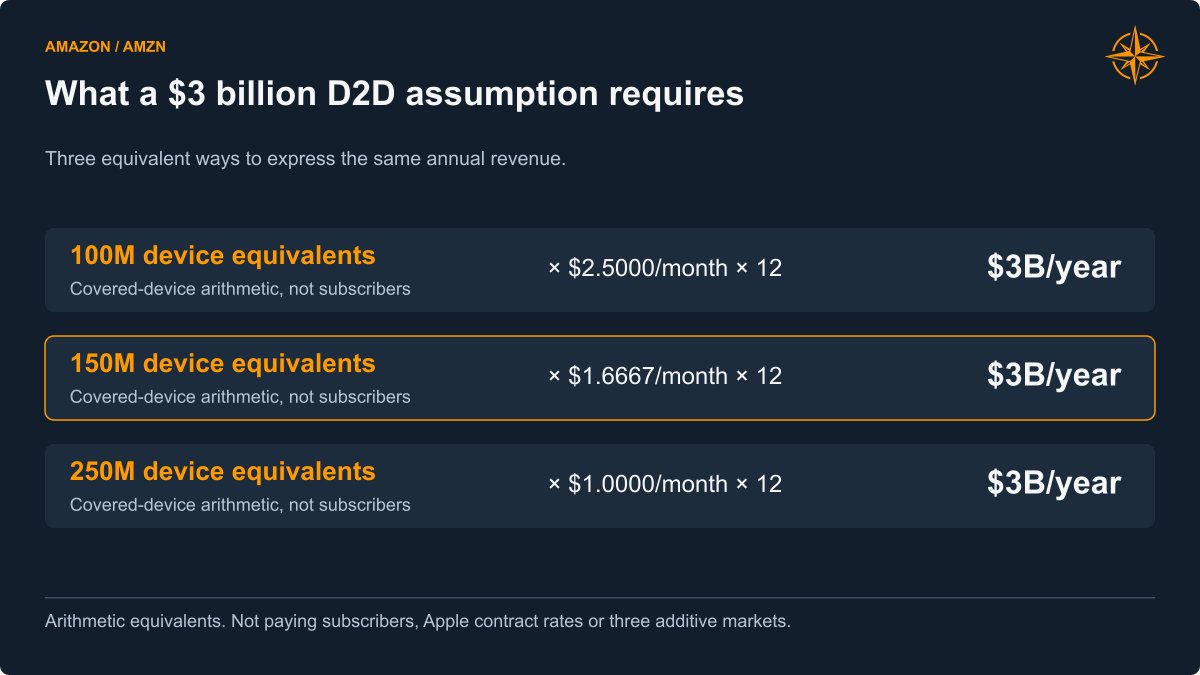
Our September model assumes $3 billion of annual revenue from these new services in 2030. One way to understand its scale is 150 million covered-device equivalents at about $1.67 a month. The chart shows two other combinations that reach the same total.
Those are arithmetic equivalents, not subscriber forecasts or disclosed Apple payment rates. We do not know the contractual economics needed to claim that each covered phone produces that monthly amount.
Putting the assumption in these terms makes it easier to challenge. Coverage, adoption and the amount retained per device each have to support the revenue. A large installed base supplies a possible market; it does not supply the price.
One store carries two Alani flavors. Another has a full range and a cold slot where shoppers can see it. Both carry the brand, but their sales potential is very different.
We think much of Alani's next phase of growth sits inside stores it already serves. For parent Celsius $CELH, high weighted distribution leaves plenty to prove: the measure weights stores by their sales importance, without telling us how deeply Alani is stocked or how often shoppers buy it.
We expect a wider range to earn additional purchases. If sales simply spread across more cans while promotions get heavier, we would lower our expectations.
I've been adding to $NBIS during this correction because I think the market is still underestimating the business Nebius is building. The demand matters enormously, but so does the question of who pays for the infrastructure needed to serve it.
That is why I've spent so much time on the asset-light program.
Nebius wants partners to fund and own the data centers and GPUs while it provides the cloud platform, operating standards and customer access. If that works, growth can reach beyond what Nebius can finance on its own balance sheet. Partners supply the heavy capital, and Nebius earns a fee from making their infrastructure useful to customers.
I see that as essential to the longer-term investment case. It could reduce the capital Nebius has to supply for each increment of growth, preserve funding for its own campuses, and add a higher-margin stream of platform revenue. Over time, more of the business could depend on the value of the software and service, with less revenue growth tied to another enormous hardware purchase.
Our conditional 2030 Base case shows what that could mean: about $11.2 billion in annual asset-light revenue, $7.5 billion in adjusted EBITDA, and $4.5 billion in cash available to Nebius after taxes, reinvestment and liquidity needs. That is roughly a 67% adjusted EBITDA margin for the segment. These are modeled outcomes that require strong execution. Management has not guided to these figures, and more than half of our simulated portfolios landed in the lower outcome band.
This connects directly to what I've been discussing recently: higher revenue potential from new hardware, faster deployment through brownfield sites and colocation, and a software stack that gives customers more reasons to choose Nebius. Asset light adds another way to capture that opportunity, provided the economics also work for the partners supplying the capital.
The fee is where the hard questions start. Owners still have to earn an acceptable return after financing and replacing their hardware. Nebius has to keep delivering enough value to justify its share. I wanted to understand how those incentives affect the size, timing and cash generation of the business.
Our new report, The Cloud Someone Else Pays to Build, works through that question in detail, with a separate 2030 asset-light model and 15 exhibits.
Management has provided limited concrete specifics on the program. This is an assumption-driven framework, and I expect us to develop and revise it repeatedly over the next several quarters as contracts, fees and project delivery become clearer.
The entire report is free. The companion Excel workbook is Premium and sits alongside our existing 2030 company model, which remains available.
Full report in the first reply.
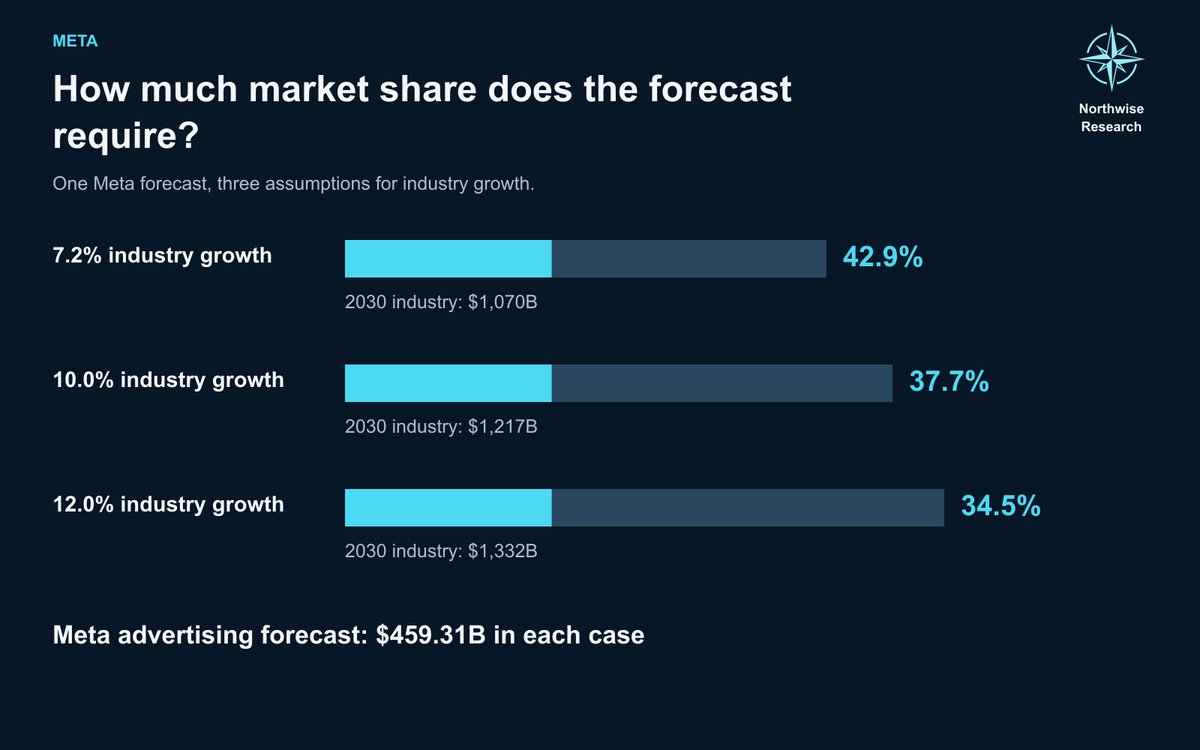
Our October 9 Base forecast has Meta $META reaching $459.31B of advertising revenue in 2030. Put that next to the size of the market and the ambition becomes clearer.
Using the industry benchmark in the report, Meta would represent about 42.9% of global internet advertising if the market grows 7.2% annually. At 12% industry growth, the implied share is still 34.5%.
The definitions do not match perfectly. We use this as a test of scale, not a precise market-share prediction.
We think better advertiser returns can help Meta win spending and expand the market itself. Even so, our forecast requires a substantial share of the industry's incremental dollars. A good quarter is encouraging; earning that position through 2030 requires years of delivery.
NVIDIA $NVDA can sell into the same AI workload through several different customers. A company may buy its own equipment, rent a large cloud's capacity, or use an independent provider such as Nebius $NBIS or IREN $IREN.
We see that variety as an advantage for NVIDIA. It can participate as customers choose different ways to build and run AI. But more equipment buyers do not automatically mean more independent sources of demand. Several providers can still rely on the same small group of AI developers.
That is why we follow the customer behind the customer. A broader route to market strengthens the opportunity. The resilience of the spending ultimately depends on who is paying to use the machines.
@TylerNorthwise This report will be completely free to the $NBIS community!
Members will receive the full downloadable model where they can input and change assumptions in our forecast.