Most people think open-source is powered by passion.
But what if the people actually building the software could be rewarded with real ownership?
That’s the idea behind Invia.
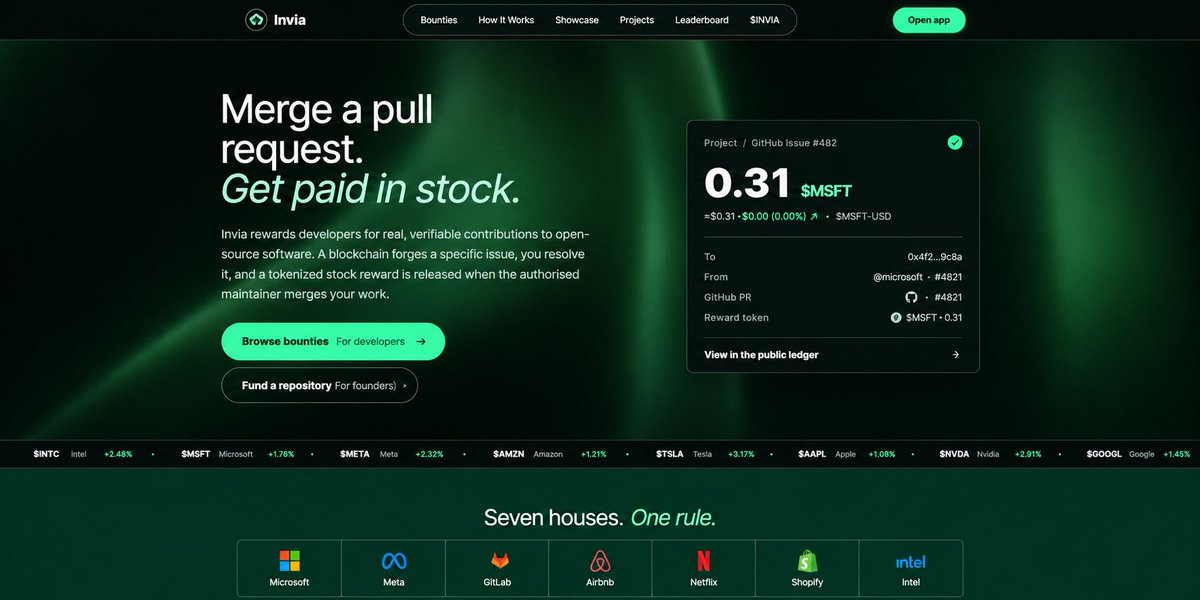
Invia creates a new way for developers to turn meaningful open-source contributions into tokenized stock rewards.
The process is simple:
A repository has a real issue that needs to be solved.
A maintainer funds that issue and sets a fixed reward.
A developer claims the engagement, works on the problem, and submits a pull request.
If the work meets the requirements and the repository’s authorised maintainer merges it, the reward is released.
No guessing based on lines of code.
No artificial scoring.
No reward for simply holding a bigger balance.
The contribution has to be real, verifiable, and actually accepted by the people maintaining the project.
What makes this interesting is the connection between open-source work and ownership.
Developers aren't just contributing code into the void.
Their work can become something tangible.
Invia also puts the process on a public ledger, making settlements and contributions easier to verify.
And the system already showcases engagements connected to ecosystems like Microsoft, Meta, GitLab, Airbnb, Netflix, Shopify and Intel.
The bigger picture is what interests me most:
Open-source software runs a huge part of the internet, but the people creating and maintaining it don't always have a direct path to economic upside.
Invia is experimenting with a different model:
Code → Contribution → Merge → Ownership.
That could create a much more direct relationship between the value developers create and the rewards they receive.
And with $INVIA powering the platform rather than determining the size of individual developer payouts, the focus stays on the work itself.
This is more than another bounty board.
It’s an attempt to build a market around verified open-source contribution.
The question is simple:
What happens when your next merged pull request can become more than just another green box on GitHub?
Maybe it can become ownership.
https://t.co/lHd0QvQrw8