Inworld Realtime TTS-2 and Realtime TTS-2 Flash sit near the top of @ArtificialAnlys's new Time to First Audio (TTFA) benchmark.
The benchmark measures how quickly models begin producing audible speech. In the latest results:
- 𝗥𝗲𝗮𝗹𝘁𝗶𝗺𝗲 𝗧𝗧𝗦-𝟮 𝗙𝗹𝗮𝘀𝗵: 86ms on average
- 𝗥𝗲𝗮𝗹𝘁𝗶𝗺𝗲 𝗧𝗧𝗦-𝟮: 181ms on average
For realtime consumer apps, low latency is as important as speech quality. We’ve made both central to how we build Realtime TTS-2 and Realtime TTS-2 Flash.
Thanks to the Artificial Analysis team for expanding its speech evaluations and sharing the methodology.
See the full benchmark: https://t.co/SUrMbXTxdU
Review the methodology: https://t.co/PCaDycSWOd
Inworld OSS Week starts next week.
We’ll be sharing code, models, and research from our work on voice AI for developers to build on in their own consumer apps.
Stay tuned 👀
Our new Swedish voices have arrived 🇸🇪 And we welcomed them with a tongue twister.
If you grew up speaking Swedish, you probably know “Sju sjösjuka sjömän…” (“Seven seasick sailors”). We gave each voice a turn with the classic, then jacked up the speed to see how they’d do.
Check out how they handled it, and try them yourself in our TTS Playground at https://t.co/4sPcISwHsf
Realtime TTS-2 is now available on @novita_labs!
Bring your app to life with Inworld voices through Novita’s API, with voice cloning and flexible delivery controls.
Start building: https://t.co/7Szc7ilUD9
Our Head of Research, @altsoph, shared an experiment in “breeding” synthetic voices to bring more variety to our TTS library.
He used Inworld Voice Design to generate voices from text descriptions, then had an LLM modify and combine those descriptions based on evaluation results. Each generation was tested for quality and how different it sounded from voices already in the collection.
After 26 iterations, 214 voices passed automated checks, and human assessors selected 12 for the library.
Read the full piece to explore Aleksey’s process and hear some of the voices: https://t.co/1sA23021gm
We just made it easier for your coding assistant to build with Inworld.
Introducing the Inworld AI plugin with 24 skills to help you explore, test, and integrate Inworld APIs from the coding tools you already use.
Start with what you want to build or test:
- “Find a voice for my app and let me hear it on this script.”
- “Transcribe this recording with speaker labels.”
- “Add a realtime voice agent to my app.”
- “Benchmark Inworld inference against my current setup using my app’s requests.”
Try it today: https://t.co/mbQw0MuBIU
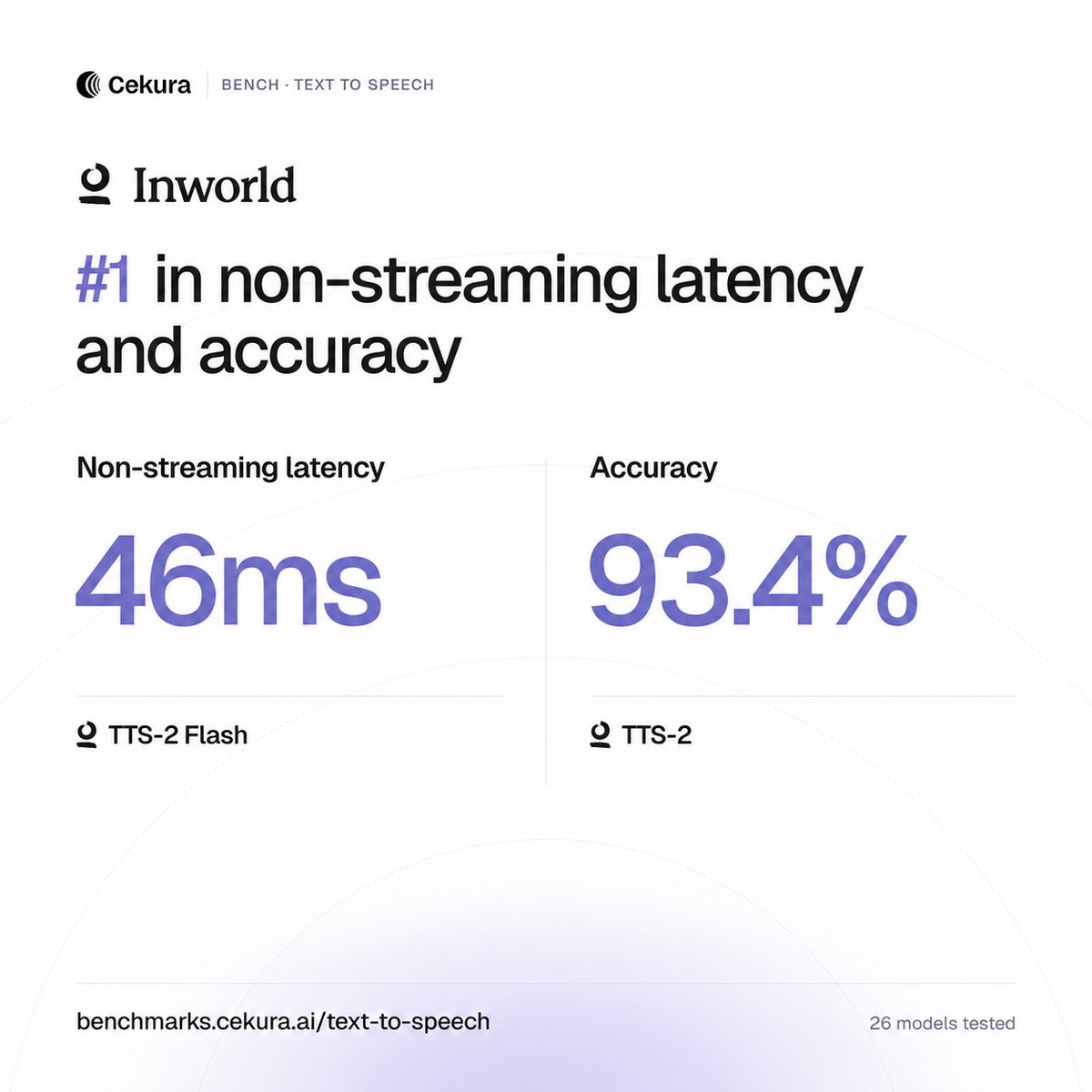
Realtime TTS-2 Flash takes 46ms to start speaking. 93.2% accuracy on hard text on @cekuraai’s new independent voice benchmarks.
Congrats to @tarush_agarwal_ and team on the launch. Better evals help all of us build better voice agents. Who are you building for? 👀
Introducing Cekura Bench: the world’s leading Voice AI Benchmarks
We benchmarked 50+ models from openAi, Google, Nvidia, xAI, Inworld, Gradium, Assembly, Fish audio and more
Now you can:
→ Compare naturalness, performance and cost
→ See how the best voice agents are being built.
→ Find the best fit for what you are building.
Our tests cover Speech-to-Speech models, Speech-to-Text models, Text-to-Speech Models, and Voice Agent platforms. We recorded real humans doing tasks in different domains and created the most representative voice benchmark out there!
Explore the benchmarks: https://t.co/eZAFy7P0Nj
We would love to collaborate with more teams on these benchmarks. Reach out if you are interested.
We ran the same build request on Inworld inference and eight other providers. Here’s how the results came together, side by side.
Check out our optimized models at https://t.co/WfawQUS0j0
On October 23, we brought 50 people together for Backchannel Berlin, an afternoon exploring speech AI and inference (and featured among Luma’s top events for Berlin!).
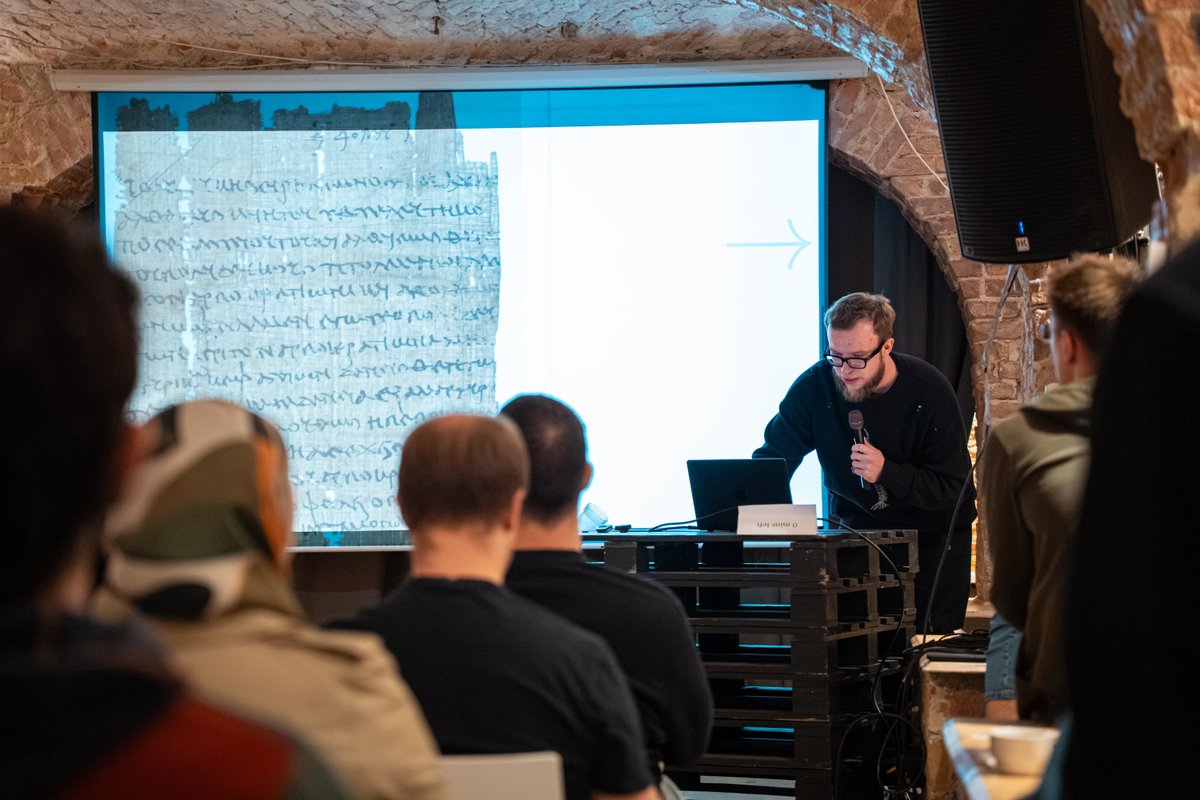
We dug into how to evaluate expressive speech and make realtime inference more efficient. Guest speakers shared their work on full-duplex conversations and using AI to read ancient papyri, before a closing fireside looked ahead to what conversations with AI could feel like in 2028.
We love being part of these conversations with people working at the forefront of consumer AI. Thanks to everyone who shared their research and perspectives. We’re looking forward to hosting more gatherings like this as our community grows.
We’re growing our team here, too. If you’re based in Berlin or elsewhere in Germany, we have remote roles open in ML engineering and research.
Come work with us! https://t.co/LLb0t75qH7
Last month, our Chief Science Officer, Igor Poletaev, sat down with research engineer, Julia Turc, to discuss how expressive voice models are built and evaluated.
Julia’s video explores why speech benchmark scores don’t always reflect what works in a real conversation, and where automated judges still miss things people can hear.
Igor shares how Inworld measures expressiveness and how we moved from broad emotion labels to innovative paths for voice direction in TTS-2.
Watch the video for a closer look at the research behind expressive voice AI: https://t.co/Rg3DTK5tqG
Today we’re introducing Reasoning for Realtime TTS-2, making it the first TTS model in the world that can steer itself based on context.
In consumer apps, your LLM generates every reply. Directing how each one sounds takes extra prompts, tags, and rules.
Reasoning now handles that inside your TTS request. It reads the text and the context you pass, writes a delivery direction, which Realtime TTS-2 performs.
For developers this means:
- Emotion, tone, and pacing shaped by the context of each line.
- No emotion-tag rules to maintain in your chat prompt.
- Fewer LLM output tokens spent writing voice directions.
The generated direction comes back in the API response, so you can inspect it. Your own instructions and inline tags always take precedence.
Available today with Realtime TTS-2. Who are you building for?
We’ve added new voices to the Inworld library, giving developers more accents and styles to choose from.
This video gives you a first listen. Keep an ear out for new additions as we keep growing the collection!
Try the latest voices in our TTS Playground: https://t.co/TbJUKJNU1g
Sat down with the @inworld team to talk through their new TTS-2 model. I was impressed with the natural language voice steering capabilities of the model.
That capability helped us bring Expressive Mode to LiveKit Agents, where the LLM uses the conversation’s context to guide the voice’s tone.
It makes a cascaded voice pipeline sound highly natural. More here: https://t.co/CAxDzhQteJ
Introducing the Inworld Spooktober Challenge 🎃
Build something spooky with Inworld between now and Halloween, October 31. Post a video of your creation, use #inworldvoice or #inworldinfra, and tag @Inworld to enter.
Whichever post gets the most likes wins AirPods Max, $500 in Inworld credits, and Inworld swag shipped to you!
For inspiration, Clint from our team used TTS voice steering to turn a talking teddy bear into something straight out of Obsession. Meet Cuddles.
Gemma 4 31B Fast is live on Inworld Inference.
- Google’s 31B open-weight model, with faster, optimized serving on Inworld’s GPUs
- 256K-token context
- Text and image understanding
- Built-in reasoning mode
Try it with your own prompts: https://t.co/e6MMR6OfOx
MiMo V2.6 Flash from Xiaomi is now on hosted on Inworld Inference:
- Open-weight reasoning model with vision and function calling
- V2.6 family showcased for 3D game development
- 524K-token context
- $0.14 in / $0.28 out per 1M tokens
- Cached input at $0.003, so long conversations stay cheap
Check it out at: https://t.co/lbHK0Ga5Ek
Inworld’s international presence keeps growing. We’re hiring across Europe, with roles in our Science and ML Engineering teams in Germany, Switzerland, Serbia, and the UK.
We’re looking for research scientists and ML engineers to help build our speech models and the inference systems behind realtime AI applications.
If that sounds like your kind of work, we’d love to hear from you.
Explore the roles and come work with us: https://t.co/LLb0t75qH7
Our @livekit partner story explores how Inworld’s speech models and LiveKit’s realtime infrastructure help developers build voice applications that can scale with their users.
Through Inworld’s integration with the LiveKit Agents framework, developers can use pre-built or custom voices alongside their choice of LLM and speech recognition models, with LiveKit handling realtime communication across web and mobile apps.
The accompanying video takes a closer look at expressive delivery, including how TTS-2’s voice steering helped the team bring Expressive Mode to LiveKit Agents.
“Inworld's TTS-2 marks a real step forward in emotionally expressive voice synthesis. When combined with the conversational intelligence of LiveKit agents, it enables interactions that feel genuinely human, responsive, nuanced, and alive in ways that feel natural.” - David Zhao, CTO, LiveKit
Watch the video or read the full partner story for more on our work together: https://t.co/4MTeupx93h
@cekuraAi's new Text-to-Speech Bench tested 26 models across 30,564 requests.
To keep the comparison consistent, every model read the same 104 sentences three times from the same cloud region, with automated speech-to-text scorers estimating reading accuracy.
Inworld stood out for both response speed and reading accuracy. A few results from the evaluation:
- TTS-2 Flash started speaking in a median of 46ms when given a full sentence.
- TTS-2 scored 93.4% on estimated reading accuracy, with Flash at 93.2%, covering details such as phone numbers, dates, codes, and medical terms.
Thanks to the Cekura team for making the methodology and audio samples available so everyone can explore the results and hear the differences themselves.
Take a look at the benchmark and have a listen: https://t.co/8YgjpTrzfT