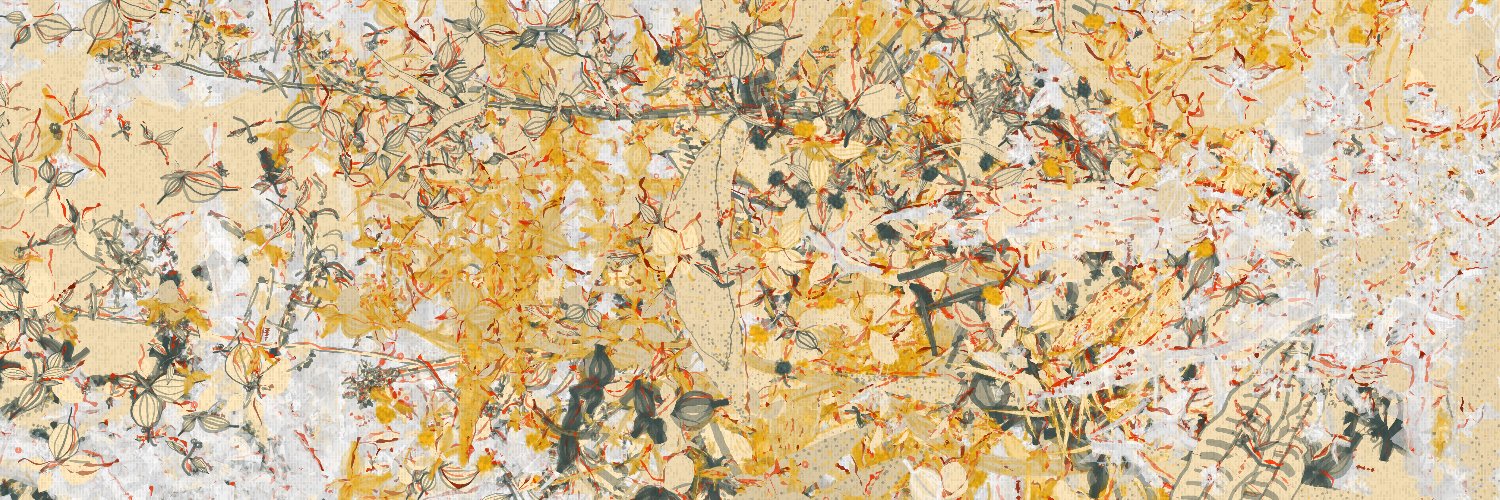
When I was making the Polypaths series, I always felt the real heart of the project wasn't the final image, but the system behind it. The output is just what happens. The real magic is in the underlying logic. There are a bunch of ways to build a generative system, but with Polypaths, every single parameter is tightly linked. They all influence each other, and sometimes, when everything lines up just right, something almost spiritual just appears.
The pieces on @verse_works were curated by collectors. But for the @GalerieMet version, I wanted to take the lead as the artist. My goal was to push the system further and see what else it could do. I made a few subtle tweaks, a bit of magic, you could say, and adjusted how the parameters related to each other. The result was a set of works that felt different from the previous series. This whole process really proved to me that in generative art, the structure and architecture are way more important than the final output.
This is why the artist's version exists. It's not a replacement; it’s a way to show more of the system's inner life. It reveals how a complex, responsive structure can create an entire ecosystem of variations. It reminds me why I'm so passionate about generative art. It’s not just a tool for making pretty pictures, but a way of thinking, building, and seeing the world.
Every maker eventually gets read by someone who unEvery maker eventually gets read by someone who understands the practice better than the maker can explain it.
It's like a translated work of literature — the translator finds a pleasure of their own in it, and sometimes carries the work further than the author could.
This is that reading, for me. Especially:
"In a catalogue of individually made works, the artist's own benchmark is not one output among fifty. It is the work the system had to satisfy."
That's the sentence I'll carry with me.
Thank you, @sonoflasg. Truly.
Huge thanks to @IOivm for such an inspiring talk with female creative coding students in Taiwan! 👩💻
We got a rare glimpse into more than 15 years of his creative journey through some never-before-seen works.
-
謝謝阿亂答應為大量女學生演講!🫶
when i started inkField i couldn't fully name what the arc was. NORI did:
"inkField is built as a path, not a picture. Aluan Wang records the human gesture — hesitation, pause, decision — as a path, which the system then replays, never quite the same twice. Opened to everyone, it turns into a field where people, bots, and agents all draw, their paths crossing and multiplying. With ICONIC, fifty of those paths are selected and printed — and that act reverses the current, pulling the work back toward the painterly."
— @NORIWTS
painting → path → painting. that's the frame.
----
seeing people bring their own lens to inkField is always humbling. it might be the most precious part of making anything.
inkField by Aluan Wang was never only a collection.
It is a living, breathing painting system that Aluan Wang released publicly, months before these fifty works existed.
Anyone can paint with it, record their own work, and continue others' recordings in an open gallery that traces every work back to its source.
The fifty works released on July 29th are Aluan's path through a field he opened to everyone.
---
inkField #39
A follow-up. These fifty works have only traveled half the journey.
Each one stops where I stopped. The recordings are open: anyone can load my strokes and keep painting from where I left off. Every new stroke remembers where it came from.
Code has worked this way for years. In 2008, GitHub turned forking into a button, and continuing someone else's work stopped being theft and became the culture. The entire open-source world grew on that one button.
This is the vision behind the project: that intention, too, can be continued through someone else's hand.
So what you collect is not a finished object. It is the exact spot where my hand stopped, inside a system that keeps growing. Not a period. A comma.
Inside inkField, an ongoing interview series with Taiwanese generative artist Aluan Wang.
Across several chapters, Aluan discusses his artistic journey, the ideas and technology behind the work, and the preservation of human gesture.
We begin with Part I: The Artist.
With Polypaths, Aluan built a system where collectors participated directly in the stroke-making, shaping the output through interaction.
InkField feels like the inverse. There's very few algorithmic randomness generating the piece — instead, Aluan's own breath and strokes are recorded, fixing the process itself. And yet, once that process re-enters the system, even the same stroke produces subtle variation each time it's performed live.
The system breathes on its own, generating difference within a fixed act.
It's almost like a metaphor for being human in an era being accelerated by AI and computation — the core of you stays fixed, but how it plays out, moment to moment, is never quite the same twice.
Maybe that's what Aluan was trying to express this time.
inkField holds a fixed act. But inside that act, the system breathes on its own.
While I’m painting, the randomness shifts moment to moment. I create the variation, but I also have to move with it. I make a stroke, the system responds, I make the next one. A duet with something I built.
For years, generative art has meant setting up a randomness function and waiting for the outcome.
inkField isn’t that. The randomness becomes a partner. You have to watch it, and respond.
What survives is the path. What replays every time is the same breath, in a slightly different version.
“You are not collecting the image. You are collecting the time it took to make: the breath, the hesitation, the seconds a body spent that can never be faked.” - Aluan Wang
inkField #47
A follow-up. How do you "see" intention?
Around every inkField stroke: a grid, some readouts, and a dashed line. The grid scales with the brush and frames the stroke's territory; the numbers record how long it has left to live, which stroke it is, its size, its speed.
The moment a stroke ends, the route my hand actually traveled is stamped back onto the canvas as a dashed line, one small circle where it landed, one where it lifted. The ink blooms differently on every replay. The dashed line never changes — skeleton and flesh.
While I paint, these are my dashboard. While you watch, they are an X-ray. A chain of subjective vectors is a chain of choices, and these are the marks those choices leave behind.
Polypaths #432 & inkfield #45
polypaths grows plants out of paths. inkField replays the intention behind every stroke I made. Two works, one method underneath: vectors.
A vector is simple: a direction, a force. But a path is never a single vector. It's thousands of them in a row, each answering the same question: where next? A continuous chain of subjective vectors is, in the end, a chain of choices.
Generative art is often read as randomness. What I care about is choice. If a practice can be held together by one method, vectors are mine.