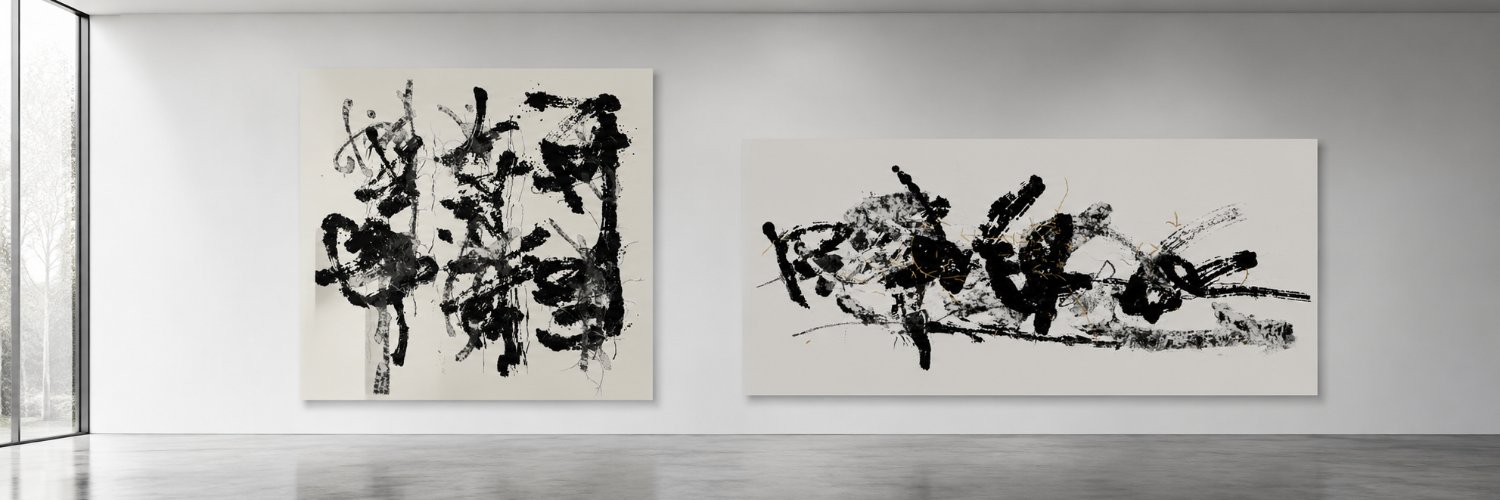
FILE 2375
AFFECT: PERSISTENT POSITIVE MARKER
STATUS: WITHIN EXPECTED PARAMETERS (PROVISIONAL)
"The same yellow face, repeated across the hierarchy like a word the system keeps misspelling."
#WritingCommunity#WeirdFiction@o8odigitalart
Like the tree in the forest, there is no sound from art unless there is collecting and curating on the other side to hear it.
@Maxand98, the collector as composer.
https://t.co/Qf07KxX6Fj
@IOivm I’m SO glad it resonates with you. I put a lot into what I share. The least I can do for work that makes me feel, think… and sometimes… shift my perspective.
It feels like IG broadly is not as far along with this conversation?
RE "why?"... Another things I've thought a lot about... Combination of things at play IMO...
👉🏾 Understanding "intelligence" as a tool.
👉🏾 People Anthropomorphising AI. (Related to the above but worth mentioning separately).
👉🏾The ethical debate.
👉🏾 The "labour as value" debate.
In many ways a very real paradigm shift that society is grappling with.
@MadaCollects@anloremi 100% a feature IMO.
I'm shy of spaces and have some travel coming up, so timing might be tricky, but def happy to jump on a call soon 🤝
An MCP server use case 📖
@maxand98 used the Art Blocks MCP to build AB5D: "a collector-led archive and argument for the cultural significance of early generative art."
https://t.co/jfxjMOGpzg 👇🧵
@mattdesl Congratulations, Matt 🙌🏾.
Wrote a Collector's Statement on one of the Latent Dispatch Studies in December. The paper confirms the periodisation. Addendum: https://t.co/6Qt1ztesZV
Seven months ago I wrote that this piece (𝐿𝑎𝑡𝑒𝑛𝑡 𝐷𝑖𝑠𝑝𝑎𝑡𝑐ℎ: 𝑆𝑡𝑢𝑑𝑖𝑒𝑠, 𝐵𝑖𝑐𝑦𝑐𝑙𝑒, 𝑏𝑦 @mattdesl) was a snapshot of a system before it becomes entangled with the world.
This month DesLauriers published the system. Peer-reviewed, DOI'd, open-sourced. The paper confirms the dividing line: everything after Latent Dispatch... noise, colour, doubt... came after.
"The machine has since learned other hands. It has still never learned mine."
Addendum to the Collector's Statement, now live. Link in 🧵
Collector’s Statement
𝐿𝑎𝑡𝑒𝑛𝑡 𝐷𝑖𝑠𝑝𝑎𝑡𝑐ℎ: 𝑆𝑡𝑢𝑑𝑖𝑒𝑠 (𝐵𝑖𝑐𝑦𝑐𝑙𝑒) 𝑏𝑦 𝑀𝑎𝑡𝑡 𝐷𝑒𝑠𝐿𝑎𝑢𝑟𝑖𝑒𝑟𝑠
My interest in this work begins long before I encountered it. Cycling has been a constant in my life... A way to stay grounded, present, connected to the physical world in a time when so much of modern life drifts into abstraction. I’ve built bikes, photographed them, collected images of them and raised my kids on two wheels. The bicycle has always been more than an object to me; it’s a form of thinking, a way of paying attention, a practice in meditation.
So when I first saw @mattdesl’ Latent Dispatch studies, the Bicycle drawing was an instant hit.
DesLauriers’ project interrogates how machines learn and generalise, how they smooth out the specificity of the world and converge toward archetype. The system he designed evolves single line drawings toward the statistically “pure” form of a thing. In the Bicycle study, that convergence is unmistakable. The machine finds the most recognisable outline: efficient, coherent, undeniably correct. Almost nothing is left extraneous.
And yet, that very correctness reveals a tension. Cycling has always been, for me, a conversation between precision and improvisation: the engineered frame versus the imperfect human body, the clean geometry of the machine versus the lived messiness of the ride. DesLauriers’ piece sits exactly in this same gap. Between the computationally distilled idea of “bicycle” and the lived experience of bicycles that resist averaging.
His recent Substack essay (link in 🧵) clarifies that Latent Dispatch is not a static project but the foundation of his PhD research into representation, entanglement and the politics of machine perception. These Studies capture the system before human interaction reshapes it. Before audience drawings feed back into the training data, before the machine begins to carry traces of other people’s gestures.
Owning the Bicycle study, then, is not just about acquiring a beautiful single line form. It is acquiring a pre entanglement artefact: a snapshot of the system before it evolves, before it absorbs the world around it, before the feedback loop alters what the machine understands a bicycle to be.
In a broader sense, this piece resonates with a cultural moment where AI increasingly dictates how things “should” look. The Bicycle study freezes that process at its infancy. The machine at the moment of certainty, before uncertainty returns through human intervention.
For me, this work sits at the intersection of personal history and contemporary inquiry. It reflects a lifetime spent around bicycles and a fascination with algorithmic drawing. But it also marks a pivotal moment in DesLauriers’ practice: the beginning of a research trajectory that will only become more complex as the system learns from us and we learn from it.
In that way, the Bicycle study is more than a picture. It’s a record of a system before it becomes entangled with the world... The machine draws the bicycle that belongs to no one. Your life is defined by bicycles that belong entirely to you.
This week I presented "Synthetic Gestures: An Evolutionary Sketching Machine" at ACM Creativity & Cognition in London —
the pictorial explores some of my recent research on CLIP-guided and gradient-free optimisation of plotter trajectories for gen art.
https://t.co/OXkU93rG1x