Humanoid robots may soon be everywhere around us, so rebuilding their AI from scratch for every new task would be a poor use of resources.
The more tasks we expect them to handle, the less sense it makes to rebuild the intelligence behind capabilities.
Microblog by @antgrasso
A robot foundation model changes the starting point.
Instead of developing a separate model for every capability, developers begin with a pretrained model that has already learned patterns that can transfer across robotic tasks.
What can be reused depends on the model. It may already contain representations that help the robot understand a scene or decide how an action should proceed.
Take a warehouse humanoid.
The base model may already help it recognize boxes and understand an instruction such as moving an item from one location to another. Adapting the robot to another warehouse may then require less task-specific training than building that capability from zero.
Now move the same idea to a factory.
The robot may face different parts or movement constraints. The foundation model provides the base, while additional training and configuration adapt the behavior to that environment.
The same principle can support new tasks on the same robot. A system adapted to move containers may later be trained to inspect components without replacing the underlying model.
But reuse does not mean plug-and-play.
A different robot may have different sensors or physical limits. Safety requirements can also change with the task. The model still needs adaptation and testing before the robot can operate reliably.
Every new capability does not have to begin from an empty page.
A robot foundation model lets developers reuse what has already been learned and spend their effort on what is different about the next task.
#Robotics #FoundationModels
Trust weakens when words, actions, and presence lose coherence under pressure and uncertainty.
The trust of others remains one of the foundations on which leadership stands, so protecting it through consistency and clarity keeps teams aligned and resilient over time
#Leadership
Turn OT visibility into enforceable protection with Cisco Cyber Vision.
Andrew McPhee shares how Cyber Vision enables you to protect industrial operations at scale.🔐
Learn more about Cyber Vision: https://t.co/m1a7g6zFwy ?ccid=cc002176&dtid=osotwt000013
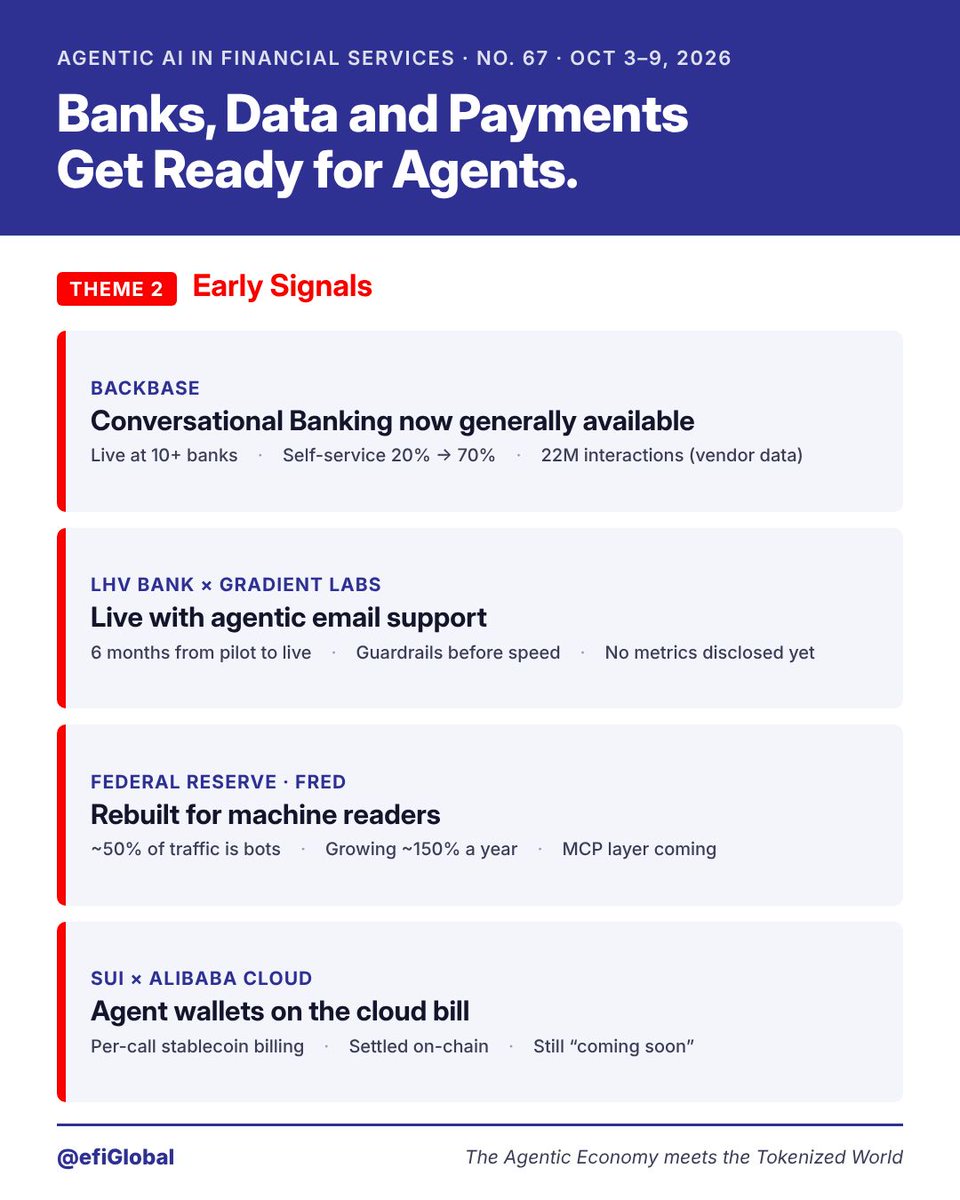
Banks, data and payments are getting ready for agents.
Backbase: Conversational Banking now generally available
LHV Bank: live with agentic email
The Fed: rebuilding FRED, bots now ~half its traffic
Sui + Alibaba Cloud: agent wallets on the cloud bill
https://t.co/vE4RWXhkol
Starlink internet kost 29€/m voor 100Mbps. Mijn BE abo kost 81€/m voor dezelfde bandbreedte.
Mijn gsm kost 24€/m en 32€ voor een maandje eSIM in het buitenland.
Starlink zal dat ganse boeltje danig overhoop gooien. Het worden moeilijke tijden voor internet-aanbieders.🤷🏻♂️👇
Solana is a Layer 1 blockchain built to process transactions quickly and at low cost.
Its Proof of History works alongside Proof of Stake, supporting decentralized finance (DeFi) and digital asset applications such as NFTs and Web3 gaming.
Microblog @antgrasso
As NIS2 requirements take hold across Europe, utilities need to modernize distributed field environments, improve OT visibility, and contain threats without putting uptime at risk.
Join us October 20 for a 45-minute virtual session on the topic.
👉 https://t.co/SuXlOLjJk4
AI agents are powerful because they can act across your business, and dangerous when nobody has designed where they must stop.
This is the real difference between a chatbot and an AI agent.
A chatbot mainly responds.
An agent triggers actions.
By @antgrasso#AIAgents.
Why can you decrypt a message but not a password hash?
Encryption keeps information private while allowing it to be recovered with the right key. Hashing creates a digital fingerprint that a system can use to check for a match.
Connecting these concepts to everyday messages and logins makes the difference easier to understand. This video walks through both examples, giving learners a useful starting point for understanding how information is protected.
Build on these fundamentals with Ascend Education’s CompTIA Security+ course.
🔗https://t.co/HNsltrr2uS
#AscendEducation #CybersecurityEducation #CompTIASecurityPlus #Encryption #Hashing
As we recognize #CXDay, we're reminded that great customer experiences start with strong partnerships. Thank you to our #PublicSector customers whose trust and feedback help us deliver better experiences for federal, state, local, education, and tribal organizations across the country. #MissionReadyWithLumen
Blockchain is known for immutability and transparency, and much of that comes from the distributed ledger, where accepted history is shared.
Several parties can refer to a verified version, making the record easier to check w/out relying on 1 central copy.
Microblog @antgrasso
A distributed ledger keeps copies of the same record across multiple participants.
When a new transaction is proposed, the network applies agreed rules to determine whether it can be accepted. If it is, the update becomes part of the shared history across the ledger.
Changing a past record on one copy does not rewrite what the other participants already hold. They can still verify the agreed history.
This makes accepted blockchain records difficult to alter without the change being detected.
Transparency does not mean that everyone can see everything. Depending on the blockchain, access can be restricted while authorized participants can still verify the history available to them.
A distributed ledger therefore reduces reliance on a single master record controlled by one participant.
Several parties can share and verify the same history without giving one of them sole control over it.
#Blockchain #DistributedLedger