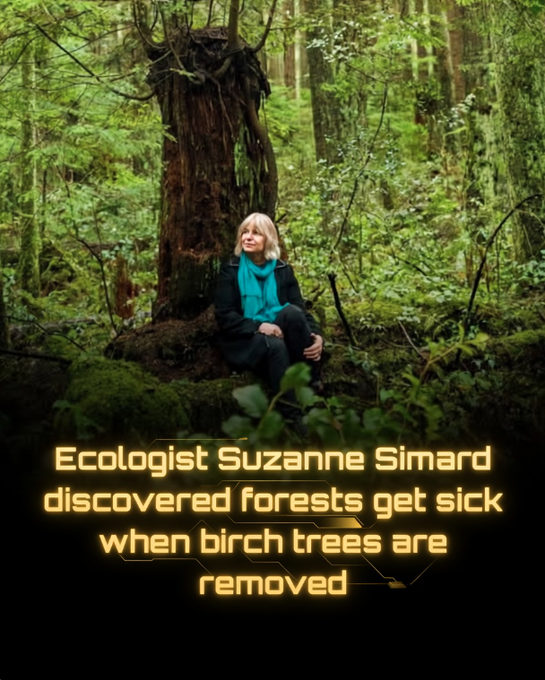
In the 1990s, Canadian ecologist Suzanne Simard made a groundbreaking discovery that challenged everything we thought we knew about how forests work. While studying managed forests in British Columbia, she noticed something puzzling: when birch trees were removed to promote the growth of valuable Douglas firs, the firs did not flourish as expected, they actually struggled and grew more slowly.
Determined to understand why, Simard traced the movement of nutrients using radioactive carbon isotopes. What she found was astonishing. Trees were actively sharing resources through vast underground fungal networks known as mycorrhizae. These delicate, thread-like fungi connect the roots of different trees across the forest floor, forming a complex web that allows the exchange of carbon, water, nutrients, and even chemical signals, sometimes between entirely different species.
She discovered that older, larger trees often serve as central "hubs" or "mother trees," supporting younger saplings by redistributing vital resources and helping the entire ecosystem remain resilient. When these key trees are removed, the underground network weakens, and the health of the remaining forest declines.
Simard’s research overturned the traditional Darwinian view of forests as battlegrounds of ruthless competition. Instead, she revealed a far more sophisticated reality: forests operate as highly cooperative systems where trees communicate, support one another, and even warn neighboring trees about threats like drought, disease, or insect attacks.
What appears to the human eye as a silent, still forest is, in truth, a vibrant, interconnected living network, built not on isolation and rivalry, but on deep connection and mutual aid.
Where did the ancient Greeks fight, whom did they fight, and who won? I mapped all 713 recorded land and sea battles of the Greek city-states and kingdoms, from c. 700 BCE to the last Greek kingdoms. In this thread: the places, the record of every state and the full list. 1/
Lyapunov spectrum of random neural networks
https://t.co/CZHhJajjxX
✍️ @d_g_clark via @arxiv
🗨️ "Working with AI models, I've arrived at what I consider the most significant pure-theory breakthrough of my research (in theoretical neuroscience) so far" - David G. Clark
👉 In this paper, the author calculates the complete distribution of Lyapunov exponents for nonlinear recurrent neural networks with random asymmetric couplings in the infinite-size (N → ∞) limit.
👉 By introducing a finite-N identity that relies on a minimum-norm condition for tangent trajectories and solving the resulting large-N response function via the cavity method, the study mathematically proves that chaos in these network architectures is extensive.
💡 Beyond its value as a pure-theory breakthrough in theoretical neuroscience, this paper serves as a landmark milestone in research methodology by openly crediting its core mathematical derivations to an active human-AI collaboration with the models GPT-6 Astra and Claude 5.5 Opus.
After six years in stealth, Atomic Machines is out. Our mission: on-demand, universal command of matter. First beachhead: the Matter Compiler, an AI-native manufacturing system that builds working micro-machines from code alone. No per-product tooling. No process development. Different code, different machine.
The next era of physics is going to be unreal.
Reality keeps getting weirder
"We have succeeded in moving centimeter scale objects using only the force generated by quantum spin. This is the first time that an object of a size visible to the naked eye has been observed moving due to quantum forces. This achievement represents an important step toward realizing macroscopic quantum superposition and a unified understanding of physics."
Some rumors I've heard. I'll start with Google, then Anthropic and OpenAI.
Google: Insiders say Google has either cracked RSI (recursive self-improvement) or is very close. Their pace has picked up fast in recent months. They went from GPT-5 level to Opus 5.5 level in months, and speculation is that RSI made that possible.
Anthropic: About a week ago, Anthropic started a new pretraining run. It is not Fable 5.5 but what would become Fable 6, or something bigger, to catch up to OpenAI's Bel.
OpenAI: Bel (it may have another codename) is the model behind the math results OpenAI published a few days ago, and RSI apparently helped there too.
From what I'm hearing, OpenAI, Anthropic, and Google are all very close to cracking RSI or already have. It will get scary and exciting at the same time.
💥Al Is Changing the Pace-and Pressure-of Mathematical Discovery
💥Three @MIT computer scientists rushed to publish a major mathematical result after hearing that #OpenAl might soon announce a related Al-generated proof.
➗Their #breakthrough concerned the limits of computation: even when a perfect solution exists, finding an acceptable approximation can remain extraordinarily difficult.
➗The researchers proved a related 4-to-1 games result. They were racing to establish recognition for their work before an Al announcement potentially overshadowed it.
💥"They solved the problem in the old-tashioned way, with their minds, and wrote it with their own fingers." —Ryan O'Donnell, Carnegie Mellon University
💥This raises a consequential question: As Al accelerates discovery, how do we preserve rigorous review, scientific credit, and the human understanding developed through years of experimentation and failure?
"You are human, right? You need to sleep, you need to eat, you have moods," he said.
"You don't know if you're going to get scooped by the trillion-dollar company."
By @benbenbrubaker@QuantaMagazine
👉https://t.co/P98qrYZoU9
#AI #Mathemathics #ComputerScience #GamesConjecture
@Khulood_Almani@pierrepinna@Shi4Tech@Eli_Krumova@drsharwood@EvanKirstel@jblefevre60@HaroldSinnott@Mack1510019@ahier@dinisguarda@ThEiLe0@RLDI_Lamy@Nicochan33@mvollmer1@jeancayeux@Ym78200@amalmerzouk@bamitav@Fabriziobustama@FrRonconii@domingonarvaez1@c4trends@TerenceLeungSF@aure79lien@stanleywaite1 #OpenAI #Research #ResponsibkeAI
#HumanAndAl #Proofs #Academia #FutureOfScience
CREDITS: Prof. Dor Minzer and his students Yumou Fei and Shuo Wang (#MIT) recently rushed to post a milestone result in theoretical computer science, hoping to avoid being upstaged by a rumored Al proof.
Design by Quanta Magazine
NYU math professor Tristan Buckmaster says OpenAI’s Tuesday drop of 722 AI-generated math papers wiped out entire research programs:
“This recent dump of papers on Tuesday destroyed the careers of early career mathematicians.”
@Shi4Tech@drmarkhyman One important detail: The oven temperature isn't necessarily the oil temperature. Food containing moisture often keeps the oil cooler than the surrounding oven air.
For roasting vegetables, chicken, or fish, I would generally recommend 375–400°F with extra virgin olive oil.
@Shi4Tech@drmarkhyman of the healthiest and safest oils for cooking, including sautéing, roasting, and moderate-temperature frying.
There's a common misconception that heating olive oil makes it toxic. That's not true under normal cooking conditions. 🧵
@Shi4Tech@drmarkhyman Extra virgin olive oil is an excellent choice for oven cooking.
Here's my temperature guide:
Oven temperatureRecommendation
300–350°F (150–175°C)Excellent
350–400°F (175–205°C)Excellent for most roasting
🧵
@Shi4Tech@drmarkhyman Dear Shi, coming from a Greek family, where my mom cooked exclusively with olive oil I can tell you that olive oil is not a horrible choice for cooking. Below is ChatGPT's answer to my question as to whether one should cook with olive oil: Absolutely! 🫒 Olive oil is one 🧵