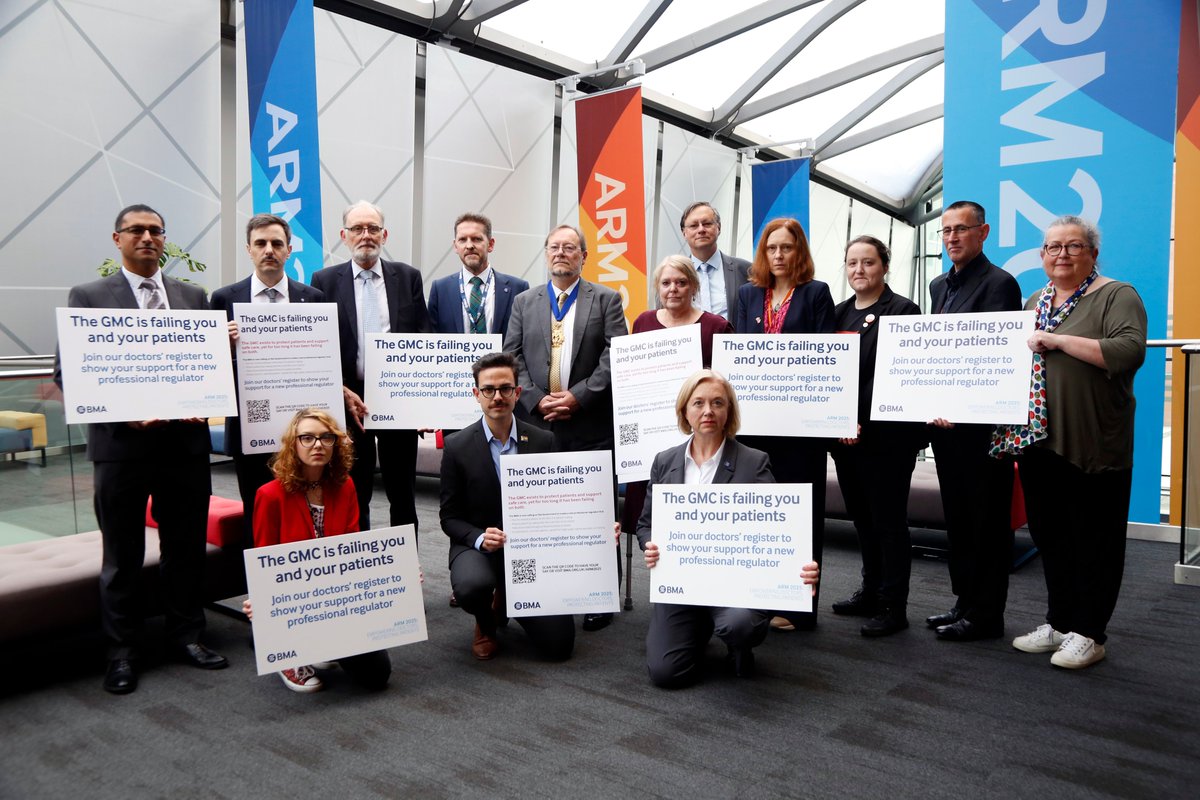
Most doctors now have no confidence in the GMC.
So today we announce the BMA's NEW register for all doctors.
Sign up today to show your support for change. https://t.co/XzxfPv3a6i #BMAARM25
🧵Why is mental health disability rising? Here are key reasons rarely discussed in mainstream media:
1️/ For decades we've neglected tackling the social determinants of societal distress, relying instead on medicalisation as a superficial ‘fix’ for downstream harms. This has...
*New* Consultant #Psychiatrist post advertised *today* - work at the interface of forensic psychiatry and neurodevelopmental conditions as part of an expanded @SLPMentalHealth community team @MaudsleyNHS https://t.co/GZFQxwH6yT
My book “Conversations in Critical Psychiatry” (Oxford University Press, 2024) brings together an edited selection of interviews published in the Psychiatric Times (@PsychTimes) from 2019 to 2022, updated with new and previously unpublished material. These interviews explore critical and philosophical perspectives in psychiatry by engaging with prominent commentators within and outside the profession who have made meaningful criticisms of the status quo.
This volume is the culmination of my pre-Substack era intellectual development with regards to critical issues in psychiatry. It includes interviews with many leading scholars such as Allen Frances, Anne Harrington, Paul McHugh, Nassir Ghaemi, Dainius Pūras, Joanna Moncrieff, Jonathan Shedler, Sanneke de Haan, Nev Jones, and Kenneth Kendler, among others.
Interviewees in the volume (ones on Twitter/X) include: @AllenFrancesMD@JonathanShedler @DrRJChapman @SameiHuda @viscidula@joannamoncrieff@nassirghaemi @SamFellowesHPS @K_L_Nielsen@paulsummergrad@DBDouble@stimimi
eBook/Kindle has been published and is available for purchase. The paperback version will be published on September 20, 2024 in the United Kingdom (available for pre-order) and by the end of November 2024 in the United States.
Book information page on my website: https://t.co/KyAsfGR83g
Features of the book:
* Foreword by Sir Robin Murray
* A detailed introductory chapter, “Psychiatry and the Critical Landscape,” (along with commentary by Sandra Steingard)
* Edited and updated interviews
* Previously unpublished interviews (including mine by @DrGipps & @viscidula )
* Every interview comes with reading recommendations to enhance educational value and facilitate use in teaching
* Relevant materials, such as book reviews, assembled in an appendix
Here are the psychiatric disorders that are most responsive to placebo:
> TOP: #Depression and Generalized #Anxiety
> MIDDLE: Panic disorder, #ADHD, #PTSD, social phobia, #bipolar mania
> LOWER: #OCD, #schizophrenia
From analysis of 90 trials:
https://t.co/Qin4SUAQ6j
We are clear: PA students do not study medicine, PAs are not medically trained, PAs are not medical professionals. We have approached the GMC to clarify its position.
Reflections on the Recent Controversy Around Lithium and Suicide Risk
The weaponization of scientific uncertainty poses unique challenges
https://t.co/y5bBlAnovD
OUT NOW: Multi-kingdom and functional gut microbiota markers for autism spectrum disorder across multiple large cohorts of children
@QiSu_123@Siew_C_Ng
https://t.co/C0A00ulp5Y
@rcpsych@rcpsychNDPSIG@BBCr4today Identifying and treating ADHD must be every psychiatrist's business. So, the real issue is how to enable all psychiatrists to diagnose and treat ADHD now instead of letting people wait many years for "ADHD assessments".