Obsidian + Claude = 24/7 personal operating system
Greg Isenberg just showed how to bridge a local Markdown vault and Claude Code through the Obsidian CLI
this setup solves the context bottleneck:
> /context - loads your projects, schedule, and interests so you stop re-explaining the same details
> /today - pulls calendar slots, tasks, and last week's notes into one prioritized plan
> /challenge - scans old entries and tests your current beliefs against your own history
> /graduate - a command Claude Code wrote for itself, turns daily logs into structured essays
build this tonight and you won't go back to a blank chat window
watch it 👇
Anthropic engineer:
“90% of our engineers were using self-improving loops. Now everyone has shifted to building agentic graphs”
“No more prompting”
In 10 min, she shows her full Claude Code setup and workflow live, starting from a blank terminal.
Worth more than a $500 agentic course
Watch the video
Then save the article below 👇
Instead of watching 1 hour of Netflix tonight, watch this ex-Google Chief Scientist Jeff Dean’s lecture. It’s the clearest explanation I’ve seen of the full AI engineering stack - from building LLMs from scratch all the way to one human coordinating 100 agents.
The best part is that it’s useful whether you’ve never touched a model or you’ve been shipping agent systems every day for the past year.
Bookmark it & watch the whole lecture this weekend, because it might end up being the most valuable thing you learn all week.
The creator of Claude Code teaches more about vibe-coding in 30 minutes than most tutorials do in hours.
Save this — it'll change how you build forever.
Harvard’s AI Research Experience free course book by @pranavrajpurkar covers the essentials and tips on doing research:
- VSCode, Git, Conda
- PyTorch, W&B
- AWS, colab
- LLMs and VLMs
- reading AI papers
- research progress and organization
this is a must read!
It's only been a day since Anthropic dropped Model Context Protocol (MCP) with Claude, like universal plug for AI.
Now AI connects to tools and data insanely easier.
And people can't stop getting creative with it to do your work.
10 wild examples:
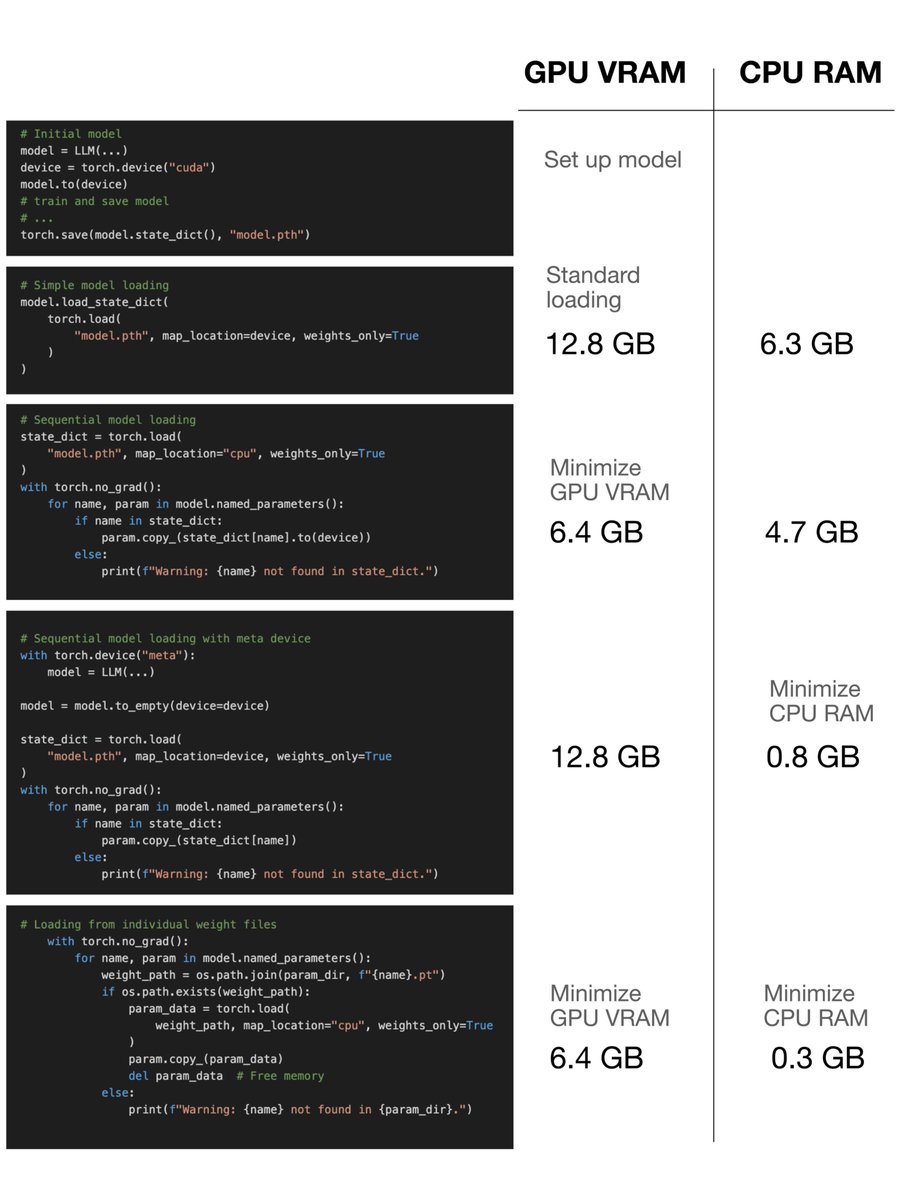
Just put together a short Jupyter notebook with tips and tricks for reducing memory usage when loading larger and larger models (like LLMs) in PyTorch: https://t.co/fEx2e8E7jS
(PS: This is an LLM example but the same concepts apply to any PyTorch model)
Previously, RAG systems were the standard method for retrieving information from documents. However, if you are not repeatedly querying the same document, it may be more convenient and effective to just use long-context LLMs. For example, Llama 3.1 8B and Llama 3.2 1B/3B now support up to 131k input tokens, making them viable alternatives if your hardware can handle it.
In either case, one big limitation of using LLMs for question answering here is their inability to provide citations.
I just read an interesting paper that aims to address (or improve) information retrieval with fine-grained citations, "LongCite: Enabling LLMs to Generate Fine-Grained Citations in Long-Context QA" (https://t.co/bmHDqNVYUt).
In this paper, the researchers use off-the-shelf LLMs to generate a dataset consisting of long-context QA instances with precise sentence-level citations and then use that dataset to finetune an open-weight LLM to generate answers with citations. The resulting LongCite 8B and 9B models are surprisingly good compared to GPT4o, Llama 3.1, etc.
How does this work? Here is the 4-step procedure for generating the dataset for instruction-finetuning:
(a) Starting with long texts or documents, their method uses an existing LLM to generate a Q&A dataset (a query and its associated answer) using Self-Instruct (Wang et al. 2023; discussed in one of my previous posts).
(b) Next, they use the answer to retrieve several 128-token chunks from the input text for coarse-grained citations.
(c) The LLM then looks for relevant sentences within these chunks to provide more fine-grained sentence-level citations
(d) The researchers filter out Q&A pairs where less than 20% of the statements in the answer don't have citations
The resulting dataset is then used to train an LLM in a conventional (SFT) fashion.
Massachusetts Institute of Technology (MIT) is offering free online courses.
No Payment Needed.
Here are 15 FREE courses to become skilled in 2024:
1. Introduction to Computer Science and Programming Using Python.
🔗 https://t.co/IBEbIKj6mM
2. Python for Data Science, AI & Development
🔗 https://t.co/axccEInHBa
3. Introduction to Generative AI
🔗 https://t.co/K68R0iN7Fe
4. Introduction to Computational Thinking & Data Science.
🔗 https://t.co/7gDx8LR2w0
5. Introduction to Statistics
🔗 https://t.co/HKeyRYbSH0
6. Introduction to Artificial Intelligence
🔗 https://t.co/C95Ajy4tlz
7. Machine Learning with Python.
🔗 https://t.co/lZLX9gdgSy
8. Data Analysis with R Programming
🔗 https://t.co/QSGV84cKfa
9. Introduction to Data Analytics
🔗 https://t.co/PuVTSVbIo1
10. HTML, CSS, and Javascript for Web Developers
🔗 https://t.co/02QuXBTh9i
11. Probability - The Science of Uncertainty and Data
🔗 https://t.co/H2v7cDtpe8
12. Google Data Analytics Certificate
🔗 https://t.co/WuoGSOxD54
13. Introduction to Computer Vision & Image Processing
🔗 https://t.co/6CcQX0vfvx
14. Supply Chain Analytics
🔗 https://t.co/lZ9Cz6nVv8
15. Google Digital Marketing & E-commerce Certificate
🔗 https://t.co/d4bQG4G3Ni
16. Databases and SQL for Data Science
🔗 https://t.co/wEEKpQwtFe
17. Fundamentals of Statistics
🔗 https://t.co/I5D7KK91Af
18. ML on Google Cloud Specialization
🔗 https://t.co/p3gg57jQSE
19. IBM AI Engineering Certificate
🔗 https://t.co/H7q70p5LL5
20. Intro To Programming Using Python
🔗 https://t.co/xjeFyHbyZf
21. Neural Networks & Deep Learning
🔗 https://t.co/p8hr9CLJ9i
22. AI For Everyone
🔗 https://t.co/zZ6csxvh7N
23. Intro To Programming In Java
🔗 https://t.co/r7BfFv7W9M
24. Intro To MATLAB
🔗 https://t.co/Zzafq4Ldwm
25. Intro To Computer Science & Programming
🔗 https://t.co/XGXyPt2tMn
26. Blockchain
🔗 https://t.co/UDjYDS89HX
-------------------------------------
Happy Learning 🌟
1. Free Notes PDF: https://t.co/mKUXQ8JcG4
2. Follow @manishkumar_dev for more such content.
#computerscience #datascience #machinelearning
'Challenging mathematical problems with elementary solutions' - Yaglom & Yaglom.
Originally published as 'Neelementarnye Zadachi v Elementarnom Izlozhenii ' by the Soviet Printing House for Technical-Theoretical Literature, Moscow, 1954.
PDF:
https://t.co/yzesi1eyxz




![KirkDBorne's tweet photo. [Download 496-page PDF eBook] Applied Causal #Inference Powered by #MachineLearning and #AI: https://t.co/NPkNAHaB47
————
#ML #DataScience #Algorithms #Statistics https://t.co/Ll3WvLvI8u](https://pbs.twimg.com/media/GWbMucca0AAhW97.jpg)


![heyshrutimishra's tweet photo. 50 AI Tools to Finish Hours of Work in Minutes:
1. Ideas
• Claude AI
• ChatGPT 4
• Bing Chat
• Perplexity
• Better research
2. Images
• Midjourney
• Bing Create
• Leap AI
• Astira AI
• Stable Diffusion
3. Notes
• Fireflies
• Laxis
• Otter
• Notion AI
• Evernote
4. Video
• Runway
• Pika Labs
• Eightify
• InVideo
• Morphstudio xyz
5. Transcript
• Podium AI
• Auris AI
• Rev
• Otter
• Sonix
6. Speech-to-text
• Trint AI
• Audiopen
• Descript
• Otter
• Rev
7. Shorts
• Opusclip
• 2Short AI
• CapCut
• Vidoomy
• Lumen5
8. Design
• Canva
• Microsoft Designer
• Flair AI
• Clipdrop
• Fotor
9. Writer
• ChatGPT 4
• Writesonic
• Jasper
• Copy ai
• Longshot AI
10. Avatar
• Synthesia
• Fotor
• Ready Player Me
• Zepeto
• Vroid Studio
[Bookmark for later]](https://pbs.twimg.com/media/GWcsE3eagAA38Aj.jpg)





