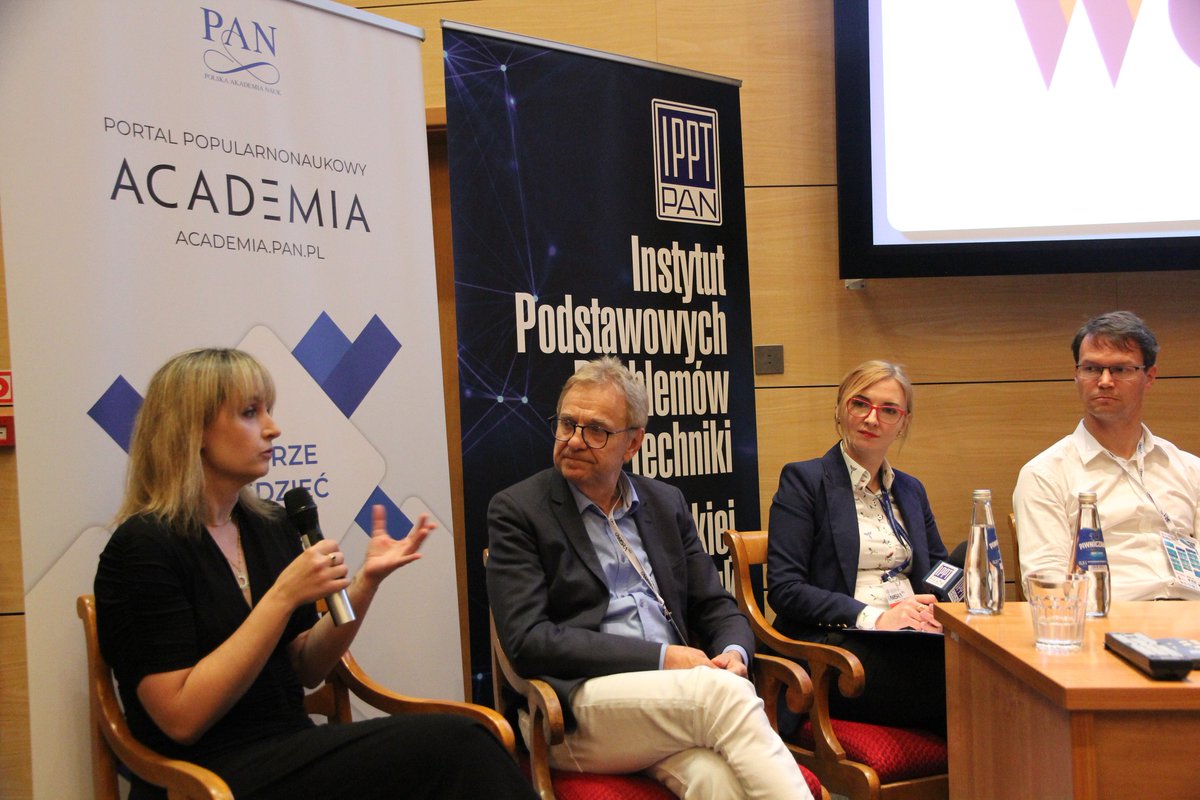
✨ Looking back at AMBRA 2026, held at IPPT PAN - Institute of Fundamental Technological Research, Polish Academy of Sciences, on May 17–21.
Over five intensive and inspiring days, our Institute had the pleasure of hosting researchers, engineers, and experts working at the forefront of advanced materials and technologies for biomedical, environmental, and agricultural applications.
The conference brought together an international community focused on exchanging knowledge, sharing recent results, and discussing future directions in materials science and its real-world applications. From keynote lectures and technical sessions to lively panel discussions and informal conversations in the corridors, AMBRA 2026 was a true space for interdisciplinary dialogue.
📷 We are pleased to share a few snapshots capturing the atmosphere of the event – not only the presentations and speakers, but also the energy of collaboration and scientific exchange that filled the venue throughout the week.
Once again, AMBRA demonstrated that interdisciplinarity is not just a concept, but a daily practice that connects fundamental research with engineering and application-driven innovation.
👏 We sincerely thank all speakers, participants, and organizers for their contributions, engagement, and inspiring discussions that made this conference a success.
Special thanks go to Wrocław University of Science and Technology and the Institute of Low Temperature and Structure Research, PAS, for their cooperation in organizing this event.
We look forward to continuing these conversations and to welcoming you at the next edition of AMBRA! 🚀
#AMBRA2026 #IPPTPAN #Biomaterials #Nanotechnology #AdvancedMaterials #ResearchCommunity #ScienceInMotion #ScienceCommunication
🚀 Touch the future, see the invisible, and explore science through hands-on experiments!
On June 13, join us at the IPPT PAN booth during the Science Picnic at the National Stadium in Warsaw.
🔬 Discover what is hidden inside Pączek the cat
🌡️ Explore the world through a thermal camera
🧬 Build DNA models
🖨️ Scan, model, and print objects in 3D
You will be able to touch, test, build, scan, print, and experiment. Science is not only about equations and laboratories - it is also about technologies that help people, solve everyday problems, and shape the future.
📍 Future Zone (F5 Tent) | 🏟️ National Stadium, Warsaw
📅 June 13, 2026
The booth has been prepared by the IPPT PAN team: Michał Niedzielczyk (Coordinator), Janusz Będkowski, Maciej Zawidzki, Kamil Opiela, Paula Broniszewska-Wojdat, Katarzyna Zielińska, Karolina Stępniak, Magdalena Osial, Paulina Pietrzyk-Thel, Adrianna Nowak, Łukasz Fura, Katarzyna Sendek, Grzegorz Molak, Julia Pietraszek, Rafał Wiszowaty, Błażej Popławski, Anita Orłowska-Gałęzia, Katarzyna Parkitna, Piotr Putek, and Dominik Krzywański.
See you there!
#SciencePicnic #IPPTPAN #FutureZone #Science #Innovation #3DPrinting #STEM
📢 UPDATE: The Seminar of the Department of Biosystems and Soft Matter, delivered by Prof. Thomas J. Webster, scheduled for May 28, 2026, has been canceled.
We apologize for any inconvenience.
📢 Join us at the Seminar of the Department of Biosystems and Soft Matter, delivered by Prof. Thomas J. Webster !
📅 Date: May 28, 2026 (Thursday)
🕧 Time: 12:30
📍 Location: IPPT PAN, the Wacław Olszak Aula on the 2nd floor.
📝Topic: "Eliminating Implant Failure in Humans with Nanomaterials: 45,000 Cases and Counting"
🚀 Science begins with curiosity. Breakthrough technologies begin with the courage to ask questions.
If you want to grow as a researcher, work on ambitious scientific projects, and help develop solutions for the challenges of the future, the Doctoral Schools at IPPT PAN may be the right place for you.
We are looking for motivated and curious candidates interested in research in:
🔹 engineering,
🔹 physics,
🔹 mechanics,
🔹 materials science,
🔹 biomedical engineering,
🔹 computational methods.
Why join us?
✨ international research environment
✨ access to modern laboratories and advanced technologies
✨ collaboration with leading scientists and research institutions
✨ opportunity to contribute to impactful scientific and technological advancements
📢 Applications are now open - join the next generation of researchers at IPPT PAN.
More information:
https://t.co/LCb4qq6HOt
📢 Join us at the Seminar of the Department of Biosystems and Soft Matter, delivered by Prof. Thomas J. Webster !
📅 Date: May 28, 2026 (Thursday)
🕧 Time: 12:30
📍 Location: IPPT PAN, the Wacław Olszak Aula on the 2nd floor.
📝Topic: "Eliminating Implant Failure in Humans with Nanomaterials: 45,000 Cases and Counting"
🤔 Does every thyroid nodule mean cancer? ❓
The data clearly says no - yet many patients still undergo invasive diagnostics and surgery “just in case”.
🎀 Yesterday was World Thyroid Day, a good opportunity to highlight the scale of thyroid nodule overdiagnosis and the challenges of accurate diagnostics. More than 4 million people in Poland are estimated to have thyroid nodules, while thyroid cancer remains relatively rare.
This imbalance means that thousands of patients undergo biopsies, although only a small percentage of nodules turn out to be malignant.
The cost of this caution can be high:
▪️ unnecessary surgeries,
▪️ risk of complications,
▪️ lifelong hypothyroidism,
▪️ permanent hormone replacement therapy and continuous medical follow-up.
👉 At IPPT PAN, researchers from the Department of Ultrasound - dr hab. eng. Hanna Piotrzkowska-Wróblewska and Prof. Jerzy Litniewski with their teams - are working to change this approach.
Their goal is to improve ultrasound-based assessment of thyroid lesions, helping physicians better identify which nodules require further diagnostics and which can be safely monitored.
😀👍 At IPPT PAN, technology does not replace physicians - it helps them see more in ultrasound images and make better-informed clinical decisions.
✨ Can we navigate without GPS?
In a world of autonomous drones and robotic systems, GNSS disruptions make this question increasingly important.
A recent study - “Magnetic anomaly navigation using Particle Filtering and an enhanced velocity propagation model” (Pisarski D., Popławski B., Jankowski Ł., Faraj R.) - explores an exciting alternative: using Earth’s magnetic field anomalies as a natural navigation map.
By combining inertial data, magnetic measurements, and Bayesian-enhanced estimation, the authors significantly improve trajectory accuracy in challenging conditions.
🧠 A great example of how physics-based models and probabilistic AI can make autonomous systems more robust and reliable.
📄 Read the paper:
https://t.co/gKG5W8iH16
Abstract:
An epidemic caused by the pathogen Xylella fastidiosa and known as olive quick decline syndrome (OQDS), has been seriously affecting olive production of various European regions including Apulia (Southern Italy) since 2013, leading to dramatic socio-economic losses.
Current agronomic practices are mainly based on uprooting sick olive trees and their surrounding ones, with later installment of more resistant olive cultivars. Unfortunately, both of these practices are having an undesirable impact on the environment (most of these trees were several hundred years old), and on the economy (e.g., costs of the new installments, the loss of production for some years and, the last but not less important, the oil quality produced by more resistant cultivars may not match the high standards of the previous ones).
Based on a mathematical model expressed in terms of a reaction diffusion-system, it has emerged that a less disrupting and cost-effective practice consists of the removal of a suitable amount of weed biomass (reservoir of the juvenile stages of the insect vector P. Spumarius of X. fastidiosa) from olive groves and surrounding areas, without requiring neither the removal nor the substitution of existing olive trees. Recently Zelus renardii (Hemiptera, Reduviiidae) has been identified as a predator of P. Spumarius for a possible control of a Xylella epidemic.
By a suitable extension of our basic model, it has been shown that, having reported that Z. renardii is a generalist predator, it is not an effective predator.
A relevant contribution of our approach consists of a suitable restriction of measures of intervention (control) only to a subregion of the whole habitat of interest (in accordance to the motto ”Think globally, act locally”).
References
[1] Aniţa, S., Capasso, V., Scacchi, S. (2021). Controlling the spatial spread of a Xylella epidemic. Bull. Math. Biol. 83: 32.
[2] Aniţa, S., Capasso, V., Montagna, M., Scacchi, S. (2022). Predators as a possible strategy for controlling a Xylella epidemic? Math. Model. Nat. Phenom. 7: 279–305.
[3] Beretta, E., Capasso, V., Scacchi, S., Brunetti, M., Montagna, M. (2022). Prevention and control of OQDS (olive quick decline syndrome) outbreaks caused by Xylella fastidiosa. J. Theor. Biol. 542: 111118.
📢 Join us at the IPPT PAN Seminar on Mechanics, honoring W. Olszak and A. Sawczuk, delivered by Professor Vincenzo Capasso
📅 Date: May 25, 2026 (Monday)
🕚 Time: 11:00
🔗 Online: https://t.co/oseSSToxuF
📝Topic: CONTROLLING OQDS (OLIVE QUICK DECLINE SINDROME) OUTBREAKS CAUSED BY XYLELLA FASTIDIOSA
We are excited to share the highlights of MSc. Gustavo Olivos Ramirez’s recent #Erasmus+ training mobility at The Martin Luther University of Halle-Wittenberg (Germany).
Gustavo joined the Laboratory of Integrative Structural Biochemistry, led by Prof. Panagiotis Kastritis at the Biozentrum of the Institute of Biochemistry and Biotechnology. 🔬
During the internship, Gustavo gained experience in integrative structural biology, particularly in cryo-electron microscopy (cryo-EM) workflows and their connection with computational modelling of protein complexes. 🧬
He received intensive training in cryo-EM data processing using the CryoSPARC software, including:
🔹 image processing,
🔹 3D reconstruction,
🔹 model-to-map interpretation,
🔹 cryo-EM map quality assessment.
This was especially useful for understanding how experimental cryo-EM data can be integrated with multiscale molecular dynamics simulations, the main focus of his PhD research. 💻
As part of this training experience, he worked with the fatty acid synthase complex from Chaetomium thermophilum, a megadalton-scale biomolecular assembly of approximately 2.6 MDa. This is the largest molecular system simulated to date using our GoMartini approach!
Congratulations to Gustavo for this successful international collaboration! 👏
Financed by the European Union. This mobility was supported by the Erasmus+ program.
#IPPTPAN #IPPT #ErasmusPlus #Erasmus+ #InternationalCollaboration #EUfunds #Research #EuropeanUnion
AMBRA 2026 starts today! 🔬
3rd International Conference on ADVANCED MATERIALS FOR BIO-RELATED APPLICATIONS - AMBRA is beginning at @ipptpan Institute of Fundamental Technological Research, Polish Academy of Sciences.
The conference focuses on progress in R&D in materials engineering and biomedical, environmental, and agricultural sciences, bringing together researchers and industry partners to exchange knowledge and foster interdisciplinary collaboration.
Key topics include nanotechnology, advanced biomaterials, bioactive materials, implants, tissue engineering, biophotonics, controlled release systems, antibacterial agents, sensing, and nanomaterials safety.
The conference is co-organized by the Institute of Low Temperature and Structure Research, Polish Academy of Sciences, and Wrocław University of Science and Technology @PWr_Wroclaw.
We look forward to inspiring presentations, poster sessions, and discussions that may lead to new collaborations and research projects.
Abstract:
The MAPK/ERK pathway plays a fundamental role in regulating proliferation, differentiation, and survival in response to growth factors. Depending on the cell type, its activation can lead to widely different outcomes. In my thesis research, I demonstrate using computational modeling how this specificity can be achieved via (1) differential expression and regulation of the isoforms (variants) of the pathway's components, as well as (2) their engagement by different scaffold proteins. The mathematical models are implemented in the rule-based environment (BNGL) to account for the pathway's considerable combinatorial complexity due to the large number of regulatory modifications and protein-protein interactions.
📢 Join us at the Seminar of the Department of Biosystems and Soft Matter, delivered by MSc. Paweł Kocieniewski
📅 Date: May 13, 2026 (Wednesday)
🕚 Time: 12:30
📍 Location: IPPT PAN, the lecture hall S3, third floor
📝Topic: Mathematical Modeling of the MAPK/ERK Pathway
✈ At IPPT PAN, we value the opportunity to collaborate with researchers from scientific institutions around the world.
In February and March, Dr. hab. inż. Daria Jóźwiak-Niedźwiedzka completed a research and academic stay at Tohoku University in Japan as a visiting professor.
The visit took place within the research group led by Prof. Tomoya Nishiwaki at the Graduate School of Engineering, Department of Architecture and Building Science, under a scholarship awarded by the host university.
🤝 During her stay, Dr. Jóźwiak-Niedźwiedzka delivered lectures to students and conducted laboratory research focused on 3D concrete printing technology aimed at reducing carbon footprint.
This visit represents an important step in strengthening international collaboration between IPPT PAN and leading research centers worldwide, as well as in fostering knowledge exchange in the field of advanced sustainable construction materials. Future cooperation will continue through joint research projects and the preparation of grant applications.
#IPPTPAN #internationalcollaboration #science #research #materialscience #3Dprinting #sustainability
📢 Join us at the Seminar of the Department of Mechanics of Materials
📅 Date: May 13, 2026 (Wednesday)
🕚Time: 14:00
📍 Venue: IPPT PAN, Aula on the 2nd floor
🎙️Speaker: mgr inz. Mostafa Fathalian
📝Topic: „Interphase modelling in metal-ceramic composites including nanoscale”
🚀 Congratulations to Dr Saketh Virupakshi from the Department of Mechanics of Materials at IPPT PAN for winning the national stage of the ECCOMAS PhD Awards 2025, organized by the European Community on Computational Methods in Applied Sciences (ECCOMAS).
He will represent Poland in the European final, competing with the best PhD dissertations in computational methods across Europe.
His award-winning dissertation, “Micromechanical modelling of voided FCC and HCP polycrystals in inelastic regime”, focuses on advanced micromechanical modelling of porous materials and crystal plasticity, linking microstructure (anisotropy, texture, porosity) with macroscopic mechanical behaviour.
More: https://t.co/qPYEFiKxQ9
👏 Congratulations and best wishes in the European final!
📢 Join us at the IPPT PAN Seminar on Mechanics, honoring W. Olszak and A. Sawczuk, delivered by Professor Krzysztof Mizerski
📅 Date: May 11, 2026 (Monday)
🕚 Time: 11:00
📍 Location: IPPT PAN, the Wacław Olszak Aula on the 2nd floor
📝Topic: Geomagnetic reversals and excursions as an outcome of non-equilibrium bulk turbulence in the Earth's core
We cordially invite you to the public defense of the PhD thesis submitted by Frederic Grabowski!
📅 Date: May 25, 2026 (Monday)
🕑Time: 14:00
📍IPPT PAN, Scientific Council Room on the 1st floor
📢 Last call coming up!
The deadline for the Marie Skłodowska-Curie Postdoctoral Fellowships at IPPT PAN is just around the corner.
📅 Submit your application by May 20, 2026!
This is a great opportunity to carry out your research in a dynamic, international environment with strong institutional support and funding.
If you’re still considering applying - now is the time to act. Make sure to check the list of supervisors and align your proposal with the right research group.
🔗 Details and application info:
https://t.co/4Fh2xeAzw9
📢 Join us at the Seminar of the Department of Mechanics of Materials
📅 Date: May 6, 2026 (Wednesday)
🕚 Time: 14:00
📍 Venue: IPPT PAN, Aula on the 2nd floor
🎙️ Speaker: Dr. Sanjoy Mazumder
📝Topic: „Modeling the evolution of defects in irradiated alpha-Uranium and Thoria for application as fuel in advanced fission reactors - an atomistically-informed cluster dynamics study”