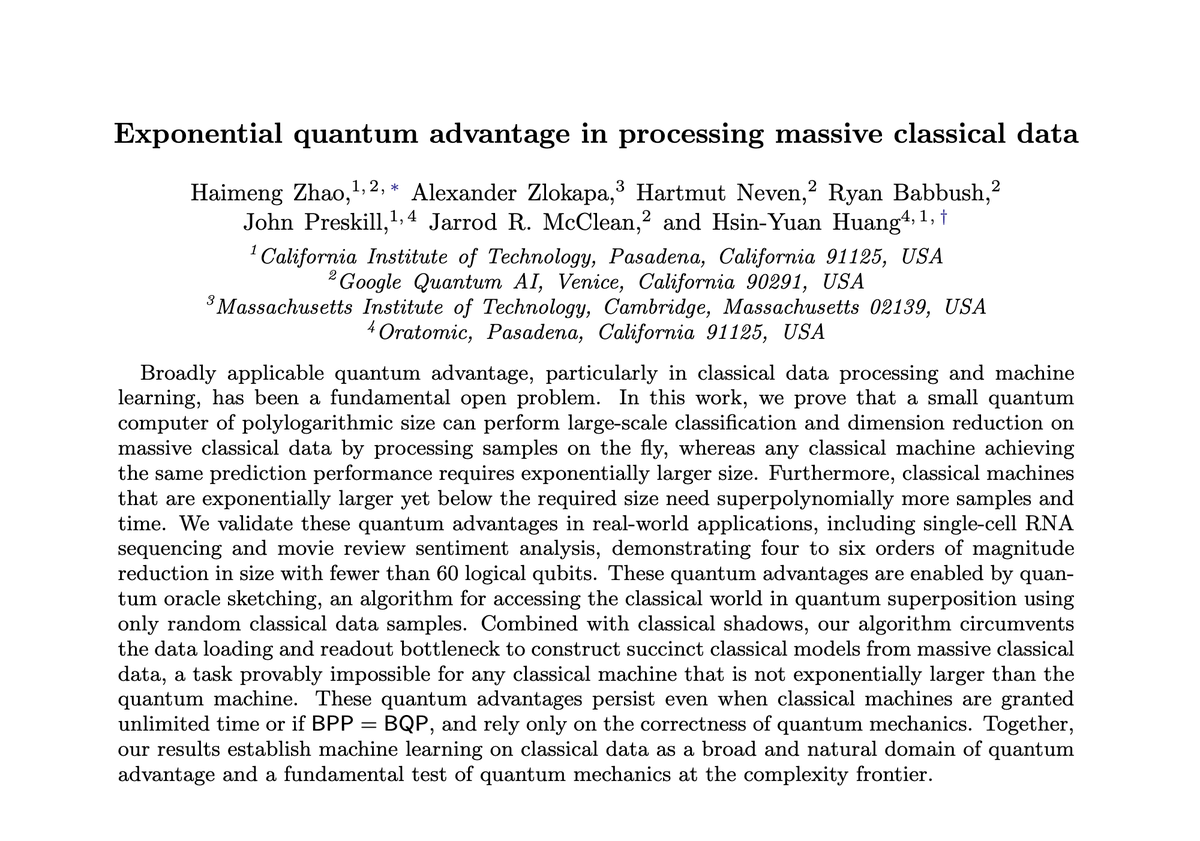
⚛ Can small quantum computers accelerate AI on massive classical data? Yes!
I am absolutely thrilled to share our new work proving *honest* exponential quantum advantages in broadly applicable classical tasks. 🧵👇
Paper: https://t.co/q1txrakSUJ
Blog: https://t.co/77svcuQ1Yl
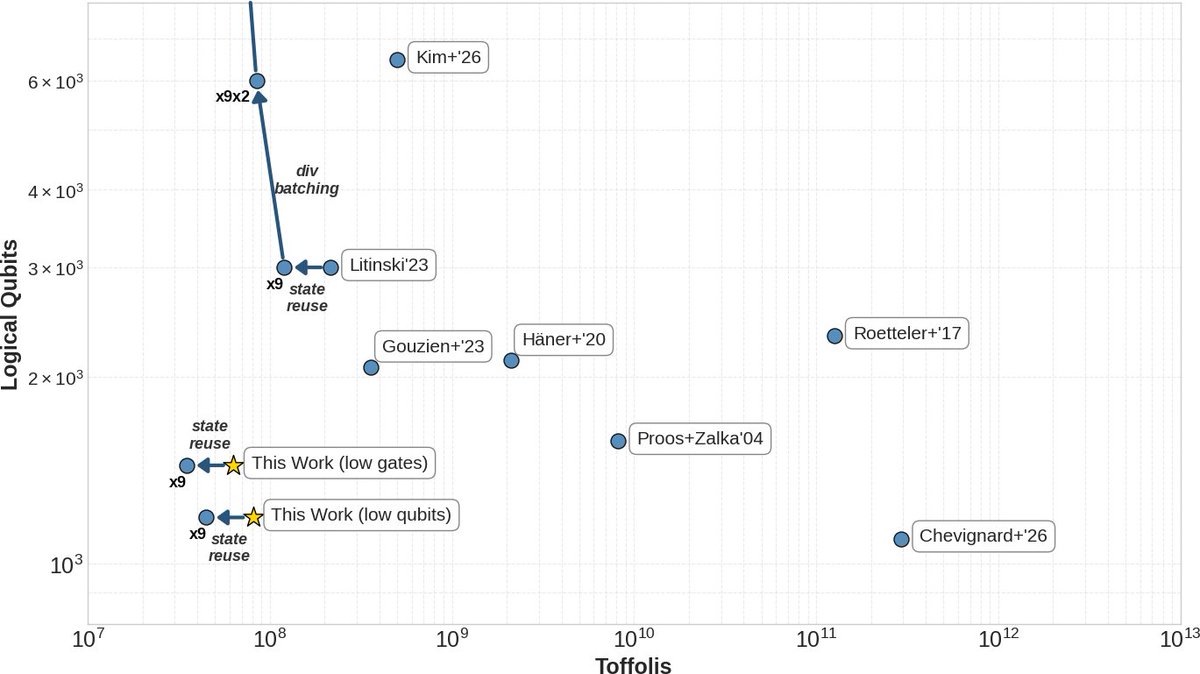
As timelines tighten, details might benefit attackers more than defenders. So we're trying something weird: proving a circuit exists without revealing it.
For example, here's a zero-knowledge proof that we found 10x smaller quantum circuits for ECDLP: https://t.co/ypwPEVurg5
With extraordinary colleagues, we are developing new architectures for neutral-atom quantum processors that dramatically reduce the resource estimates for fault-tolerant quantum computing. This progress makes me optimistic that broadly useful quantum computing will soon be a reality.
We’ll continue fundamental research @Caltech to advance quantum science and technology, while building fault-tolerant quantum machines and exploring their applications @TeamOratomic.
It’s a very exciting time to be a quantum scientist!
https://t.co/fCEMU3LG0J
Great series of blog posts on quantum advantage by Dominik Hangleiter, one of the postdocs in our Quantum Research Pod.
https://t.co/cb2St7Y83d via @IQIM_Caltech#simonsquantum
Today we are announcing Oratomic. Based in Pasadena, our goal is to build the world’s first fault-tolerant quantum computer using neutral atom qubits.
Last Fall, I came to fully appreciate the potential of neutral atoms combined with high-rate error correction. Soon after, I made the decision to leave Google and Berkeley to go all-in on what is now Oratomic.
My teammates are truly exceptional, and it’s an honor to work alongside them with a chance to make history.
If you are excited by this mission, please get in touch!
Website → https://t.co/tOll34RdhT
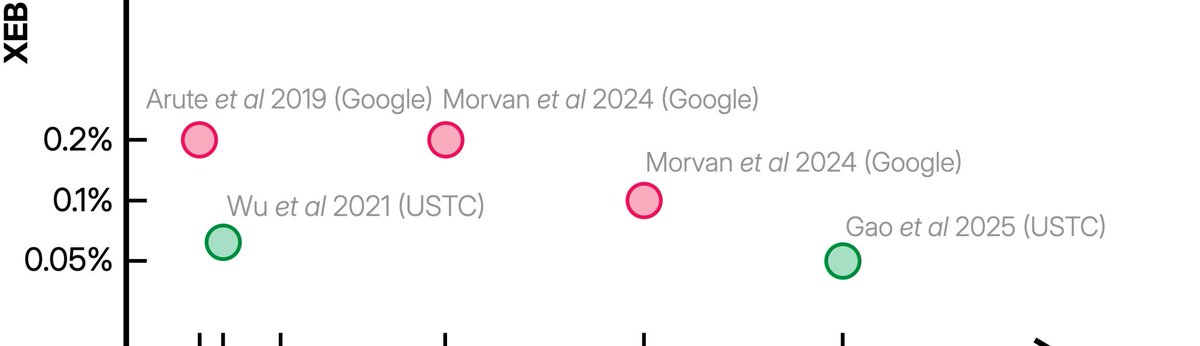
Dominik Hangleiter weighs in with an informative post about a much debated question: Has quantum advantage been achieved? This is the first post in a three-part series.
https://t.co/KmlyCny4h3
Every December since 2017, I've delivered a keynote at Q2B Silicon Valley, commenting on recent progress in quantum computing. Here is what I said this time. It's been a good year for quantum.
https://t.co/NcZqWV0dDV
In predicting properties of electronic structure or deciphering signals produced by Nature, will classical artificial intelligence eat quantum's lunch? Here @robbieking1000 considers the issue from the perspective of complexity theory.
https://t.co/9USlKPCjZj
One of my first encounters with closed timelike curves (CTCs) took place when I read The Eyre Affair as a teen. I didn't expect to become a physicist who co-writes papers about simulating CTCs to improve quantum metrology. https://t.co/sFd6WDjUBL
Today marks (at least roughly) the 404th Thanksgiving...and my 150th post for Quantum Frontiers! Only 254 to go to catch up, right? https://t.co/K2XmvtkVbP
Happy to see that our work with @RobertHuangHY and @preskill is now published! We use shadow overlap to make machine learning of quantum systems verifiable, and to benchmark & optimize quantum circuits.
I’m deeply honored to receive the 2025 Academic Pioneer of the Year Award from the Quantum World Congress. Curiosity-driven fundamental research revealed the promise of quantum science and technology, and will be just as vital for future advances.
https://t.co/pL4bXGITQY
Welcome to the team, @IQIM_Caltech!
Caltech’s IQIM helped shape Marvel’s Multiverse, co-designed Quantum Chess, and continuously pushes the boundaries of quantum science.
Together, we will demonstrate that Science, play, and curiosity are inseparable.
“Unlike simplified projectile motion, you can never predict the exact trajectory of your life or career. Plans will change, and unexpected opportunities will arise. Sometimes, the best path forward isn’t the one you first imagined.” https://t.co/tcaMKFGSMK