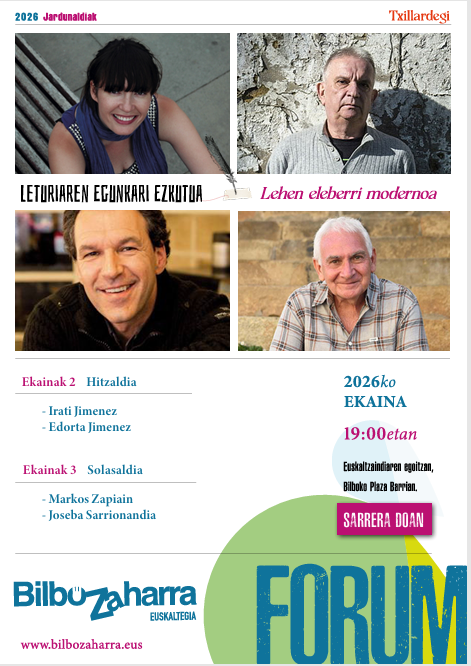
Iruñea, Gasteiz, Donostia, Bergara, Maule, eta Lakuntzaren ondoren Bilbon bukatzen da Mirandek imajinatu ezingo zuen bidaia. Bere herrian lekurik ez zuela sinetsirik hil zenean, Jonek ez zekien herriak Miranderengan topatuko zuela literatura berri bat hasteko aberri literario bat
Ezinezkoak ziruditen gauzak egin zituen gizonaren neurria hitzetan emateak ezinezkoa dirudi. Baina ezinak ekinez direnez eginak, 19.00etan, @euskaltzaindia_ |n egongo gara, baten faltan Jimenez bi, Bilbo Zaharra Forumaren eskutik.
Gobidatuta zaudete, lagunok.
Asteazken honetan, @irati|rekin batera, Lakuntzako Liburutegian “Mirande arazo ala gu? Jon Mirande arbasoen gelan” hitzaldia… @ElkarArgitaletx|earen eta @deabruaren Eskolaren laguntzaz antolatutako “Mirande, hasiera berri bat” zikloaren azkenaurrekoa…
Hurrengo geldialdia: Bilbo
Ayudaría a separar a Lorca de la política que no lo hubieran fusilado por motivos políticos. Ahora bien, hay que ser un lector completamente idiota para separar lo político de los versos de Lorca
Shame on the Basque police @ertzaintzaEJGV for brutalising Flotilla members returning home after being abducted, unlawfully detained and ill-treated by Israel. May those responsible be held accountable.
We must resist the Israelisation of our societies.
“Mirande, hasiera berri bat” hitzaldi-zikloaren berri zabaldutakoan, ezin izan genuen Zuberokoaren data eman, itxi gabe zegoelako, baina badago:
📍Hurrengo asteazkenean, maiatzaren 27, 18:30ean, Mauleko Hebentik elkartean (Matalas karrika).
📢Lagundu zabaltzen!
@paulinau Ay, qué ilusión me ha hecho esto! El ecosistema de Livejournal es el mejor que he encontrado nunca para la creatividad. Fue un momento maravilloso ❤️
Que Aquiles haya pasado a la cultura popular como un ideal de masculinidad… normal. Que haya quien crea, justo por eso, que debía ser hetero… vale. Pero que esa gente se niegue a aceptar toda evidencia en sentido contrario en lugar de revisar la heteronormatividad… 🤦
Me da mucha risa ver a nostálgicos sacando imágenes IA de Aquilles, diciendo que es el culmen de la heterosexualidad occidental y nosequé, cuando tenemos textos como el Banquete de Platón, donde uno de los temas de discusión es si Aquiles daba o recibía de Patroclo.
Recibía.
“Euskera gabeko abertzaletasuna zorokeri hutsa” zela uste zuen Jon Mirandek, eta, horri buruz arituko gara @irati eta biok @DorreaOlaso|n gaur, Telesforo Monzon “aberkide maitea”ren etxean
@DonMitxel_I Es que lo más raro para un cristiano es ser verdaderamente un cristiano. Es triste pero es as��. Tenía razón Erich Fromm: los ateos hemos perdido siglos debatiendo con ellos sobre la existencia de dios y haríamos mejor en exigirles es que se comportarán según el evangelio de Jesús
Quizá ningún escritor anterior o posterior a Cervantes haya tenido nunca una idea tan diabólicamente genial como la que puso en marcha El Quijote, una obra que nunca deja de crecer porque Cervantes la escribió en colaboración con sus lectores presentes y futuros, como nosotros
FLAUBERT: "El Quijote. ¡Qué libro abrumador! Crece a medida que lo contemplas, como las pirámides, hasta que casi acabas teniendo miedo. Lo prodigioso de Don Quijote es la fusión de ilusión y realidad, que lo convierte en un libro tan cómico y poético. ¡Qué pequeño los demás!"
IN PRAISE OF FRANCESCA ALBANESE
There is a question that visits me in the small hours, when sleep will not come and the mind turns over old stones. The question is this: “What would I have done in the 1930s, on the morning after Kristallnacht?"
Not what I say I would have done. Not what I hope I would have done. But what would I actually have done—when the trains began to run, when the neighbours grew quiet, when the cost of decency became the loss of everything?
Most of us, I think, would have done little. Not from malice. From fear. From the soft, creeping conviction that someone else will speak, that the situation is complex, that we must be 'reasonable'. Lest we forget, the ordinary is the extraordinary's alibi. And how we have clung to that alibi! How we still cling to it!
And then, every once in a terrible while, someone appears who does not cling. Someone who steps forward when others step back. Someone who speaks the name of the thing when everyone else is busy naming something else.
Francesca Albanese is that someone.
She stands before the world—alone, unarmed, armed only with law and language and a rare courage—and she says what the centrists will not say, what the foreign ministries will not say, what the editorial boards will not say. She says: "This is a genocide. And we are watching it happen."
Do not tell me that is hyperbole. Do not tell me the term is contested. She has not used it lightly. She has used it as a physician arrives scientifically at a diagnosis—not to wound, but to warn. Not to inflame, but to name.
And for that, they have come for her. Oh, how they have come for her. Smears. Investigations. Vicious editorials. Frozen bank accounts. Dispossession of the only apartment she had ever owned. The machinery of the respectable turned to crush her. Because the respectable cannot abide what she represents: a mirror held up to their complicity.
Let us, once again, travel back to the 1930s. Back to the few who stood up when the trains began to run laden with Jewish people.
There was Aristides de Sousa Mendes, a Portuguese consul in Bordeaux. He defied his own government. He signed thousands of visas, by hand, for hours, until his fingers bled. He saved more lives than Schindler. And he died penniless, disgraced, erased.
There was a German officer in Warsaw named Wilm Hosenfeld. He hid a Jewish pianist in the rubble. He did not save thousands. He saved one. But that one—Władysław Szpilman—carried the memory. And memory is "the only haven from which we cannot be expelled."
There was Raoul Wallenberg. There were the villagers of Le Chambon. There were the anonymous, the quiet, the furious few who said: “Not on my watch.”
Francesca Albanese is their heir. Not because she carries a gun. Not because she hides refugees in her basement. But because she does something equally dangerous in a world that has perfected the art of not seeing. She sees. And she speaks.
She does not speak as a diplomat. Thank Goodness she doesn't! Diplomats have given us the language of "there are arguments on both sides" and "restraint" and "proportionality." Diplomatic language is the perfumed grave of moral clarity. No, she speaks as a jurist. As a human being. As a woman who has looked into the abyss and refused to call it a "complex geopolitical landscape".
Edna O'Brien once described a character who "had the recklessness of those who have already lost everything worth losing." Francesca Albanese has not lost everything. She has her dignity, her office, her voice, her family. But she has calculated the cost of speaking truth to power. And she has decided that that cost is infinitely less than the cost of silence.
What is that cost? Let us name it. She has been called antisemitic—she, who stands on the ground of international law forged in the ashes of Auschwitz and the fires of Nuremberg. She has been called a conspiracy theorist—she, who cites every source, every footnote, every UN resolution. She has been called naive—she, who understands better than most the machinery of realpolitik.
These accusations are not arguments. They are the spittle of the threatened. Because Francesca Albanese threatens something very precious to the powerful: the right to commit atrocity without being named.
Friends, the 1930s did not arrive with jackboots and pogroms on day one. They arrived in small increments. With "reasonable" restrictions. With "proportional" measures. With the silence of the respectable.
We tell ourselves that we would have been different. That we would have been Sousa Mendes. That we would have been Wallenberg. But most of us, I fear, would have been the neighbours who later said, "I didn't know."
Francesca Albanese knows. And she refuses to pretend otherwise.
So let us praise her. Not with statues or awards she does not seek. But with something harder: with our own refusal to look away. With our own voices, raised in places that are safe for us but dangerous for her. With our own bodies, if it comes to that.
A brave woman, who was injured while demonstrating outside a US nuclear military base in 1982, the infamous Greenham Common, had told me that "the heart is a hunter for what it cannot have." But I say the heart is a hunter for what it will not lose. And what we will not lose is the memory of those who stood up when standing up cost everything.
Francesca Albanese is standing up now. In our time. In our name. Under our indifferent sky.
Let us stand with her.
Not tomorrow. Not when it is safe. Now.
[Extract from a speech in Athens on Sunday 3rd May 2026]
“Most people don't know that Jesus is a beloved figure in Islam. He's mentioned by name more times than Muhammad is mentioned in the Quran.”
Filmmaker Alex Kronemer speaks with @mehdirhasan about his docudrama project, portraying Jesus as he is understood in Islamic tradition.
@LnaThunderstorm Coño, qué forma más insana de pensar. Y más marciana. Es terrorífico todo, incluido el hecho de que esta persona no está planteándose que si su novio está a prueba y pende de él esta sospecha constante, es ella la que no está apostando por él ni por su relación
@zenizitas Iba a decir algo sobre hablar con los libros pero lo has dicho mucho mejor tú.
Mistificar el objeto físico que utilizamos para escribir por un supuesto amor a la literatura es como reverenciar las cuerdas vocales por amor a la conversación. Eso no es amor. Es idolatría
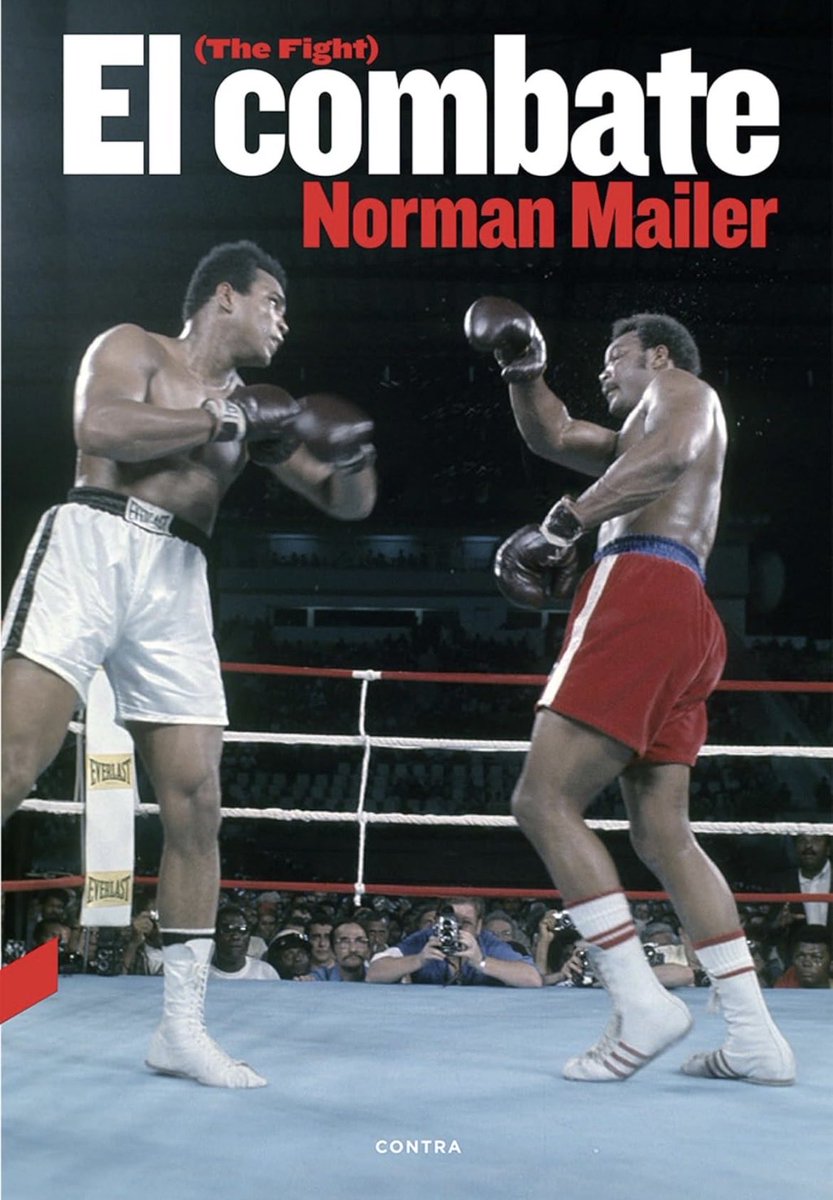
Norman Mailer creía que si no se le devolvía el título, no sería Ali el peor parado porque su grandeza era incuestionable, sino su país, por cometer una bajeza imperdonable
Aprovecho para recomendar esta maravilla, uno de los libros que más veces he releído
Tal día como hoy en 1967 Estados Unidos le retiró su título de campeón de boxeo al legendario Muhammad Alí. El día anterior él se había negado a alistarse al Ejército: "Mi enemigo son los racistas blancos de aquí, no los vietnamitas". Grandioso.
@josebagabilondo Inolako zalantzarik gabe. Justifikatzen gaituen literatura bat nahiko dugu edo motibatzen gaituena? Irakurleak abandonatu ditugu pentsaturik ez ditugula behar edo sinetsirik, sakonean, ezin ditugula irabazi? Zer gaude, ekibokatuta edo etsituta?
Azkenaldian, oso kezkatuta nago ez dakidalako euskal literatura irakurleak galtzen ari den edo irakurleak abandonatzen.
Aukera tristea litzateke. Irakurleak behar ditugulako, eta irakurleekin dena ederrago delako, Hasier Etxeberriak Artzeren hitzekin esan zuen moduan.
Hasier Etxeberria zenak asko miresten zuen Artzeren "Isturitzetik Tolosan barru". Liburu multimedia aitzindaria izan zelako, poema zoragarriak zituelako, eta bertan topatu zuelako, bere ustez, idazle guztien ereserkia izan beharko litzatekeena
https://t.co/qn0aRGAlzC





![yanisvaroufakis's tweet photo. IN PRAISE OF FRANCESCA ALBANESE
There is a question that visits me in the small hours, when sleep will not come and the mind turns over old stones. The question is this: “What would I have done in the 1930s, on the morning after Kristallnacht?"
Not what I say I would have done. Not what I hope I would have done. But what would I actually have done—when the trains began to run, when the neighbours grew quiet, when the cost of decency became the loss of everything?
Most of us, I think, would have done little. Not from malice. From fear. From the soft, creeping conviction that someone else will speak, that the situation is complex, that we must be 'reasonable'. Lest we forget, the ordinary is the extraordinary's alibi. And how we have clung to that alibi! How we still cling to it!
And then, every once in a terrible while, someone appears who does not cling. Someone who steps forward when others step back. Someone who speaks the name of the thing when everyone else is busy naming something else.
Francesca Albanese is that someone.
She stands before the world—alone, unarmed, armed only with law and language and a rare courage—and she says what the centrists will not say, what the foreign ministries will not say, what the editorial boards will not say. She says: "This is a genocide. And we are watching it happen."
Do not tell me that is hyperbole. Do not tell me the term is contested. She has not used it lightly. She has used it as a physician arrives scientifically at a diagnosis—not to wound, but to warn. Not to inflame, but to name.
And for that, they have come for her. Oh, how they have come for her. Smears. Investigations. Vicious editorials. Frozen bank accounts. Dispossession of the only apartment she had ever owned. The machinery of the respectable turned to crush her. Because the respectable cannot abide what she represents: a mirror held up to their complicity.
Let us, once again, travel back to the 1930s. Back to the few who stood up when the trains began to run laden with Jewish people.
There was Aristides de Sousa Mendes, a Portuguese consul in Bordeaux. He defied his own government. He signed thousands of visas, by hand, for hours, until his fingers bled. He saved more lives than Schindler. And he died penniless, disgraced, erased.
There was a German officer in Warsaw named Wilm Hosenfeld. He hid a Jewish pianist in the rubble. He did not save thousands. He saved one. But that one—Władysław Szpilman—carried the memory. And memory is "the only haven from which we cannot be expelled."
There was Raoul Wallenberg. There were the villagers of Le Chambon. There were the anonymous, the quiet, the furious few who said: “Not on my watch.”
Francesca Albanese is their heir. Not because she carries a gun. Not because she hides refugees in her basement. But because she does something equally dangerous in a world that has perfected the art of not seeing. She sees. And she speaks.
She does not speak as a diplomat. Thank Goodness she doesn't! Diplomats have given us the language of "there are arguments on both sides" and "restraint" and "proportionality." Diplomatic language is the perfumed grave of moral clarity. No, she speaks as a jurist. As a human being. As a woman who has looked into the abyss and refused to call it a "complex geopolitical landscape".
Edna O'Brien once described a character who "had the recklessness of those who have already lost everything worth losing." Francesca Albanese has not lost everything. She has her dignity, her office, her voice, her family. But she has calculated the cost of speaking truth to power. And she has decided that that cost is infinitely less than the cost of silence.
What is that cost? Let us name it. She has been called antisemitic—she, who stands on the ground of international law forged in the ashes of Auschwitz and the fires of Nuremberg. She has been called a conspiracy theorist—she, who cites every source, every footnote, every UN resolution. She has been called naive—she, who understands better than most the machinery of realpolitik.
These accusations are not arguments. They are the spittle of the threatened. Because Francesca Albanese threatens something very precious to the powerful: the right to commit atrocity without being named.
Friends, the 1930s did not arrive with jackboots and pogroms on day one. They arrived in small increments. With "reasonable" restrictions. With "proportional" measures. With the silence of the respectable.
We tell ourselves that we would have been different. That we would have been Sousa Mendes. That we would have been Wallenberg. But most of us, I fear, would have been the neighbours who later said, "I didn't know."
Francesca Albanese knows. And she refuses to pretend otherwise.
So let us praise her. Not with statues or awards she does not seek. But with something harder: with our own refusal to look away. With our own voices, raised in places that are safe for us but dangerous for her. With our own bodies, if it comes to that.
A brave woman, who was injured while demonstrating outside a US nuclear military base in 1982, the infamous Greenham Common, had told me that "the heart is a hunter for what it cannot have." But I say the heart is a hunter for what it will not lose. And what we will not lose is the memory of those who stood up when standing up cost everything.
Francesca Albanese is standing up now. In our time. In our name. Under our indifferent sky.
Let us stand with her.
Not tomorrow. Not when it is safe. Now.
[Extract from a speech in Athens on Sunday 3rd May 2026]](https://pbs.twimg.com/media/HHsnlr9WIAEr4Cw.jpg)