International journal for the critical study of religion. Boundary maintenance, gatekeeping and category formation, and the implicit assumptions they reveal.
🚨Call for Papers: Bruno Latour and the Study of Religion
This special issue will consider the relevance, legacy and potential of Bruno Latour's work for the critical, social-scientific study of religion. Full details at the link. Please share widely!
https://t.co/8yrvu6IyLr
📢 New issue just published!📢
“Bruno Latour and the Study of Religion” sets out #Latour's influence along three key vectors—relocating agency beyond the human; religion as “mode of existence”; and his critique of the critical project itself.
https://t.co/XgXdoGPeyX
#religion
New Call for Papers 👀
"Private and Intimate Spaces of Spirituality", exploring the interconnections between physical spaces, religious creativity, and spiritual experience.
Guest Editors: Henrietta Grönlund, Alastair Lockhart & Krzysztof Nawratek
https://t.co/G1uzWKLd3A
The proofs here! In this article, I propose the notion of “double decolonization” to capture how western & East Asian hegemonies co-produce the essentialization & orientalization of East Asia. As a result, Confucianism is often evoked out of context in global events such as COVID
Plus! New papers by Malory Nye, Leonie Granger, and Stefania Palmisano and Nicola Pannofino, and a review essay on Nickolas Roubekas's "The Study of Greek and Roman Religions" by Tenzan Eaghll.
https://t.co/BSPqYhjNkn
Naomi Richman's contribution focusses on a Nigerian Pentacostal church, to examine how anthropologists navigate colonial assumptions about knowledge and their subjects' self-identification as "believers":
https://t.co/ZqfnntaNYB
The collection concludes with a response from Charles McCrary, who responds to the other contributions by considering "sincere belief" in regards to science, rather than religion:
https://t.co/8DIcKUG2C9
In "The Feeling of Believing", Jack Williams argues for the importance of including affectivity in our models of belief, if the category is to be rehabilitated in Religious Studies:
https://t.co/e6RMbBdwKn
Leonardo Ambasciano challenges the abandonment of belief in favour or orthopraxy in the study of the Roman Empire, in "Zombies Roaming Around the Pantheon":
https://t.co/RxI5wPbWWT
In "Is There Such a Thing as Religious Belief?", Mikel Burley engages with recent philosophical arguments about the conceptualisation of beliefs in a context where there is a disconnect between belief and empiricism:
https://t.co/J1ZZCJwdTH
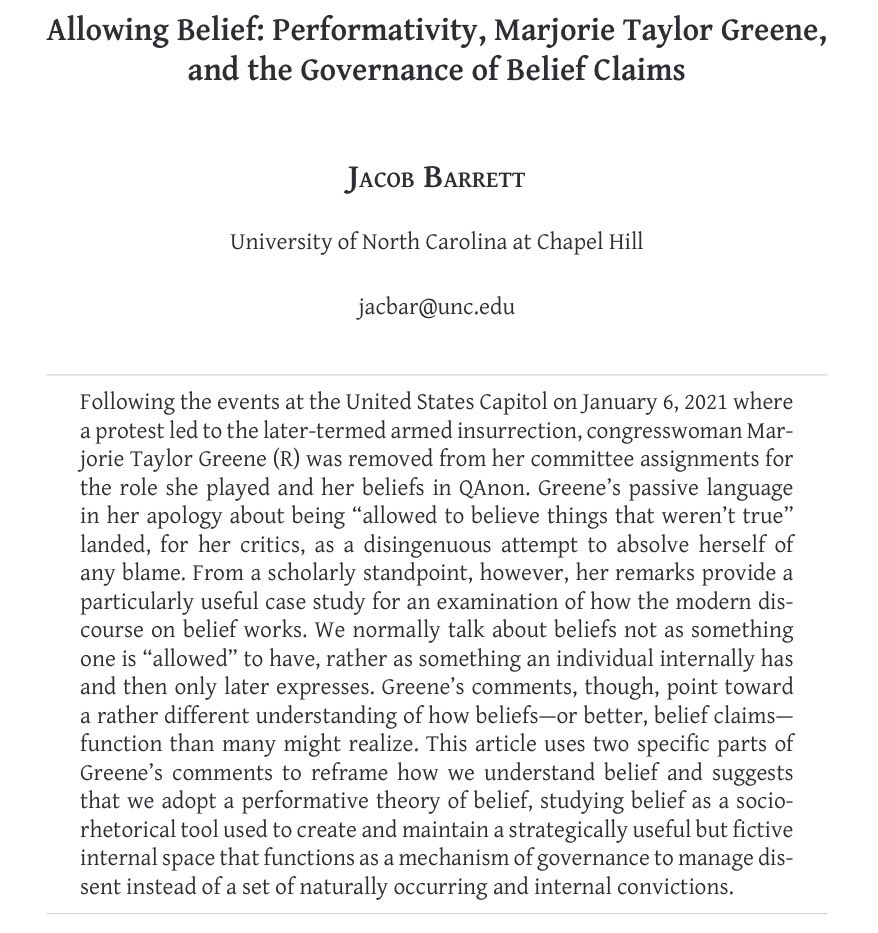
@jakebarrett25's "Allowing Belief: Performativity, Marjorie Taylor Greene, and the Governance of Belief Claims" puts forward a performative model of belief in which it functions as a socio-rhetorical tool to manage dissent:
https://t.co/q4FeaEtXdN
The introduction, "I Believe in Bees", by the editors, Jack Williams and @d_g_robertson, sets out some different ways we use "belief", in Religious Studies and in everyday discourse - and it's Open Access!
https://t.co/F30TzYZXGF
Did you miss the publication of our new issue over the holidays? "Belief, Reconsidered" takes a look at the category "belief" from a critical perspective, something that is so fundamental to the study of religion that we often take it for granted. https://t.co/BSPqYhjNkn
🚨Call for Papers: Bruno Latour and the Study of Religion
This special issue will consider the relevance, legacy and potential of Bruno Latour's work for the critical, social-scientific study of religion. Full details at the link. Please share widely!
https://t.co/8yrvu6IyLr
Excited to see this out! I wrote the first version several years and many political moments ago, but that almost makes the case study even more interesting. Find my article, as well as the whole special issue “Belief, Reconsidered” @ircriticalrel here: https://t.co/ibTS1GBosk
🚨Call for Papers: Bruno Latour and the Study of Religion
This special issue will consider the relevance, legacy and potential of Bruno Latour's work for the critical, social-scientific study of religion. Full details at the link. Please share widely!
https://t.co/8yrvu6IyLr
@FZemmin In "Religion in the 21st Century: Disciplinary Critique, Global Restructuring, Categorical Diversity", Peter Beyer summarizes the upheavals religion as a category of study in academia has undergone in response to major transformations in global society.
https://t.co/SrGJunTMUA
🚨 New issue just published!🚨
Vol. 24 No. 3-4 (2021): "Global Perspectives on Religion as an Object of Historical and Social Scientific Study."
Guest Edited by Florian Zemmin (@FZemmin).
https://t.co/rtkpGfg25r
In "What does Siberian Shamanism do for the Academic Study of Religion?" Liudmila Nikanorova (@Liudmila_Nik) argues that the study of Siberian shamanism tells us more about colonial scholarship than the people who inhabit Siberia.
https://t.co/I8MjHUCcPZ
@FZemmin Giovanni Maltese's "Gender and the Conceptualization of Religion and Islam" draws on Judith Butler to argue that religion-making and gender-making should not be investigated apart from each other.
https://t.co/pCXq0PBs3Z
@FZemmin In "The Emergence of “Esoteric” as a Comparative Category: Towards a Decentered Historiography", Julian Strube contributes to debates about religious comparativism by focusing on the emergence of “esoteric” as a comparative category since the C17.
https://t.co/jimVc4f2MO: