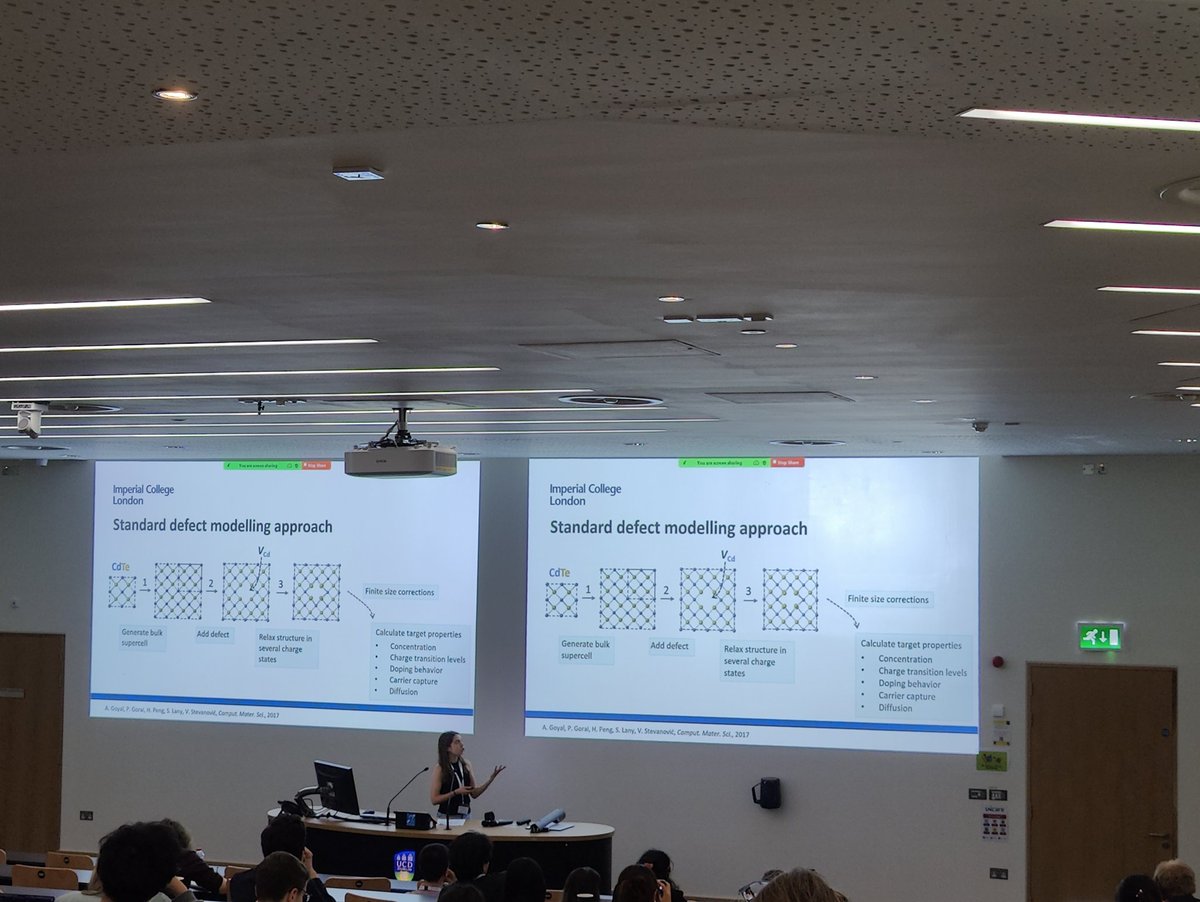
Point defects are often modelled at 0 K instead of the material synthesis or operating temperatures. But how accurate is this approximation? Explored with machine learning force fields in https://t.co/WjE9G0QEB7 - @lonepair & Johan
@ireaml's comprehensive study of pre-trained universal MLFFs for defect structure searching with ShakeNBreak is now published open-access here.
Many useful takeaways and insights to challenges for MLFFs with defects!
https://t.co/o7ucVKSgXJ
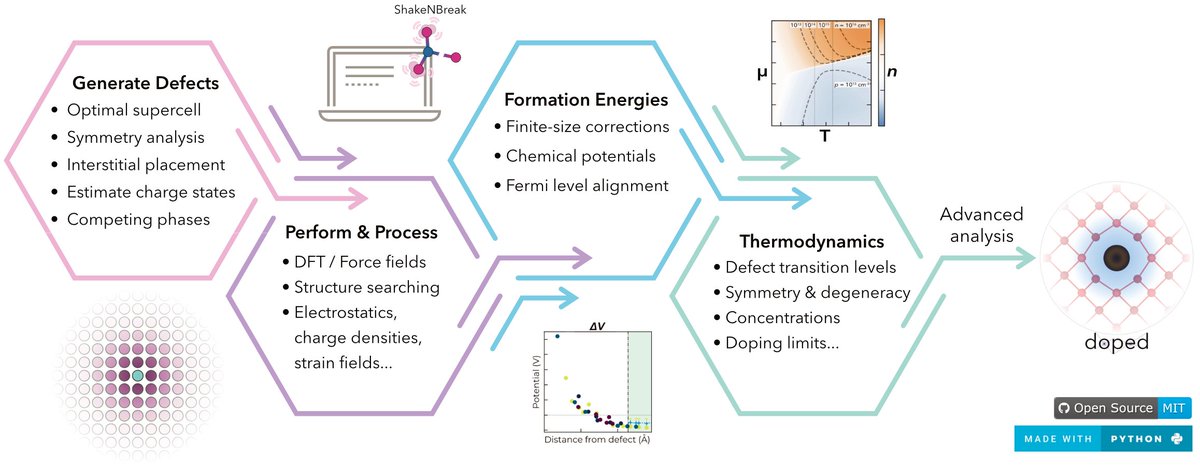
Our comprehensive i̶n̶-̶h̶o̶u̶s̶e̶ defect modelling python package 𝙙𝙤𝙥𝙚𝙙 is now fully live!⚛️
𝙙𝙤𝙥𝙚𝙙 implements the defect
simulation workflow in an efficient and user-friendly, yet powerful and fully-flexible, manner.
See 🧵 for features (1/n)
https://t.co/gdGKcMKd0b
📢Two open positions in my group!
Looking for a Postdoc or a PhD in computational materials chemistry? I have two open positions in my group at Aalborg University, Denmark.
Postdoc: https://t.co/xwMhQ4lUEG
PhD: https://t.co/u4oVCKO6Ub
Please share with anyone interested!
@Debmalya_UMN@prashungorai@Kavanagh_Sean_@alexganose@lonepair We haven't tried defect clusters, but we expect the approach to also work for them! If targeting large/complex clusters, it might require more training configurations. There was a recent study about it: https://t.co/88DP8IRFZ1
Defect structure searching can be computationally expensive💸, especially for high-throughput studies or materials with complex PESs. Can we accelerate it with universal machine learning force fields? Explored in https://t.co/dbfHDwzKtu @Kavanagh_Sean_@alexganose@lonepair
Don't miss this #OpenAccess Tutorial review by @ireaml, @lonepair, Seán Kavanagh, Johan Klarbring and Kasper Tolborg
@ImpMaterials
"Imperfections are not 0 K: free energy of point defects in crystals"
Part of our Pioneering Investigators collection
🔗 https://t.co/oFtnOcprcE
Defect calculations are often performed at 0 K - yet finite temperature effects can be important!🌡️ Explored in our Tutorial Review targeting the main contributions to defect free energies - with @Kavanagh_Sean_@KasperTolborg Johan Klarbring & @lonepair https://t.co/P7Lxcs4opI
A great chance to come and join @ImpMaterials@tyc_london at Imperial College London to work on materials informatics. There are two new postdoctoral positions available in the @lonepair group! https://t.co/N8s5qNjRvF!
Feel free to contact!
Finally online!🤩
@ireaml's tour de force on symmetry-breaking and energy-lowering reconstructions at defects across many materials/chemistries🧪
(missed by the standard supercell approach!!)
You won't find this if you don't go looking!
➡️ ShakeNBreak🔍
https://t.co/ZHAUT9hSzl
Another presentation, another GIF...
My favourite thing about being in 2 groups is getting to do twice as many presentations! 🤥
Today's GIF from the @lonepair group meeting featured the ShakeNBreak CLI and its ease-of-use 👨💻
https://t.co/Yv1llpEApH @ireaml@scanlond81
I had way too much fun messing around with PowerPoint while procrastinating making my slides for the @scanlond81 SMTG group meeting last week 😅
Getting the ground-state defect structure is important!
https://t.co/XmmVbcPVXp
@ireaml@lonepair
Code to implement available here: https://t.co/68BdsxJCNm
Compatible with VASP, CASTEP, FHI-AIMs, Quantum Espresso and CP2K, and takes only one or two lines of code to run! 🏃
Docs and tutorials incoming! 👷
The implication of this study is that a large fraction of the computational defect literature needs to be revisited. Bold work by @ireaml & @Kavanagh_Sean_