we live on a planet where trees warn each other of danger through underground networks. where octopuses dream. where elephants return to the bones of their dead and stand over them in silence. where bees communicate through dance, showing each other where to fly. where flowers bloom...where crows remember human faces -especially those who were cruel to them - and pass that memory on to their young. where ants build entire cities. where cats purr at a frequency that can help heal bones. where forests, after fires, grow flowers first.
There's a physicist at Stanford named Safi Bahcall who modeled this exact principle and the math is wild.
He calls it "phase transitions in human networks." When you're stationary, your probability of a lucky event is limited to your existing surface area: the people you already know, the places you already go, the ideas you've already been exposed to. Your opportunity window is fixed.
When you move, your collision rate with new nodes in a network increases nonlinearly. Double your movement (new conversations, new cities, new projects) and your probability of a serendipitous encounter doesn't double. It roughly quadruples. Because each new node connects you to their entire network, not just to them.
Richard Wiseman ran a 10-year study at the University of Hertfordshire tracking self-described "lucky" and "unlucky" people. The single biggest differentiator wasn't IQ, education, or family money. Lucky people scored significantly higher on one trait: openness to experience. They talked to strangers more, varied their routines more, and said yes to invitations at nearly twice the rate.
The "unlucky" group followed the same routes, ate at the same restaurants, and talked to the same 5 people. Their networks were closed loops. No new inputs, no new collisions.
Luck isn't random. Luck is surface area. And surface area is a function of movement.
The lobster emoji is doing more work than most people realize. Lobsters grow by shedding their shell when it gets too tight. The growth requires a period of total vulnerability. No protection, no armor, soft body exposed to the ocean.
That's the cost of movement nobody posts about. You have to be uncomfortable first. The new shell only hardens after you've already moved.
BREAKING: Senator Babet announces "you would be very surprised who's not entirely human" — but says he can't disclose more because the alien hybrid program is classified.
Netanyahu died on March 8th, 2026.
Yair, his son who posts 24/7, took an exact 7 day break on X from 3/8 to 3/15. That lines up precisely with the Jewish Shiva mourning period.
President Trump looked visibly shaken on 3/8.
Now they are striking oil fields and hitting civilian infrastructure in response. They wouldn’t do that unless something serious happened, like a major assassination.
That also lines up with the strange military council absences and event cancellations.
Every video you are seeing of him after 3/8 is AI assisted.
🇮🇱 | In the latest video of Benjamin Netanyahu, they were so focused on counting fingers that they forgot to pay attention to the ears. I’ve never seen someone with two ear canals before.
A powerful scene in the Odyssey happens when Odysseus finally returns to Ithaca after twenty years of war and wandering.
You would expect the story to end with celebration, with the hero coming home, the family reunited, and order restored.
Homer does something far stranger.
Odysseus arrives disguised as a beggar, because Athena warns him that the palace has been taken over by more than a hundred suitors who have been living there for years, eating his food, drinking his wine, and pressuring his wife Penelope to marry one of them.
They believe Odysseus is dead and in their minds the kingdom is already theirs.
So the king of Ithaca walks through his own halls dressed in rags while the men stealing his house sit comfortably at his tables. They mock him, throw scraps at him, and one of them even strikes him, and Odysseus takes it. That is the remarkable part, because the same man who blinded the Cyclops and survived twenty years of disasters now stands quietly while strangers insult him in his own home. Homer tells us his heart burns inside his chest and that he wants to attack them immediately, yet he restrains himself and waits.
Instead of striking, Odysseus studies the room carefully. He counts the men, watches their habits, and quietly observes which servants remain loyal and which have betrayed him. The hero of the Odyssey does something most people cannot do, which is delay revenge until the moment is right.
Eventually Penelope announces a contest and brings out Odysseus’ great bow, declaring that she will marry the man who can string it and shoot an arrow through twelve axe heads lined up in a row. One by one the suitors try and fail, because none of them can even bend the bow. Then the beggar asks for a turn. The suitors laugh at first, but the bow is eventually handed to him.
Odysseus takes it in his hands and strings it effortlessly. Homer says the sound of the bowstring tightening rings through the hall like the note of a swallow. Then he places an arrow on the string and sends it cleanly through all twelve axe heads.
In that moment the beggar disappears. Odysseus turns the bow toward the suitors and reveals who he is.
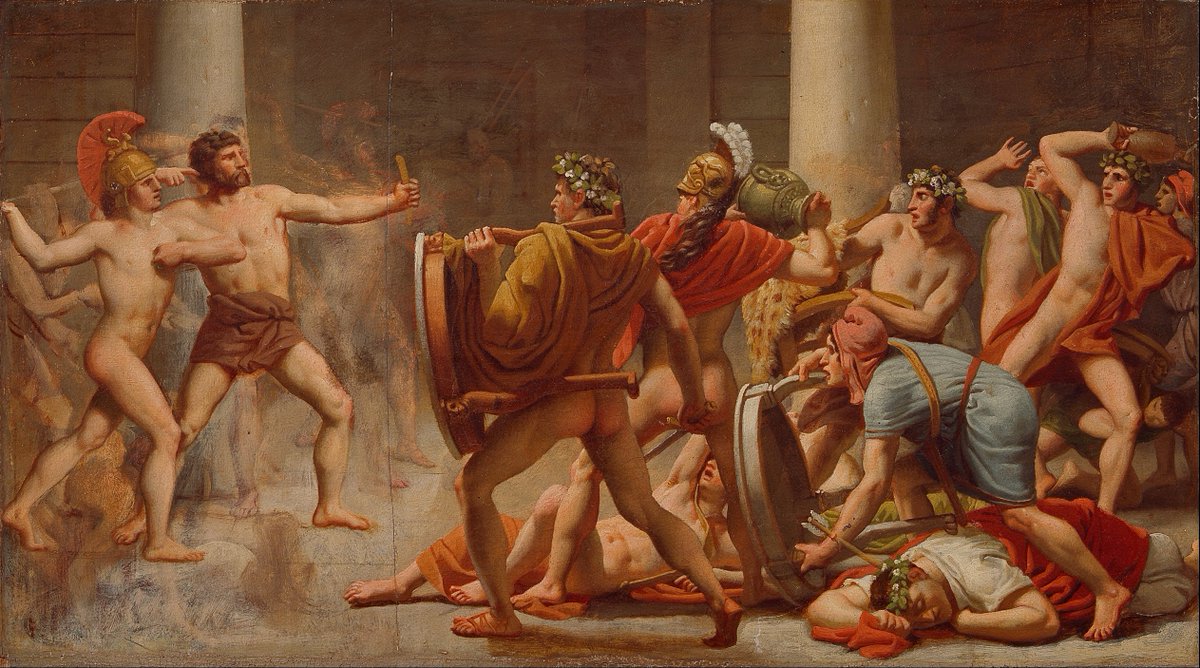
What follows is one of the most brutal scenes in Greek literature. The doors are sealed and the suitors realize too late that they are trapped inside the hall. Odysseus, his son Telemachus, and two loyal servants begin killing them one by one. There is no escape, no mercy, and no negotiation. The men who spent years consuming another man’s house die inside it.
It is a violent ending, but Homer wants you to understand something important. The real danger to Odysseus was never just the monsters and storms on the long journey home. It was the possibility that someone else might take his place while he was gone. When Odysseus finally returns, he reminds everyone in Ithaca of a simple truth: a man’s home is not truly his unless he is willing to fight for it.
I went to see this. Parents shouldn’t take kids under 10 to see this movie. Kids 10-13 years old should see it with parents and have a discussion afterwards. It is the darkest Pixar film with heavy themes, destruction and violence due to the main character’s selfishness and bad decisions, none of the main human characters are likable, promotes a message of “all people are good inside” and that “animals should be elevated to the same level as humans” (neither biblical). It’s also completely void of joy, atypical for a Pixar film. Only a handful of laughs and instead a focus on heavy and serious topics. Can’t imagine any children wanting to watch this film a second time let alone over and over again.