Trade Robinhood Stock Tokens at the live market price with decentralized swaps.
Every cost is shown up front and every fill settles on-chain on Robinhood Chain.
$IRIDIUS is officially live.
0x28e3c0c404088f1a5d739221072ddf6ab4431022
What is Iridius?
Iridius is a non-custodial swap venue for Stock Tokens on Robinhood Chain. You trade tokenized equities like NVIDIA, Apple and Tesla for USDG, at prices pinned to the live Chainlink mid.
How pricing works:
Every quote comes from one published formula:
your price = mid + spread × regime ± skew + fee
Anyone can rebuild any price from on-chain inputs. The spread and the 2 bps protocol fee each get their own line on the ticket, and nothing is buried in a curve.
Built around the market clock:
Stock Tokens trade around the clock, but US equity markets are open only about 32 hours a week. Iridius prices in that gap: spreads run at ×1.0 when markets are open, ×1.5 in extended hours and ×3.0 when closed. The session is always shown on the ticket.
One router, two venues:
Standard-size orders fill instantly against vaults anchored to the oracle. Block-size orders go to professional market makers as signed quotes. The router settles whichever pays you more.
Guardrails:
No fill ever settles outside the oracle band (75 bps for Tier A).
Settlement is atomic, so the venue never holds your assets.
LP withdrawals stay open in every state, even when trading is paused.
Parameter changes are published and timelocked.
Why Robinhood Chain:
It's the only network where a regulated broker issues tokenized stocks as plain ERC-20s, backed by Chainlink feeds. Transactions cost under a cent.
Tokenized stocks can be held by any wallet. So who's allowed to trade them on Iridius?
Every venue that lists Stock Tokens has to answer that for itself. Here's our answer:
Attestations, not account lists.
You verify once with a KYC provider. Your wallet gets an on-chain attestation saying only your role, your jurisdiction class and an expiry date. No name, no documents, no personal data on-chain.
The issuer's rules, not looser ones.
Who can trade follows Robinhood's own eligibility list for Stock Tokens. If they tighten it, we tighten with them.
Checked at every entry point.
Every swap, deposit and maker quote checks the role. Revoke an attestation and the wallet's next action fails, wherever it comes from.
Never a trap.
Withdrawals are never gated. A compliance system that can lock up your funds has quietly become a custodian, and Iridius never will be.
Read more: https://t.co/vECKNdmPh3
Every price on Iridius passes through one contract before it gets anywhere near your trade.
OracleRouter takes the Chainlink price and checks it first. It stops the market, or rejects the price, if:
The price is zero or negative
The last update is too old for the session: 1 hour when markets are open, 2 in extended hours, 4 days over a weekend
One update moves the price more than 25%. The market stays halted until a public review is published.
The feed reports a corporate action in progress
The second Chainlink source disagrees beyond tolerance
Silence counts too. A feed that stops updating halts its market on its own.
And Iridius only ever prices the exact token the vault holds. Never a wrapper, never an exchange rate derived from one. Some of the costliest RWA failures so far came from an accurate oracle pointed at the wrong number.
A halt only stops quoting in that one market. Withdrawals keep working throughout.
Read more: https://t.co/97vzHvi42i
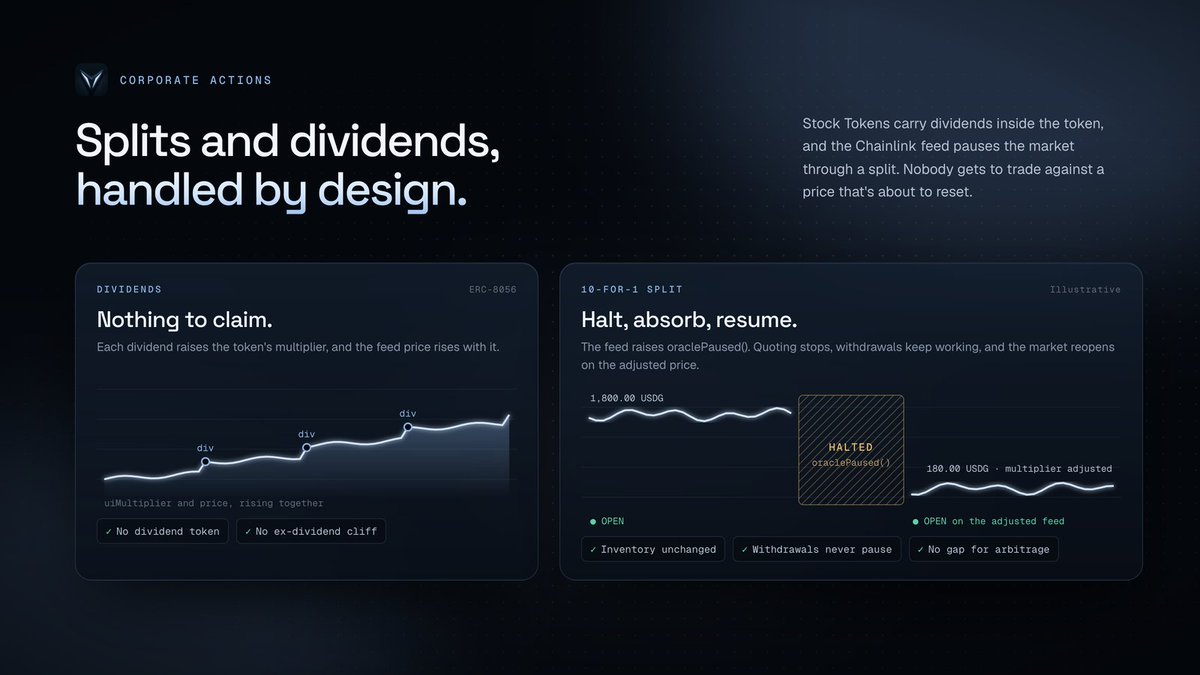
What happens to a tokenized stock when Apple pays a dividend, or NVIDIA splits 10-for-1?
On a lot of venues, money quietly goes missing. After a split, the token's price resets overnight, and any pool that wasn't told hands the gap to the first arbitrageur who notices.
On Iridius:
Dividends need nothing from you.
Robinhood Stock Tokens raise their multiplier with each dividend, and the Chainlink price rises with it. There's no dividend token to claim and no ex-dividend cliff to misprice. Value just builds up in the token.
Splits pause the market automatically.
When a split or merger hits, the feed raises its pause flag and the market halts. No quotes, no fills, nothing to trade against. Deposits and withdrawals keep working throughout.
Then it resumes on the adjusted price.
When the feed comes back, the new price already reflects the split, so quoting restarts from the right number. The vault holds the same tokens it always did.
And if a stock is delisted, the market is retired through the timelock. Quoting stops for good, and LPs withdraw their share in kind.
Learn more: https://t.co/tsf25mggaf
Contracts update: catch bad price feeds at setup.
Every market on Iridius is priced by a Chainlink feed, configured in OracleRouter. Two mistakes used to slip through that setup:
A feed for USDG itself. Every price on Iridius is quoted in USDG, so a USDG feed prices nothing.
A missing feed. An empty feed address passed configuration and only failed on the market's first quote.
configureFeed now rejects both straight away. A misconfigured market fails at setup, in front of the person configuring it, not on a trader's first swap.
It's the same principle behind the listing framework: no market goes live without a real feed for that exact token.
Github commit:
https://t.co/ksmIwoJDK1
Contracts update: safer handover of governance.
ParamController holds every parameter on Iridius: spreads, caps, bands, fees and listings. Whoever owns it runs governance, so handing it over is the most sensitive change the protocol can make.
Ownership already moves in two steps: the current owner proposes a new address, and that address has to accept before anything changes. A handover sent to the wrong address simply never completes.
Now there's a clean way back too:
New cancelOwnershipTransfer withdraws a pending handover outright, before anyone accepts it.
transferOwnership rejects the zero address and the current owner, since either can only be a mistake.
When control of the venue changes hands, it should only ever go exactly where it was meant to.
Github commit:
https://t.co/Am4taROtf0
How does a stock get listed on Iridius? Not by anyone's opinion.
Every listing is decided by a checklist. An asset meets the bar or it doesn't, and the evidence is published with the listing.
The bar, for every market:
A live Chainlink feed on Robinhood Chain for that exact token
A market-status signal, so the venue knows when the stock is open or closed
A regulated issuer with published terms and one-for-one backing
A bytecode review of the token, so pause, freeze or blacklist powers are found before listing, not after
Standard ERC-20 behaviour: no fee-on-transfer, no surprise rebasing
Fail even one and there's no listing. Nothing can override it.
Pass, and the asset gets a tier that sets every parameter with no further judgement:
Tier A, like SPY, QQQ, AAPL, MSFT and NVDA: 10 bps base spread, 75 bps oracle band
Tier B, liquid single names: 20 bps, 150 bps band
Tier C, the long tail: 40 bps, 300 bps band, with caps that keep the exposure honest
Long-tail stocks aren't excluded for being harder to price. The wider spread and band price that in, openly.
Tier changes and delistings go through the timelock, published with their reasoning. A retired market stays open for withdrawals.
Learn more: https://t.co/UDDlPDc4vf
With the migration of $IRIDIUS, here's a 20-second look at what the token does.
Govern every spread, cap, fee and listing.
Stake for 15% off the protocol fee.
20% of protocol revenue bought back and burned.
$IRIDIUS, in 20 seconds.
Govern: holders propose and vote on every spread, cap, fee and listing, behind the same timelock. No vote can move user funds, gate withdrawals or bypass the band.
Stake: 15% off the protocol fee on every trade, shown on the ticket.
Burn: 20% of protocol revenue buys $IRIDIUS on the open market and burns it, recorded on-chain.
No emissions. No points. No inflation.
$IRIDIUS has migrated.
Thank you to everyone who got us here: the early holders, the people who shared, and everyone who read the docs and asked hard questions.
This is the start. The protocol work continues.
Iridius × Sectoral (@sectoralxyz)
We're building an integration with Sectoral, private banking on Robinhood Chain for people and the AI agents they run. Same chain, same dollar: everything settles in USDG.
What we're building together:
- Agents that trade inside limits
Every Sectoral agent gets its own wallet and a spend policy its owner sets: daily limits, per-trade caps, approved counterparties. The Iridius router is open to any caller. Put the two together and an agent can trade tokenized stocks on Iridius, with no way to spend past the budget it was given.
- Verify once
Both sides check identity before anyone transacts. A verified Sectoral account, and the agents under it, will be able to trade on Iridius without going through verification twice.
- From balance to trade
USDG held in Sectoral, Stock Tokens traded on Iridius, back again in seconds.
The development scope and API contracts are agreed, and development starts today. More soon.
https://t.co/j2k2wU1o3e · https://t.co/lEdHtasV6X
100 users!
A few months ago, Iridius was a set of docs and a test suite. Today, 100 people have connected a wallet, been verified, and chosen to trade tokenized stocks with us.
That's small next to the big venues. But each of you took a chance on something new, read the ticket line by line, and told us when something felt off. That feedback is already in the product.
We built Iridius around one idea: tokenized stocks, priced as the shares are, with every cost in plain sight. Seeing 100 of you use it means more to us than any metric.
Thank you for being early. The next 100 will have you to thank for a better venue.
Every venue says it gives you good execution. Iridius publishes the proof.
Each fill is scored in basis points against the Chainlink mid it was checked against at settlement. That benchmark is locked into the fill event, so nobody can swap in a kinder one later.
What gets published:
Every fill, with no minimum size and nothing withheld
Open and closed sessions side by side, so the weekend premium is a number, not a suspicion
Price improvement from RFQ makers against the vault quote
The revert rate, because failing fills is one way to make the rest look better
The worst fill, not just the median
Every figure links to the Blockscout transaction it came from. Anyone can download the full dataset and rebuild it from the chain. If the explorer and the chain ever disagree, the chain is right.
Leave the bad days out and a dataset becomes marketing.
Contracts update: a share price for every vault.
LP returns on Iridius build up inside the vault. Every fill adds earned spread, which raises the value of each share. No emissions, no claiming.
New pricePerShare on AnchorVault returns what one share is worth in USDG at the current mid. Shares start at 1 USDG, and the number moves as the vault earns spread and as the price of its tokens moves.
LP dashboards can chart it directly to show returns over time, straight from the contract.
Github commit:
https://t.co/QtBnbmZuAx
Contracts update: eligibility for a whole list, in one call.
New isEligibleMany on EligibilityRegistry takes a list of wallets and a role, and returns a yes or no for each.
Back-office tools and indexers can check hundreds of accounts in one read instead of one call per address, while personal data stays off-chain as always.
It pairs with last week's rolesOf, which returns every role for one account. Now you can go the other way: one role, many accounts.
Github commit:
https://t.co/Z8mHsI3YCI
Most liquidity pools pay LPs in emissions and quietly lose to arbitrage every time the price moves.
Iridius vaults work differently. They quote around the live Chainlink mid, so arbitrageurs have nothing to pick off. What's left is the real business: getting paid for immediacy.
How LPs earn
90% of the realised spread on every fill goes to the vault's LPs, building up in the value of each share. No emissions, no points, nothing to claim.
What you choose
Every market has its own vault, its own LPs and its own parameters. Pick the stocks you want exposure to. Losses in one market can never touch another.
How you leave
Withdraw any time, with no lock-up and no fee. You get your exact share of the vault's USDG and tokens, in kind. Exits work in every vault state, even during a halt.
The risks are written down too: price exposure to the token you pick, weekend gap risk, and issuer risk. Read them before you deposit.
Contracts update: check a quote before you send it.
RFQ quotes are short-lived. They expire in seconds, can be cancelled in bulk, and depend on the maker staying eligible. Sending a dead quote just wastes a transaction.
New quoteFillable on RfqSettlement runs the same quote checks settlement does: expiry, reserved taker, self-trade, nonce, signature and maker eligibility. It returns true or false instead of reverting.
Makers and front-ends can drop dead quotes before routing them. The oracle band and balances are still checked at fill time, as always.
Github commit:
https://t.co/tvS61xJjNS
$IRIDIUS, in 20 seconds.
Govern: holders propose and vote on every spread, cap, fee and listing, behind the same timelock. No vote can move user funds, gate withdrawals or bypass the band.
Stake: 15% off the protocol fee on every trade, shown on the ticket.
Burn: 20% of protocol revenue buys $IRIDIUS on the open market and burns it, recorded on-chain.
No emissions. No points. No inflation.
Stock splits break AMM pools.
If a stock splits 4-for-1, a constant-product pool quotes the old price until arbitrage drains it. On Iridius, the ERC-8056 multiplier feeds the event into pricing, and the market pauses while it settles.
Market structure for real stocks.
Big trade? Don't walk the curve.
Above the vault's clip, Iridius goes to RFQ. Attested makers sign EIP-712 quotes off-chain, the router compares the best one against the vault, and you settle the better price in one atomic transaction.
Iridius never holds your assets.
Two days in, and the response to $IRIDIUS has been more than we expected.
Thank you to everyone who followed, shared and asked hard questions about RWA market structure. Keep them coming. They shape what we build.
More on the protocol soon.