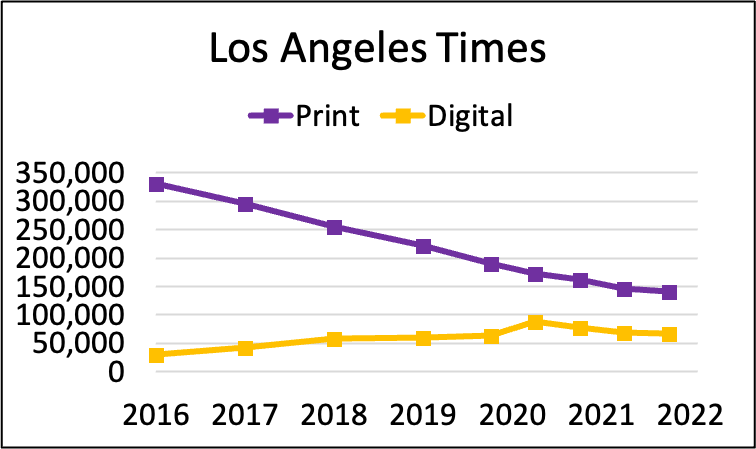
What happened to newspaper subscriptions during COVID (and why)? @azcentral@latimes@denverpost@sacbee_news@arizonarepublic
Download the full report on 18 newspapers' circulation and pricing data, 2016-2022: https://t.co/qfRDieT92t
Scholar Iris Chyi has been saying for more than a decade that digital news reports are the "ramen noodles" of journalism.
Her latest study doesn't recant but aims to explore making the best of digital, even if big financial challenges remain.
https://t.co/0jvJBzn6rU
The problem of digital transformation: “not everyone who discontinued the increasingly expensive print subscription turned to the same newspaper’s digital subscription despite a much lower price,” the authors add.
https://t.co/Lr4oWuGua7
@eduardosuarez@BostonGlobe Some contextual info from the full report: The Boston Globe began charging its print subscribers a whopping annual rate of $1,347 as early as 2017. In comparison, its digital package was $333/year during covid.
What happened to newspaper subscriptions during COVID (and why)? @seattletimes@journalsentinel Download the full report on 18 newspapers' circulation and pricing data, 2016-2022: https://t.co/yv40ycrSvn
What happened to newspaper subscriptions during COVID (and why)? @azcentral@latimes@denverpost@sacbee_news@arizonarepublic
Download the full report on 18 newspapers' circulation and pricing data, 2016-2022: https://t.co/qfRDieT92t
What happened to newspaper subscriptions during COVID (and why)? @Newsday@CincinnatiEnqu1@startelegram@ExpressNews Download the full report on 18 newspapers' circulation and pricing data, 2016-2022: https://t.co/yv40ycrSvn
What happened to newspaper subscriptions before and during COVID (2016-2022)? Our new study analyzed 18 U.S. newspapers' digital/print circulation data and visualized the findings in 37 charts and 5 tables, free of academic jargon. Download full text now: https://t.co/qfRDieT92t
"In 2013, the Washington Post charged about $130 a year for home delivery. Today, it costs about $700."
My latest research shows that a typical metro newspaper now charges $1,000 for 7-day home delivery.
Wondering why print circulation keeps declining? For new San Diego Union-Tribune subscribers — home delivery rates guaranteed only eight weeks.
https://t.co/OhH2MhnQpQ
I'm working with my colleagues on a project funded by the IC2 Institute. Our goal is to help community newspapers in Texas address their "leadership pipeline" issue through research and training.
FRP Awardees @kathleeno, @irischyi, and Christian McDonald share their funded research proposal and plans on “Building Rural Journalism: Leadership & Training.” IC2 catalyzes #research across the @UTAustin campus to better understand and support small #communities.
@UTexasMoody
@RickEdmonds I'll rather trust the numbers they filed for the AAM as opposed to these newspapers' staff, who have a stake in this and thus are inclined to cover up their failure. Additionally I think introductory offers close to $0 may also play a role in inflated subscription numbers.
Oddity: While national newspapers and newspaper chains are touting digital-only subscription growth, most don't report those numbers in their audit reports to the Alliance for Audited Media. I explore why. https://t.co/mqWsoZIw8N
Why are people not paying for local news? My answer is: in print, it's way too expensive. Online, it's an inferior good like Ramen noodles.
https://t.co/P0kCl47BtO
@PeterEricson NYTimes' digital news sub revenue exceeded its print sub revenue for the very first time in Q4 2020, with 5.1 million digital news subscribers and 833K print subscribers.
Digital subscriptions went up / print circulation went down during covid-19. But it takes nearly SIX digital subscribers to make up for the revenue loss of one print subscriber. Full report here: https://t.co/fSEXlzCXcK