The sounds of Irish are not the sounds of English.
But Irish is often taught without its native pronunciation.
As if it were English, just with “Irish” words.
There’s one man fighting back: “An Loingseach”.
https://t.co/izSzVBZuFU
🧵👇…
Paragraph from RIA MS D iv 3, 19v. wherein Ériu meets the Gaels at Uisneach and declares:
"Yours shall be this island for ever, and there shall be no island of like size that shall be better....There shall be no race more perfect than your race."
(Lebor Gabála Érenn)
@Anc_Aesthetics@jackneefus When the Ulster Scots first arrived in the 1700s, they often called themselves “Irish”, since they had physically come *from* Ireland.
However, to distinguish themselves from the later wave of impoverished Gaelic Irish (mostly to urban centers), they adopted “Scotch-Irish”.
@eric_nelligan “Late Modern Irish and the Dynamics of Language Change and Language Death” by Feargal Ó Béarra, ar dheis Dé go raibh a anam.
https://t.co/7rdDWSiJ64
@eric_nelligan If you wanted to kill the language while claiming to preserve it, you could not design a better system than what we have.
12+ years of what Ó Béarra rightly called “English in Irish drag”—butchering the sounds, draining the soul of the language, breeding nothing but resentment.
Fun fact: goodbye is a contraction of “God be with you.” We used to be more earnest about farewells. Another phrase that existed in Old English was God þec gehalde, or “God hold you.”
@joehas When RBS tried innovation, we got “Bó” 🐮
A brand that literally sounded like “B.O.” to English speakers.
Cost ~£100m to build. Lasted less than 6 months.😆
Sometimes doing nothing is the smart move...
Irish spelling is relational and asymmetrical.
Vowel letters can be:
▪ silent consonant modifiers, or
▪ both spoken sound AND modifier.
Take the Irish word “bean” ♀️
[slender-b] → [a] → [broad-n]
The ‘e’ in “bean” is silent and just marks the ‘b’ as slender.
“Caol le caol agus leathan le leathan”
A common, but misleading phrase.
Write a lone Irish “b”, is it broad or slender?
You can’t know.
There is no neutral “b”.
There is only:
be / bi → slender b
ba / bo / bu → broad b
Vowels don’t decorate consonants—they define them.
English isolates letters or vowel combinations into distinct, static sound blocks.
Take the English word “bean” 🫘
[b] -> [ea] -> [n]
where the [ea] is long ‘e’ sound /iː/.
There’s an Irish word “bean”.
It means something else entirely, and is pronounced very differently!
To be clear, “caol le caol...” describes the *end* result of Irish spelling.
It’s not a recipe for spelling words.
Nobody starts with a heap of broad/slender consonants and sorts vowels about them.
Start with the sound—Irish spelling is highly consistent, if you know the rules
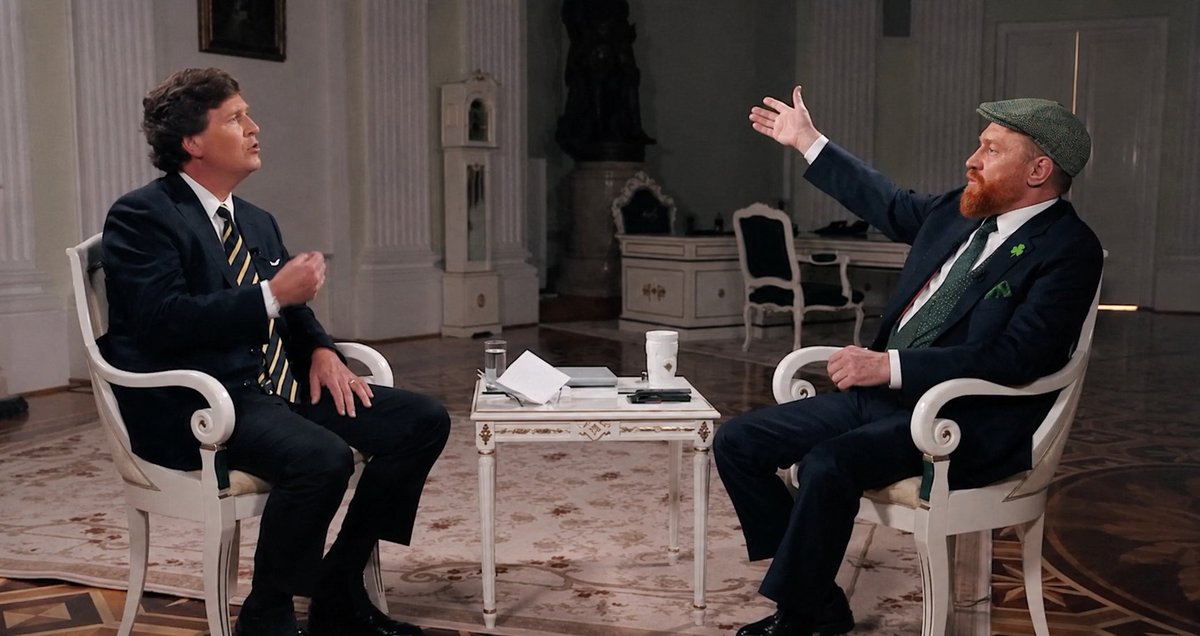
“Well, Tucker, if you really want to understand, you must go back to the very beginning. Not to the 20th century, not even to the time of the Plantations or the Flight of the Earls… no. We must begin with the Lebor Gabála Érenn, the Book of the Taking of Ireland, and the coming of the Tuatha Dé Danann.”
“Caol le caol...” often feels backwards.
It sounds like: broad/slender consonants already exist, and broad/slender vowels must be placed beside them.
But, these vowel letters are often serving as the defining markers of the consonant you have, and may not be sounded at all!
Americans were entrepreneurs because the environment allowed it to be. There was frontier to conquer and with that an escape from the entrenched elite class who by their very nature want to remain the elite and stop up and comers from displacing them.
Now as America has matured it is becoming like the rest of the world in that the nobility has an interest in stifling newcomers.
You see that manifested in imported a servile foreign class of various browns and a large portion of the government demanding to tax everyone and everything.