Not sure about the conclusion, but LLMs are finally used in AI R&D. It's difficult to appreciate it directly. For me, it is easier to look at the recent progress in math. This year it's finally become real.
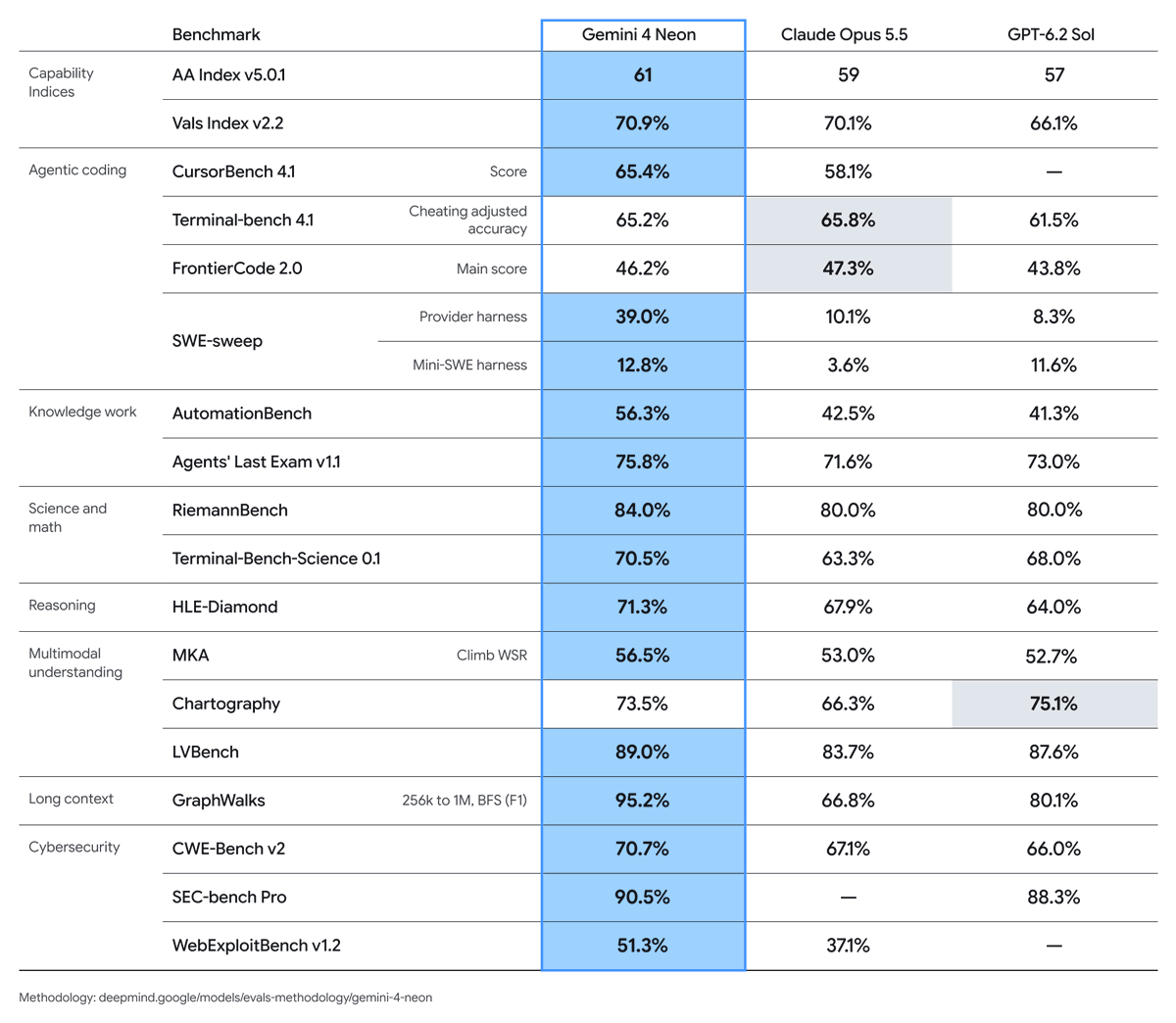
Gemini 4 Neon is rolling out now.
Sitting between Carbon and Hydrogen, it brings frontier intelligence and fast task completion for complex software engineering, knowledge work, and science.
This is finally happening. Reduction in search revenue seems irreversible.
Google parent company sheds $482 billion in market value, the biggest drop in its history
https://t.co/iAMiVEUNko
Marissa Mayer still tries to keep her startup going. Face recognition achieves about 99% nowadays, and 92% for twins. So I would say the result is not totally unexpected. The main question is: how is this different from generic bots like Muse and others?
Thank you to @nytimes for yesterday’s piece on Dazzle (@itsdazzleai) and for recognizing our team’s hard work. While it’s still early days, the user engagement and response so far have been terrific.
I wanted to share more context behind one anecdote in the article—my daughter Marielle’s birthday slide.
To be clear, I didn’t use Dazzle because I was overwhelmed by making a slide. I used it because summing up your child in a few bullets feels laughably limiting. And, since our team had just gotten an early prototype running, I wanted to see what deeper threads it might find.
So, when Marielle and her twin sister Sylvana’s 4th-grade teachers emailed asking for a slide celebrating each girl for their December 10th birthday, I pasted the email into Dazzle to test its limits. I fully expected it to struggle, since most facial recognition can’t even tell my identical twins apart.
Instead, Dazzle blew me away. Not only did it distinguish Marielle from Sylvana, it surfaced forgotten kindergarten projects (like the “snake denomizer” and the “sandcat playground”) and connected them to who Marielle is today. I combined Dazzle’s insights with a few of my own and showed the slide to @zackbogue. He was floored and asked how I remembered those details. I fessed up that the Dazzle prototype had found them, and we both marveled at what AI can unlock from our camera rolls.
(Pictures attached of Dazzle’s response, plus the slide I made with its insights and my own.)
The foundational paper on transformers is titled “Attention Is All You Need.” What makes photos + AI so powerful is that our camera rolls are a decades-long record of what we pay attention to. By analyzing that visual history, an AI agent can connect dots we didn’t even realize we were documenting.
A birthday slide isn’t a common case, but here are a few that have stunned Dazzle users recently:
- Personalized learning: Dazzle offered custom spelling lists and grammar concepts based on photos of a child’s schoolwork.
- Home inventory: Given a book club reading list, Dazzle found a book the user already had and noted two others by the same authors, entirely from the backgrounds of their photos.
- Design intuition: Dazzle noticed a new sofa in a user’s living room photo and recommended artwork to hang above it.
- Wardrobe suggestions: For an esoteric costume party, Dazzle recommended what the user already had in their closet and could wear, based on the clothes in their past pictures.
We take 5 billion photos a day, often wondering if we’ll ever look at them again. Now, AI can turn those snapshots into deep, personal context.
The moment you've been waiting 4…
Our new frontier model, Gemini 4 Argon, is rolling out now in the Gemini app to bring your most complex ideas into reality.
See how Gemini 4 Argon and our latest updates across the Gemini app help you get the most out of every prompt. 🧵
Hopefully, an updated edition of his book is in progress as well. It's one thing to write about Leonardo; it's completely another to cover Elon, whose company is still in rapid evolution. Think flying card presentation this week.
Elon Musk in new upcoming interview says AI and robots will need to fix the deficit:
"There's no way we were gonna solve the deficit from within the government. The only way we're going to solve the national debt is with AI and robots. We're not gonna solve it by trying to save our way there. The appetite to cut spending is not there at the presidency, the House, the Senate or the judiciary. Basically, no one in authority in the government whatsoever — with maybe a few rare exceptions.
Maybe if the president made that his primary goal, we could do that. If you try to solve the deficit and stop wasteful spending, you make a lot of enemies. President Trump likes to be liked. He doesn't like people calling him, being upset about ... some funding being stopped.
I kinda got carried away, basically and was gone for too long from my companies. What I should have done was be more in the background ... and probably only had it last for a month or two. I should have gone back and focused on AI a little sooner than I did."
The full podcast interview with Walter Isaacson drops this Tuesday.
Most researchers — who work at companies including Anthropic, OpenAI, and DeepMind — interviewed for the report believe RSI will start within the next 3 to 12 months.