Bill Chen, the mathematician who proved randomness itself could be turned into a repeatable, provable edge:
"There's one specific skill that got me hired at one of the biggest quant trading firms in the world, and once you actually learn to see it, you'll start noticing it in almost every decision you make with money."
this is the exact skill separating people who make decisions under uncertainty well from everyone else who's just guessing and calling it instinct.
cut through the poker table and the mechanism is almost elegant in its simplicity. instead of trying to memorize the correct response to every possible situation, the actual skill is learning to track how much you'd regret not having chosen each alternative, every single time, and slowly adjusting toward whatever choice keeps that regret lowest across many repeated decisions.
nobody hands you the winning strategy in advance. it emerges purely from paying close attention to your own past mistakes, over and over, until the mistakes become rare enough that nobody can consistently exploit you anymore.
most people make decisions under uncertainty by trusting a gut feeling in the moment, without ever going back to systematically check which past choices they'd actually regret if they had to make them again.
zoom out to how this plays out reviewing a trading decision after the fact on a desk today. tracking regret across many repeated decisions, not just whether a single trade won or lost, but whether a different choice would have consistently done better across similar situations, is exactly the discipline that separates a systematic edge from random noise dressed up as skill.
this is exactly what "trust your gut" advice skips. instinct built on unexamined outcomes and a strategy refined by systematically tracking regret across many repetitions are different things, and only one of them reliably converges toward something better over time.
the edge was never about knowing the right answer in advance. it was about paying close enough attention to your own mistakes that they eventually stopped happening.
Bookmark this gem and follow for more.
🇸🇦 Aramco is already rerouting.
The company is offering extra crude cargoes from Sidi Kerir, its Mediterranean port in Egypt, to bypass Bab al-Mandeb entirely.
This follows the first enforcement action under the new blockade, a drone and missile strike on 2 Saudi oil tankers.
The market thesis is no longer theoretical.
Riyadh itself is now hedging the exact route in question.
https://t.co/xypHlF1x4K
I HAVEN'T STOPPED THINKING ABOUT THIS SETUP SINCE I SAW IT.
No new tab explaining yourself every session. Type a question, get an answer that already knows who you are.
The mechanism is one file. CLAUDE.md.
Not a prompt. A full picture of a person. Who you are. How you think. What you're building right now. Where you get stuck. How you want Claude to talk to you.
Claude reads this file first, every single session, automatically. Never starts from zero.
The actual shift this produces: you stop spending time explaining yourself. You just think.
Every project gets its own folder. Sit down to work, Claude sees only that project, not your whole life, just the one thing in front of you.
Anything you do more than once becomes a skill. One line, and Claude does it your way, every time.
Schedule a daily pass and Claude reviews the entire vault on its own. Links new notes to old ones. Flags what's gone stale. Sends a short summary of what changed overnight.
You open your laptop and the thinking already started without you.
The part that matters most. It's all just text files on your own machine. No cloud dependency, no lock-in. A better model comes out, you point it at the same folder, nothing else changes.
Not a better prompt. An external memory that compounds every day you use it.
Most people use Claude like a smarter search engine. This setup turns it into something that actually knows you instead of guessing.
This is funny.
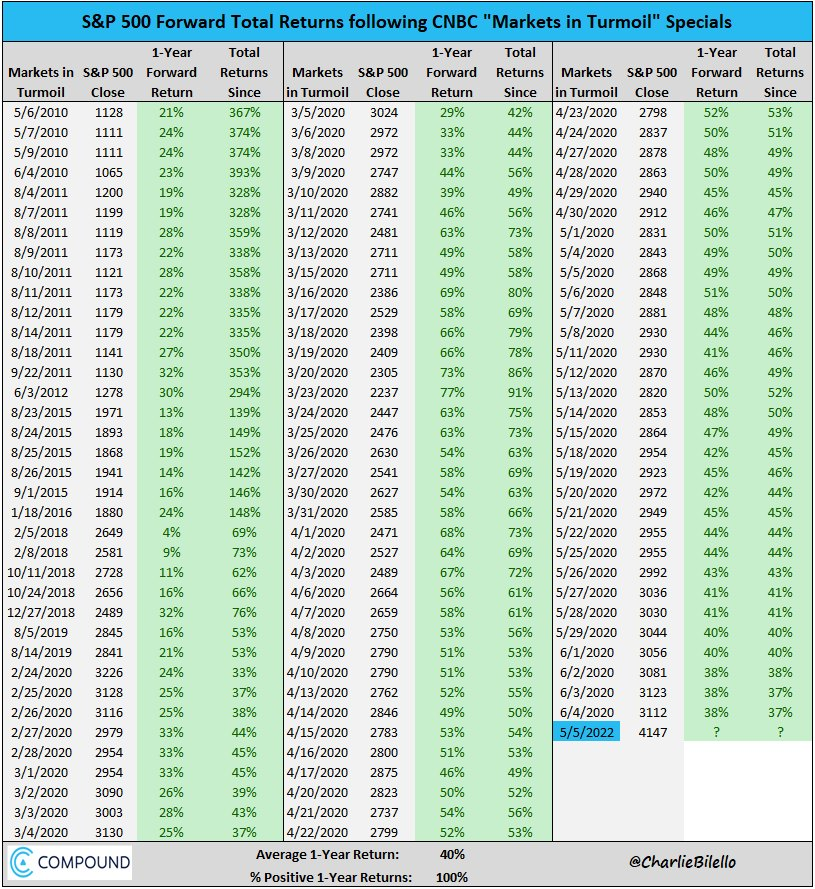
What if you invested in the S&P 500 every time CNBC had a "Markets in Turmoil" special?
Well... your average return after one year would be 40%, with a 100% success rate.
Anthropic didn't build his memory system. He built it himself, and what you're looking at is the proof.
Same source, no gatekeeping. The Obsidian CEO published it, anyone can install it.
That's not a screensaver on his second monitor. It's his vault. Every point of light is a note. Every cluster is a project his AI already understands without being told again.
He doesn't even touch the keyboard to move through it. One hand up, and the whole cluster tilts and spins, like he's turning a globe that happens to be his own head.
A year ago he opened a new AI tab every morning and explained himself from scratch. Who he is, what he's building, what he wants. 200+ hours a year, just re-introducing himself to a machine.
Then he stopped writing prompts and started writing one file instead. It loaded before every session. His goals, his projects, his blind spots. Claude read it first, every time, without asking.
Now the cluster on that screen keeps growing on its own. New notes link themselves. Nothing gets explained twice.
He's not showing off code. He's showing off the machine that finally stopped forgetting him.
Cernovich is right that AI + Big Tech could easily turn into Big Brother. But what’s the alternative to living off the grid or in the Panopticon? The third option is to run your own AI on your own hardware, retaining data sovereignty. That’s why open source matters. It’s software freedom.
Palantir sells governments a war room that costs millions a year.
So, a guy named Elie just rebuilt it, put it on GitHub, and gave it away.
It's called World Monitor.
Open it and you get a live 3D globe with 500+ news feeds pouring in across 15 categories, all summarized by AI as they land.
> Military movements.
> Economic shocks.
> Natural disasters.
> Cyber incidents.
> Flight paths.
> Shipping lanes.
+ 56 different map layers you can stack on top of each other.
It scores 31 countries on a stress index and updates the number as things happen.
It watches 29 stock exchanges, commodities, and crypto in one panel.
It runs local AI through Ollama, so you can use the whole thing without a single API key.
Native desktop app for Windows, macOS, and Linux. 25 languages. Works out of the box after one clone.
You must avoid having guilt and shame at all costs
Guilt and shame are the lowest of low frequencies
Most arent even aware of this
When you are vibrating on the frequency of guilt or shame you are in the lowest possible state of being
In hell
Now what do you think you attract when you are in a low frequency? More low frequency entities
Scarcity is low frequency . Struggle is low frequency .
This is why some people cant seem to outrun misfortune
This is why it is so important to live in alignment with a total clear conscience
You simply cannot ascend into higher states of being without getting rid of your guilt and shame