Ready to grow your accessibility awareness this fall? Join me on October 1 and October 15 for two open-to-all events about digital accessibility basics and actions you can take to improve the accessibility of your own work. Learn more and register here: https://t.co/2gevjsVnrZ
Ready to grow your accessibility awareness this fall? Join me on October 1 and October 15 for two open-to-all events about digital accessibility basics and actions you can take to improve the accessibility of your own work. Learn more and register here: https://t.co/2gevjsVnrZ
Notebook authors, I'm thrilled to be able to share recommendations for writing more accessible notebooks! This talk answers questions educators, researchers, and docs writers have been asking me for years.
https://t.co/VBa1q6uEcY
@DocFast@venkypotluri@IotaSchool And I often design tests to not spend a lot of our test time running a resource heavy computation because those tests were made to answer different questions.
@DocFast@venkypotluri@IotaSchool It sounds like we might have different manual testing goals, though. Tests I've been involved in were not designed specifically to test strain/high resource notebooks or interactions. For example, I don't think we've ever broken 100 cells on a notebook I've tested in.
Currently, @ProjectJupyter Notebooks are not accessible for screen reader users, often keeping #blind folks out of STEM. We presented @JupyterCon on our team's recent work on improving #a11y for HTML notebooks.
https://t.co/0k1w6jFgum
@DocFast@isabelapf2@eteq +Jen Kotler
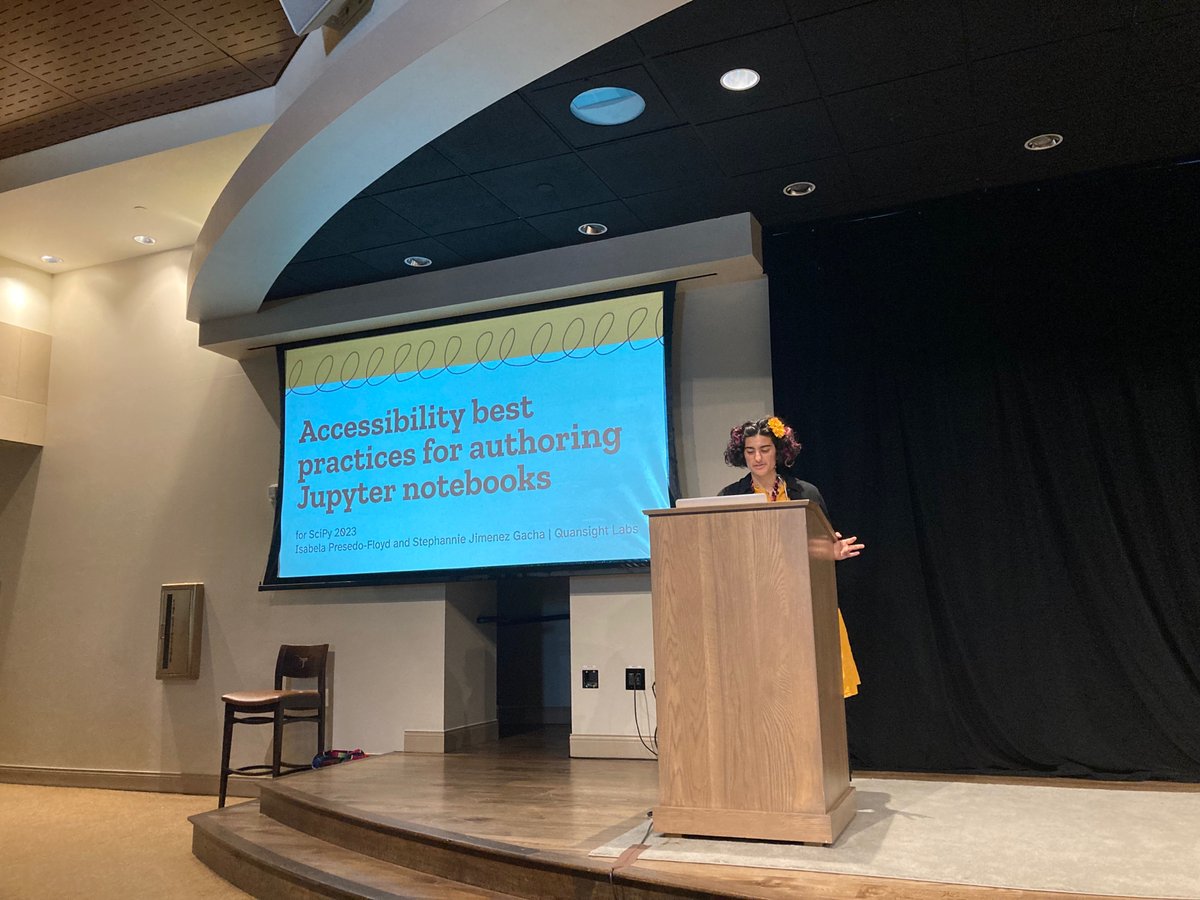
Coming up @SciPyConf! 🙌 We’ve got @isabelapf2 discussing “Accessibility Best Practices for Authoring Jupyter Notebooks.” Learn how to create inclusive notebooks and thereby reach a wider audience. 🖊️ Co-authored by @StephannieJime2
https://t.co/ZDj2TOIuEb
back during my GSOC the numpy/matplotib handling of Unicode was severely busted & and I learned this by accident cause I was writing tests w/ Cyrillic characters - the previous tests for Unicode used ASCII characters that had been "encoded" into Unicode.
Slides here from yesterday's SciPy talk on making Jupyter notebooks accessible:
https://t.co/IafgsHeuMr
As usual, many practices that help disabled users are also better for everyone.
I'm recruiting participants for a JupyterLab #accessibility study! Please check it out and share around.
More info and a sign up link on the @ProjectJupyter Discourse: https://t.co/ZiV0vtQyPq
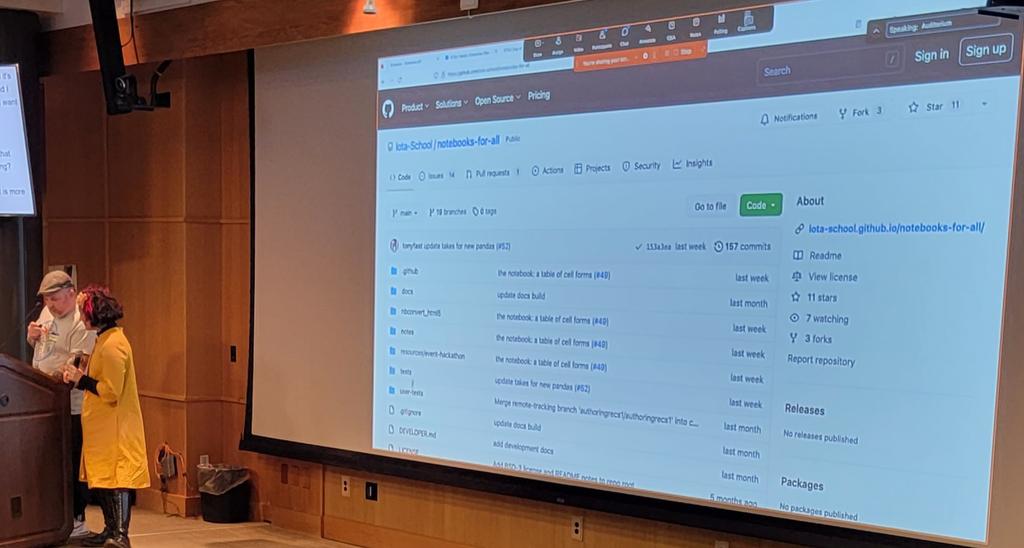
Great presentation by @isabelapf2 and T Fast on the https://t.co/WhJowYNrgr project (with @psmyth01, J Kotler, and myself) doing user testing to improve the accessibility of Jupyter notebooks at the #dayofaccessibility at @stsci
There are two days left to register for the Day of Accessibility at @SpaceTelescope! It's a jam-packed schedule of experts, and you might get to see me there.✨
Register in person or virtual at https://t.co/Pe6cLvhus1
I'm recruiting participants for a JupyterLab #accessibility study! Please check it out and share around.
More info and a sign up link on the @ProjectJupyter Discourse: https://t.co/ZiV0vtQyPq
Your next Jupyter community call is coming up on February 28 at 8am Pacific. This is a great time to share something in Jupyter's orbit you learned, you made, or that you want to say thanks for!
More info on the Jupyter discourse: https://t.co/9cQdVC3OSG