A new combined solar PV cell + thermoelectric generator could provide a continuous source of renewable energy for people without access to the electrical grid.
https://t.co/kevWSE4Pvs
Super-resolution, sub-cellular-level images of coronavirus reproduction could aid the development of infection-fighting therapeutics. https://t.co/OWWKjNmmyL
The surface of iron plays a crucial role in corrosion, forming reactive species even when the material is immersed in a non-corrosive fluid, say researchers @RiceUniversity. https://t.co/kcwVugJrhS
[#TOP10] ☀️ « Passant de ~10GW à 600GW sur 10 ans. L’énergie solaire mondiale peut alimenter le Brésil. Cette utilisation dépassera nos réserves de silicium! »
➡️ Pour Nathanaëlle Schneider, il faut privilégier la piste de matériaux alternatifs.
https://t.co/tCWdf0Q3bz
A new wood-based material developed at @BrownUniversity and @UofMaryland that conducts ions 10-100 times better than other polymers could find use in next-generation solid-state lithium-ion batteries. https://t.co/QQ3YAehEQD
"Urban mining" – the process of recovering valuable metal from electronic waste – could become much less energy-intensive thanks to a newly-expanded technique called flash Joule heating.
https://t.co/X52xUT8oOw
Conventional soft capacitive pressure sensors only work at pressures below 3 kPa, meaning that tight-fitting clothing can be enough to hinder their performance. @nanshulu and colleagues @UTAustin built a hybrid sensor that works over a much wider range. https://t.co/iNpFhMbrw1
A new ultrasound technique that measures the strength of atomic bonds within 2D materials, as well as the weaker forces between layers, reveals that the velocity of sound within these materials depends on the layers’ stacking arrangement. https://t.co/0U1nFpwCZ6
Quantum materials known as Mott insulators can “learn” to respond to external stimuli in a way that mimics animal behaviour, say researchers @RutgersU. The discovery could lead to new AI algorithms. https://t.co/DxpURPF3d9
“Where does the local magnetism come from in this metal-organic nanomaterial?” Nanoscience researcher @kumar_dhaneesh of @FLEETCentre found that it's all in the material's star-like "kagome" structure.
https://t.co/djwV5YhLLQ
🏇 « Bien que nous ayons de nombreux choix en ce qui concerne les différents matériaux photovoltaïques disponibles et en cours de développement, il est difficile de prédire lesquels gagneront la course. » Nathanaelle Schneider @CNRSIdFSud @IPVF
https://t.co/tCWdf0Q3bz
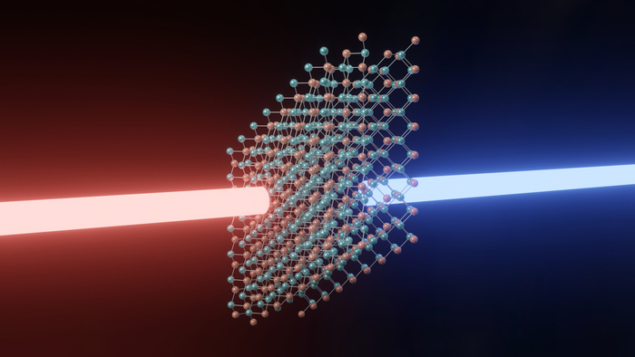
Researchers in China and Spain have made a "saser" – a laser for sound waves – by adding a gain medium to artificial acoustic materials known as sonic crystals. The new saser could have applications in medical ultrasonics and materials testing. https://t.co/457hfnz7Us
Electrons in a transition metal superconductor called ditetrelide (niobium germanide) flow like a fluid rather than behaving as individual particles – a finding connected to the physics of electron-phonon liquids. https://t.co/ZrRCmZi2ys


![Poly_InsightsFR's tweet photo. [#TOP10] ☀️ « Passant de ~10GW à 600GW sur 10 ans. L’énergie solaire mondiale peut alimenter le Brésil. Cette utilisation dépassera nos réserves de silicium! »
➡️ Pour Nathanaëlle Schneider, il faut privilégier la piste de matériaux alternatifs.
https://t.co/tCWdf0Q3bz https://t.co/ow6KnGcEjH](https://pbs.twimg.com/media/FIVKhltXIAIJ8tf.jpg)