Google Ads for Ecom Brands | $60M+ in Revenue | 100% Performance based.
100+ DTC brands scaled
A city on a hill cannot be hidden. — Matthew 5:14
Free Audit 👇
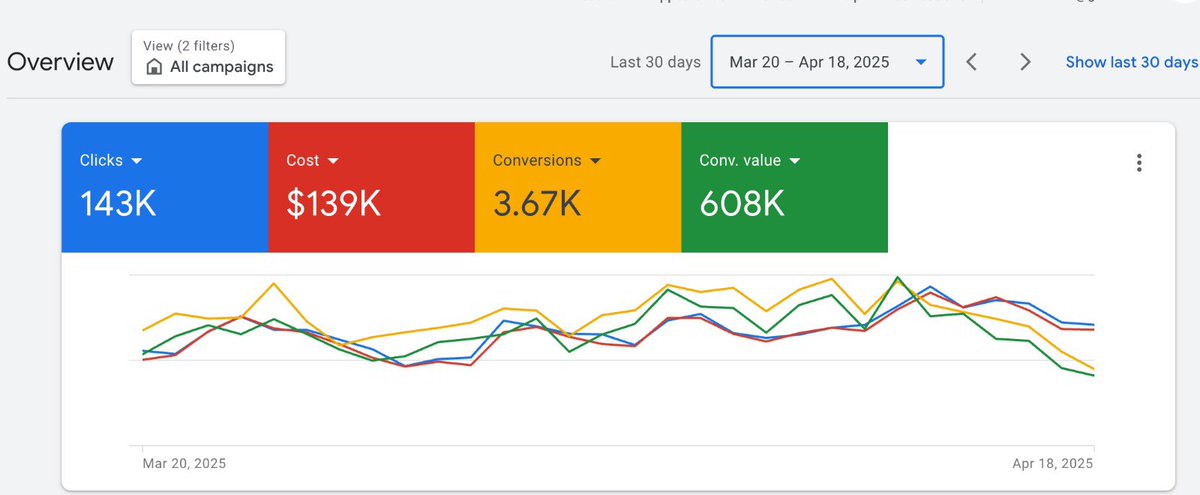
Last month with this brand:
Spent $139K on Google Ads.
Pulled in $608K.
143K clicks.
3.67K conversions.
When the math works, scale is inevitable.
If you’re selling high-intent products & not seeing this kind of return—your campaign structure’s leaking money.
DM me—I’ll run a free audit & show you exactly where you’re bleeding cash.
30 days of Demand Gen + PMax + General search for a client:
→ $54.7K spend
→ $265K conversion value
→ 4.86 ROAS
The "black box" excuse is dead. Next stop: a half-million-dollar month.
Real companies have:
a physical address that google can verify.
a google business profile with real reviews.
a customer service team that answers the phone.
a return policy that's actually followed.
a website that looks like it was built for humans, not conversions.
Brand search volume that exists without paid ads.
an email list that people actually open.
ecom brands built on the "paid ads + dropship" playbook have none of these.
and google's trust model is quietly penalising them for it.
Not in an obvious way.
Not a suspension or a flag.
just a slightly lower quality score.
a slightly higher CPC.
a slightly lower impression share.
a slightly slower product approval.
Death by a thousand small disadvantages.
A classic case of infringement and cybersquatting.
If you're dropshipping, never do this. Sooner or later, the penalties will put you right back in grandma's garage.
Nobody in the ecom space talks about how fragile these businesses actually are.
i mean genuinely fragile.
one event away from zero.
i've watched it happen three times in the last 18 months.
Brand one: google merchant center suspension. $600k/month revenue. gone in 48 hours. support took 19 days to respond meaningfully. they had no email list. no organic traffic.
no wholesale channel. $600k/month to zero for 19 days. two employees let go in week one.
Brand two: meta ad account banned. $400k/month. had a backup account. that got banned too for being associated with the first.
Took 6 weeks to resolve. founder burned through his entire cash reserve keeping inventory moving with zero revenue.
Brand three: payment processor flagged the account for chargeback ratio. stripe froze $180k in reserves. shopify payments terminated.
couldn't process orders for 11 days while finding an alternative.
All three of these founders had one thing in common.
they built businesses entirely dependent on platforms they don't own.
🚨 Our team noticed a massive spike in Google Merchant Center "Product page unavailable" errors on June 3.
If your live landing pages are suddenly getting flagged as uncrawlable, it’s a widespread Google glitch.
Don't wait for a slow auto-resolve to tank your performance.
Go to your GMC "Needs Attention" tab, select a flagged item, and click "Request Website Check" to force a recrawl and get your ads back on track within 24 hours.
the ecom playbook that made people rich in 2020 is now the playbook that's making them broke.let me explain exactly what changed.2019-2022:
CPMs were cheap. competition was thin. google and meta were hungry for advertisers. you could run a mediocre product, decent images, generic copy — and print money.margins were good because CAC was low.
CAC was low because most brands hadn't figured out paid yet.
you were early. that was your entire advantage.that era is completely gone.
here's what actually happened:the brands that survived ios14, the privacy changes, the cookie deprecation, the AI overhaul — they got operationally excellent.they fixed their feeds.
they built real creative systems.
they understood their unit economics.
they segmented by margin.
they built retention infrastructure.and now they own the auctions.
when CPCs went up 40% between 2022 and 2024, weak brands exited.
the floor got cleaner.the remaining brands got stronger signals, lower auction competition, and better placement.
if you're entering ecom in 2026 with a white-label product, a $300 shopify theme, and a facebook ads course from 2021 —you're not competing with other beginners.
you're competing with brands that have been compounding for 4 years.they have better creative, better data, better LTV models, lower CAC from established brand search volume, and a google trust score you can't buy.
they will outbid you, outconvert you, and outlast you.this isn't doom.
it's just the honest state of the market.the bar is higher.
Your conversion rate problem is a pre-click problem.
most founders fix the landing page.
the real fix is the image.
people decide in the search results.
they've already judged your price, your brand, your quality — before they hit your site.
if the image doesn't look worth it, the landing page never gets a chance.
$200k/month in ad spend.
zero impression share report pulled. ever.
we inherited the account 6 weeks ago.
top 5 products were sitting at 34% impression share.
Google was barely showing them.
Here's everything that actually matters from google marketing live 2026:
Gemini scores your creative before the auction now.
Ads are coming to AI mode — feed quality decides who shows up.
Universal cart is google building checkout infrastructure between you and your customer.
ask advisor removes the data interpretation moat agencies relied on.
Data retention cuts to 37 months june 1 — export your history now.
Qualified future conversions predicts LTV — only works if your tracking is clean.
Meridian is now inside analytics 360 — google measuring google's own effectiveness.
The biggest announcement from GML nobody is talking about:
Universal cart.
Google is building a persistent shopping cart that works across search, youtube, gmail, gemini, and maps.
A user adds your product on youtube.
comes back to google search two days later.
the cart is still there.
This sounds amazing for conversion rates.
and it is.
but here's what it actually means:
Google is building checkout infrastructure that sits between you and your customer.
you get the sale.
Google owns the relationship.
three things that should be in every agency report but never are:
impression share by top product
merchant center disapprovals this month
feed coverage — how many products are actually eligible to show
if your report is just spend, clicks, ROAS —
you're reading the highlights with no context.
In a landmark judgment on May 22, 2026, the Delhi High Court held Google liable for trademark infringement.
The case was between Hindware and Google. The court held that, by allowing competitors of Hindware to purchase the keyword “Hindware” (a trademarked name) through Google Ads, Google enabled trademark infringement. The court said that “Hindware” is not a generic English word but a specific brand trademark. By allowing competitors to place ads on that keyword, Google is enabling competitors to divert traffic that should have legitimately gone to Hindware.
This has been a big challenge for companies, both big and small. Even today, if you search for Zerodha, you will see search results from competitors. This has been happening for well over a decade.
Although it is hard to quantify, we have lost a lot of business to this. Think about what happens. Whenever someone searches for "Zerodha", the traffic should rightfully come to Zerodha. But what often happens is that the first couple of results on Google Search are ads, leading the customer to a competitor's website. In the process, we lose business that should have come to us.
This is made worse by the fact that we do not advertise.
There is also an even more ironic thing here. A lot of brands, just to capture the traffic that should have come to them organically, end up bidding on their own keywords. Think about it. If you own a business and have a trademarked name for your business, you still have to pay Google just to hopefully make your name too expensive for your competition to run ads on it.
But now, thanks to the Delhi High Court judgment, we have the option of taking legal action whenever we come across instances of other companies squatting on our keyword.
The other brilliant part about this judgment is that it levels the playing field. And this matters even more for startups, who are already starved for resources and have the odds stacked against them. The last thing they need is for competitors to bid on their brand keywords and steal their traffic.
This judgment now opens up a route for legal recourse whenever such deceptive practices occur.
While keyword squatting is most visible in Google web results, it is an even bigger problem when it comes to app stores. Whenever someone searches for your brand, the first couple of results, both above and below your app listing, often tend to be those of your competitors. And in the case of app stores, I think the ads are even more problematic. When a user clicks on an app-store ad, they often end up installing an app. That is a much higher-commitment action than clicking on a competitor’s web search result and then just closing the page. Because the user has installed an application, the conversions, at least anecdotally, tend to be much higher.
Again, brands that do not advertise are at the receiving end of this. So I welcome this ruling and hope this changes the unfair norms we've been living by for so long.
June 1, 2026 — google cuts granular reporting access to 37 months.daily, weekly, hourly data older than 37 months.gone. permanently.
no recovery.
If your agency hasn't exported your historical campaign data, conversion history, product-level performance, and search terms —it's gone after thursday.
What to export before june 1:
Campaign performance by day going back 3+ years.
Product-level ROAS history.
search terms report.
Conversion data by campaign.
audience performance https://t.co/9QTR8r4CGp it in bigquery, google sheets, or a spreadsheet.
if your pmax is spending 70% of budget on low-margin products — no financial model saves you.
margin-adjusted tROAS per product tier.
that's where profit actually gets fixed.
before the spreadsheet. inside the campaign.
ask your Google Ads agency this:
are you bidding the same tROAS on a 20% margin product and a 60% margin product?
if yes — you're scaling your worst products the hardest.
A 10x ROAS on PMax is not always good news.
If 80% of your conversions are brand search — you're paying for customers who were already coming.
PMax loves brand traffic because it converts easily.
It inflates your ROAS. Makes the campaign look like a hero.
Meanwhile new customer acquisition is zero.
Segment your brand vs non-brand conversions