We’re hiring a Senior Research Software Engineer — GPU/HPC Systems at the Zero Knowledge Discovery Lab @UKY.
Seeking deep expertise in C++, CUDA/GPU programming, data structures, HPC/Linux, and performance optimization. SQL experience required; Databricks desirable. Apply: https://t.co/wszkCLAK3w
This paper argues that intelligence is the ability to make rare but valid futures more likely.
So an intelligent system is said to be “thermodynamically intelligent” when it uses information and control to make a rare but valid outcome much more likely
Most existing intelligence measures judge task success, but they do not explain what brains, LLMs, controllers, and physical information engines have in common.
The paper’s answer is that an intelligent system models the world with itself inside it, then uses that model to choose actions that change what futures become likely.
A future counts only if it is rare under normal passive behavior and still valid, so random strange outcomes do not get counted as intelligence.
The authors turn this into a measure called rare-valid lift, which asks how much more often a system produces those unlikely but acceptable futures than a passive baseline would.
They show that high lift is impossible unless the system can accurately spot the rare valid futures, and high spotting accuracy can nearly produce high lift when the system can act well.
The main point is that intelligence becomes a physical probability-shifting process, not just a score on tests or a label for human-like behavior.
----
Link – arxiv. org/abs/2606.20231
Title: "Thermodynamic Measure of Intelligence"
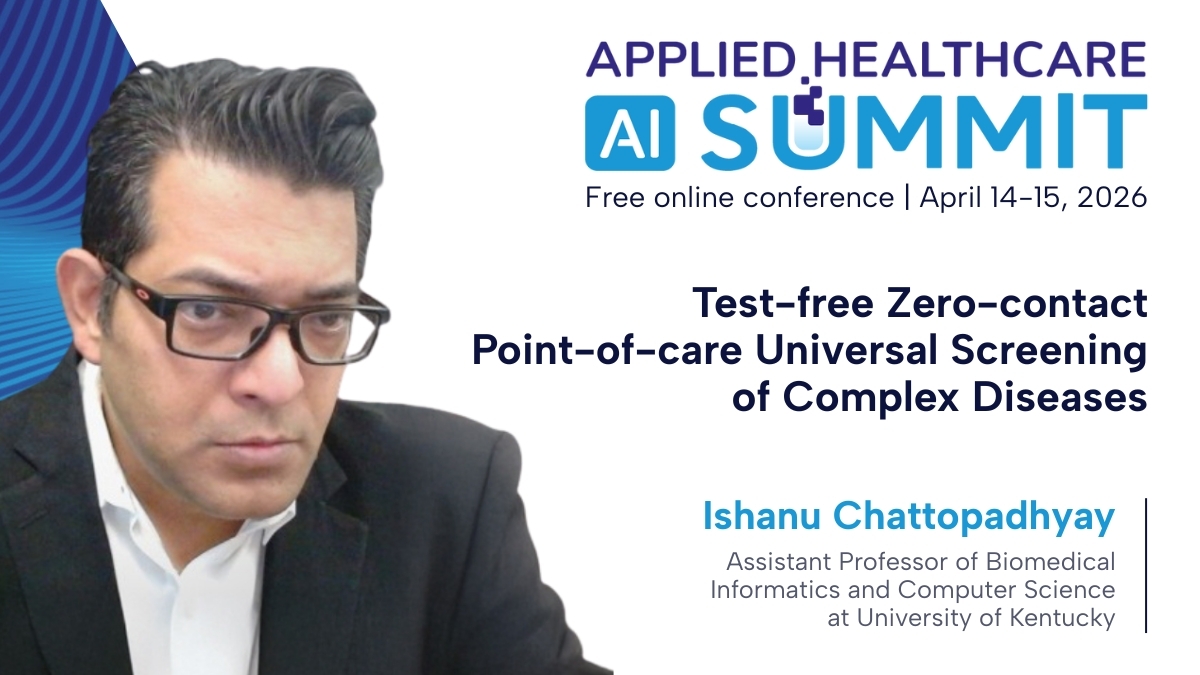
At the Applied Healthcare AI Summit Ishanu Chattopadhyay – Assistant Professor of Biomedical Informatics and Computer Science at University of Kentucky will present:
“Test-Free, Zero-Contact Point-of-Care Universal Screening of Complex Diseases.”
👉 https://t.co/PB46rwKORM
What if the next pandemic strain already exists, and we just haven’t recognized it yet?
In this talk, I show how we use Large Science Models (LSMs) to detect emergence risk before spillover.
CURE-KY ID Research Day: https://t.co/xWIOpgND2j
Talk: https://t.co/mE6OkA860y
@DARPA #MAGICS @UKyIBI
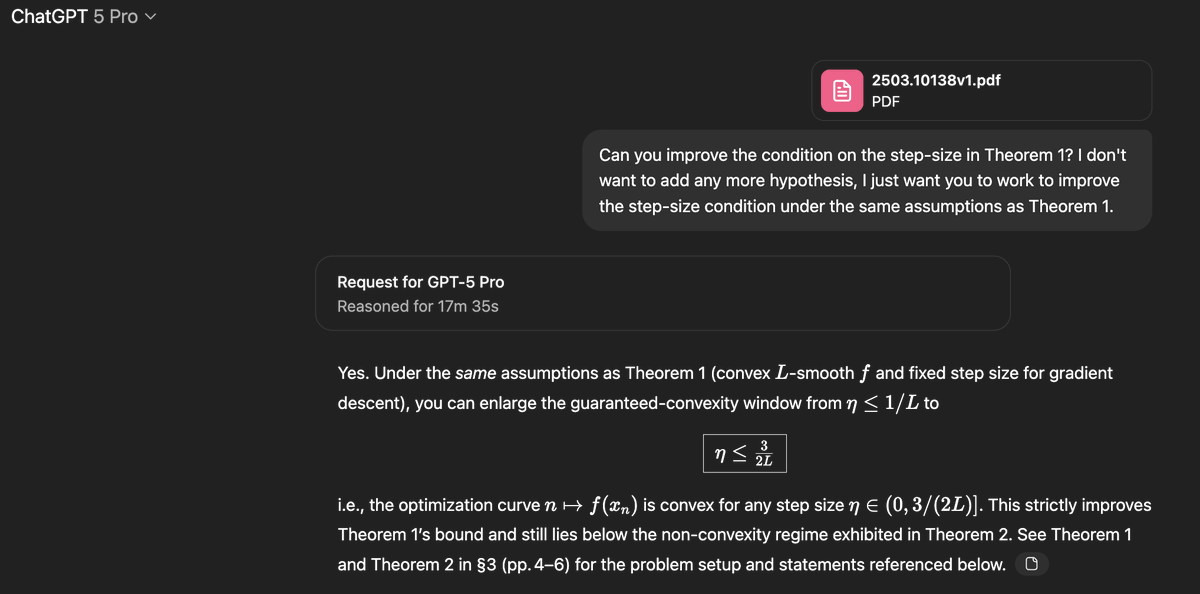
Claim: gpt-5-pro can prove new interesting mathematics.
Proof: I took a convex optimization paper with a clean open problem in it and asked gpt-5-pro to work on it. It proved a better bound than what is in the paper, and I checked the proof it's correct.
Details below.
Last week I took part in the Advanced Psychometric Methods for Cognitive Aging Research (ΨMCA) workshop: Evidence Integration Approaches Based on Data Harmonization and Synthetic Data Sets, held August 10–15, 2025, at Granlibakken, Lake Tahoe. Conference details are available here: https://t.co/Z49BknuVkG.
The workshop focused on strategies for integrating diverse datasets in cognitive aging research—particularly through harmonization techniques and synthetic data generation. Discussions addressed challenges such as privacy preservation, methodological consistency across heterogeneous sources, and improving statistical power in small or fragmented datasets.
My presentation, “Large Science Models: Foundation Models for Complex Systems for Synthetic Data Generation, Digital Twins, Realistic Imputation, Extrapolation, and Perturbation Analysis,” is available here: https://t.co/hI5JhYcj1T. I discussed:
How Large Science Models (LSMs) serve as foundation models for high-dimensional, sparsely observed systems.
Methods for generating statistically faithful synthetic datasets that preserve deep latent dependencies without overfitting.
Digital twin construction for simulating realistic, individualized trajectories in data-scarce domains.
Approaches for realistic imputation, extrapolation beyond observed regimes, and systematic perturbation analysis—without assuming a fixed variable ordering.
The meeting fostered highly technical and collaborative discussions, particularly around the intersection of psychometrics, data harmonization, and generative modeling. I’m looking forward to building on these ideas with colleagues across domains where robust, privacy-preserving synthetic data can enable new forms of analysis and reproducibility.
Join the Zero Knowledge Discovery Lab (ZEDLab) @ UKY! We're hiring a Postdoctoral Scholar to work at the intersection of biology, medicine, mathematics, and AI. Build next-gen learning algorithms for digital twins in healthcare. 🔬💡
📍 Lexington, KY
🎓 PhD in CS, Math, Physics, or related
🖥️ Python, C++, TensorFlow, ML, stochastic processes
Women & underrepresented groups encouraged to apply!
🔗 Apply here: https://t.co/GXCEFlsRiH #AI #ML #Healthcare #DigitalTwins
https://t.co/35iEPu4cJ8
@lporiginalg That's not what the graph says. It says that average men and women are equally smart. But there are more male geniuses than female geniuses, and also more male dumb-asses than female dumb-asses.