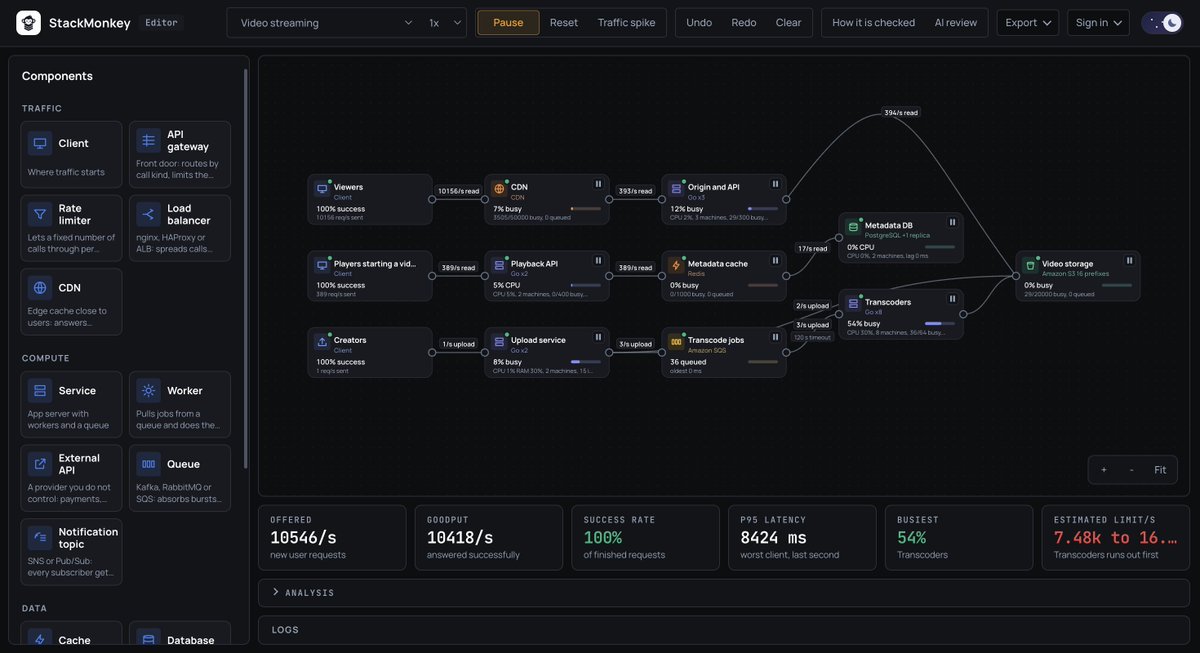
Built StackMonkey: drag in a load balancer, cache and database, send traffic, and watch what breaks first. Free, runs in the browser, numbers checked against queueing theory.
https://t.co/iAi3FvgVyw
System design is better learned by breaking things, not just drawing boxes.
StackMonkey is a free playground to design architectures, simulate traffic, and discover bottlenecks under load.
Built for engineers preparing for system design interviews.
https://t.co/iAi3FvgVyw
@ProductHunt Liance finds gaps continuously, maps them to controls, and pushes work to your team before audit week turns chaotic.
https://t.co/C2hxgLwBZo
@vikrambuilds Liance finds gaps continuously, maps them to controls, and pushes work to your team before audit week turns chaotic.
https://t.co/69gmKV8IhJ
@suni_code Liance finds gaps continuously, maps them to controls, and pushes work to your team before audit week turns chaotic.
https://t.co/69gmKV8IhJ
Superplan turns AI from chatty guesser into a disciplined executor.
A CLI-first system that forces step-by-step workflows, prevents drift, and ensures real progress not hallucinated “done.”
Open source → https://t.co/lckYy4aNGb
After working with AI agents in real systems, one thing is clear:
Prompting doesn’t fail because prompts are bad.
It fails because decisions stay implicit.
When agents re-infer intent at every step, drift and hallucinations are inevitable. Planning forces decisions before execution.
Read more: https://t.co/4cRO1QWtpQ
I feel sort of a fatigue re-explaining things to these coding agents. I call it AI Fatigue. Written some thoughts on how I talk to my agent.
Read more: https://t.co/7QrPnWdvWT
How do PayPal, Visa, banks and open banking interact with each other?
The diagram below shows how the payment ecosystem works from a bird’s eye.
From bottom to top:
🔹 A bank or a PSP (Payment Service Provider) provides payment services to merchants and card holders.
🔹 The card schemes such as Visa and Mastercard connect to PSPs on both card acquiring and issuing sides. They do clearing for credit/debit card transactions.
🔹 The commercial banks have reserve accounts in the central bank, where the actual money movement happens.
🔹 Open banking provides universal APIs for 3rd-party service providers to access bank accounts and create transactions. By creating a 𝐬𝐡𝐨𝐫𝐭𝐜𝐮𝐭 in the current systems, open banking APIs are already fostering innovations.
In payment systems, the information flow and settlement flow are separated. So although there are layers of systems in the diagram, they don’t need to happen at the same time.
Over to you: How will open banking impact the current payment systems?
–
Subscribe to our weekly newsletter to get a Free System Design PDF (158 pages): https://t.co/RibM5u7UxP