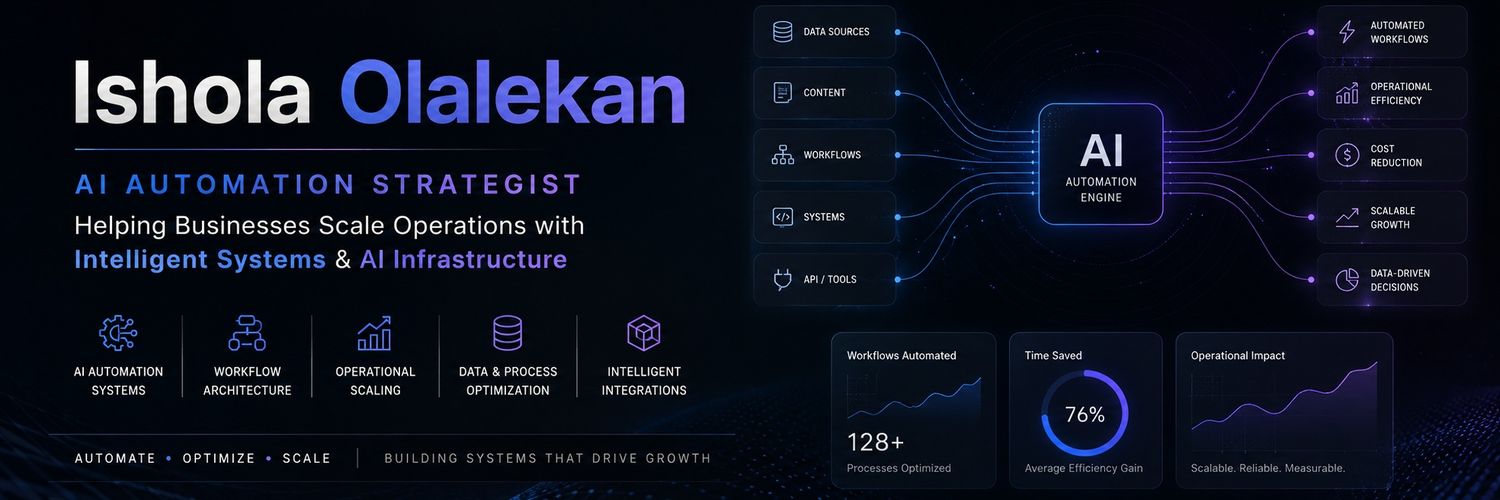
We generated content for 10,000 products in 6 hours.
Total cost: $900. Nine cents per product.
The human equivalent: 5,000 hours of work. $97,500–$150,000. Four months.
The revenue impact: +250% in 90 days.
AI didn't cause the revenue jump. Removing the catalog bottleneck did.
That's the difference between AI as a gimmick and AI as infrastructure.
I build the infrastructure. Thread on exactly how it works coming this week.
A chess grandmaster was once asked what it felt like to lose to a computer for the first time.
He said it felt like nothing.
That answer matters more now than ever.
Because AI does not want anything.
It does not want to protect your customer relationship.
It does not want to preserve trust.
It does not want to notice that a technically correct answer is commercially reckless.
It just executes.
That is its strength.
That is also its limit.
A lot of the AI conversation is still framed the wrong way.
Human vs machine.
Smarter vs faster.
Replacement vs survival.
But the real question is:
Where should execution end and judgment begin?
That is where useful systems are built.
In practice, the highest-leverage AI workflows usually look like this:
• AI handles throughput, repetition, and structured data
• guardrails define what it can and cannot do
• human-in-the-loop review protects high-consequence decisions
• the operator keeps ownership of meaning, context, and tradeoffs
The important part is not autonomy.
It is agent reliability inside a well-designed workflow.
The AI can draft the message.
A human decides if sending it is wise.
The AI can flag the anomaly.
A human decides what it means.
The lesson for operators is simple:
Do not confuse execution with judgment.
As workflow automation gets better, judgment becomes more valuable, not less.
That is the line that matters.
#AI #WorkflowAutomation #HumanInTheLoop #Operations #Ecommerce
Paid AI tools vs free alternatives that actually work.
• Research: Perplexity Pro → free: https://t.co/uJlnvXuHYo
• AI chat / writing: ChatGPT Plus or Jasper → free: https://t.co/cr72i6sU8t / https://t.co/b9kpXMQ1S8
• Image generation: Adobe Firefly → free: https://t.co/A1eWweNBQm
• Video creation/editing: Runway or Premiere → free: https://t.co/IkbedVgoqx
• Design: Canva Pro → free: https://t.co/vbhEqCNAaD
• Coding assistant: Cursor Pro → free: https://t.co/oAgsCfi3JV
• Meeting notes: Fireflies Pro → free: https://t.co/aQ1cGKNDLO
• Research across documents: paid RAG tools → free: https://t.co/58tZHAD4xP
• Voice generation: ElevenLabs Pro → free: https://t.co/o3bG742u66
• Automation: Zapier → free: https://t.co/kj8z3T3X0E
Pay when limits create real drag on throughput.
Not before.
The goal is not novelty. It is operational leverage.
#AI #WorkflowAutomation #AITools #Operations #Productivity
Three years ago, the question was:
Can AI do this?
Now the question is:
Who is going to build the system that makes it work inside my actual business?
That is where the money is.
Not in the models.
Not in the tools.
In closing the gap between AI capability and business implementation.
That gap is still enormous.
A company has a process costing $30,000 a year in manual work.
The solution already exists.
But nobody internally has the workflow, system design, or time to build it properly.
So they keep paying the $30,000 tax.
That is the opportunity.
Last year, I built a catalog automation pipeline for an ecommerce merchant.
3,500 products to 10,000 in six hours.
$900 in API cost.
250% revenue growth in 90 days.
The important part is not that the AI looked impressive.
The important part is that the bottleneck was expensive.
The pattern is simple:
• Find a process with clear operational drag
• Calculate what the current manual workflow really costs
• Build the infrastructure that removes it
• Add guardrails and human review where needed
• Price the solution somewhere between build cost and business value
That is useful, not futuristic.
The real question is not whether AI can help.
It is whether you can identify friction and build something reliable enough that a business pays to keep it running.
That is the line that matters.
What manual process have you seen that should already be automated?
#AI #Ecommerce #WorkflowAutomation #CatalogAutomation
A store owner showed me her chatbot metrics last year.
On paper, it looked like a massive win: ticket volume down, instant response times, and interactions costing $0.50 instead of $6.
Then she showed me the reviews.
Customers were furious. One tried to exchange a damaged product, and the bot just spam-sent the standard return policy four times. By the time a human stepped in and fixed it in four minutes, the customer had already decided never to come back.
The issue wasn't the AI. It was the lack of workflow judgment.
A bad self-service interaction is worse than no self-service at all. The $5.50 saved on a ticket means nothing if you burn the customer’s lifetime value in the process.
Smart automation needs clear guardrails:
• Let AI handle: order tracking, basic returns, FAQs, and policy lookups.
• Route to humans: damaged items, edge cases, policy exceptions, and second-attempt failures.
The goal isn't replacing your team. It's letting the bot handle the volume so your humans can handle the moment that actually saves the relationship.
What’s one support scenario you’d never trust an AI to handle alone?
#ecommerce #customersupport #AI #workflowautomation
You can be the most qualified person for a job and still never get an interview.
Not because a recruiter rejected you.
Because the recruiter never saw you.
Your CV had to get past a machine first.
ATS.
Keywords.
Formatting.
Job description matching.
The uncomfortable truth about job hunting in 2026:
You’re not just competing for the job.
You’re competing for the right to be seen.
Use AI to get past the machine.
Then let your experience speak for itself.
#AI #Hiring #Careers #FutureOfWork #ArtificialIntelligence #Recruitment #JobSearch #CareerTips #ResumeTips #Workflow #Positioning #WorkflowAutomation
The question is not whether candidates use AI.
The better question is whether they can do the work.
Hiring already runs on AI screening.
But judging you for using AI to write CV/Resume is weird.
My Take: Use AI to sharpen your story. Don’t let it replace you.
#AI#FutureOfWork #Hiring #Career #ArtificialIntelligence #Recruitment #JobSearch #CareerTips #ResumeTips
Africa isn’t behind in AI.
African builders are building for reality, not ideal conditions.
Unstable power. Weak connections. Messy data. API failures.
So they build resilience from day one.
The constraint may be the advantage.
Maybe Africa isn’t catching up to the future.
Maybe it’s building it differently.
#AI #Africa #WorkflowAutomation #SystemDesign
I work alongside AI every day. Here is what that actually looks like:
I write the first line of every important email.
The machine writes the rest.
Then I edit until it sounds like me again.
I do the first five minutes of every research task.
I decide what I am actually trying to understand.
Then I hand it over and judge what comes back.
I design every workflow automation system myself.
The machine helps with code, pattern recognition, and speed.
But the system design is still mine.
I handle every difficult conversation personally.
Because context matters.
And stakes are rarely visible in the prompt.
I write the last line of every piece of content myself.
Because the last line is usually where positioning lives.
After a year of this, here is what I have noticed.
The work did not get easier.
It got more concentrated.
The manual work that created drag started to disappear.
Not all of it.
But enough to change my throughput.
And that is the important part.
AI did not remove the need for judgment.
It increased the value of judgment.
That is why I think most teams frame this incorrectly.
The real question is not whether AI can do the work.
The better question is:
What work should stay on the human write path?
And what friction should the machine remove?
That is where operational leverage comes from.
Useful, not futuristic.
What have you handed to a machine and not looked back?
#AI #WorkflowAutomation #OperationalLeverage
@Amaa_baby1 Exactly this. The drag disappears, the judgment compounds, and suddenly you realize your best thinking was always being taxed by work that never needed you.
Before I automate anything in a client’s business, I ask one question.
Not: what can AI handle here?
The better question is:
What does this process actually need to work reliably, whether a human or an agent is doing it?
That is the line that matters.
Because most automation problems are not model problems.
They are process definition problems.
A client once told me:
“Automate our onboarding workflow.”
Fair request.
So I asked them to walk me through it step by step.
They could not.
Not because they were weak operators.
Because the workflow lived in three people’s heads.
It worked through memory, judgment, side conversations, and undocumented exceptions.
In other words, it was functional.
But it was not infrastructure.
And an AI system cannot reliably execute what the business itself has not clearly defined.
So before we touched workflow automation, we spent two weeks documenting:
• the actual steps
• the decision-making points
• where bad data showed up
• where human review was required
• what guardrails mattered when exceptions appeared
The interesting part is this:
By the end of that exercise, the manual process was already better.
Less drag.
Cleaner handoffs.
More reliable throughput.
That is why process mapping creates value even before automation.
AI is not the strategy.
AI strengthens the strategy.
What is one process in your business you could not describe step by step right now?
#AI #WorkflowAutomation #Operations #SystemDesign
They asked us to automate onboarding.
I said: define it first.
They couldn’t.
That changed the whole project.
Before workflow automation, define the workflow.
No guardrails can save undocumented manual work.
Most companies do not need an AI agent.
But some people absolutely should build one.
Not as a demo.
Not as content.
As a revenue asset.
The business model I think we will hear much more about is this:
**Revenue sharing for AI agents.**
Imagine an operator builds a real-estate deal analysis agent that solves one narrow problem well.
A user finds it in a marketplace.
They pay $5.
Another pays $20.
A firm subscribes for recurring use.
At that point, the important part is not the model.
It is the write path for monetization.
Who owns the economics?
• The model provider?
• The marketplace?
• The agent builder?
• The expert who supplied the workflow?
• The data layer behind the outputs?
That is the real question.
Because this shifts AI from service delivery to capability ownership.
From selling labor
to owning useful, not futuristic, infrastructure.
If agent marketplaces mature, revenue sharing becomes core system design.
Not a billing feature.
A baseline expectation.
Why?
Because the value is rarely created by the foundation model alone.
It comes from positioning, structured data, workflow orchestration, guardrails, and agent reliability in a specific context.
That stack needs a fair economic model.
Lesson I believe:
The next important layer in AI may not be another model.
It may be the infrastructure that pays builders, experts, and platforms correctly.
Do not just ask what an agent can do.
Ask who captures the upside when it works at scale.
That is where the economy gets built.
#AI #AIAgents #BusinessModel #WorkflowAutomation #PlatformStrategy
The contrarian take is this:
This week, do not just learn how to use AI.
Start thinking about what you can own inside the AI economy.
There is a real difference.
Learning ChatGPT makes you a better user.
Learning workflow automation makes you a better operator.
Building agents makes you a builder.
Building systems other people rely on makes you a product owner.
And building an AI workforce starts to make you something else entirely:
an economic operator.
That is the real story.
Most people are still treating AI as a tool adoption cycle.
Useful, yes.
But incomplete.
The better question is:
What are you building that creates operational leverage beyond your own keyboard?
Because the important part is not just output.
It is ownership.
Ownership of workflow.
Ownership of infrastructure.
Ownership of a system of record.
Ownership of the friction it removes.
The internet gave people distribution.
Social media gave people audiences.
Creator platforms gave people monetization.
AI is giving people productive leverage.
One person can now design systems that used to require teams.
With the right guardrails, workflow orchestration, and human review, those systems become useful, not futuristic.
And if marketplaces around these systems mature, they may become assets.
That is why I would not only ask, “Which AI tool should I learn?”
I would ask:
What am I building now that becomes more valuable as the AI economy scales?
Do not just be an early user.
Build toward being an early owner.
#AI #Automation #WorkflowAutomation #AIEconomy
@Stair_AI That's the sharpest pushback and mostly right. Distribution is the real wall. But I'd separate browsing from deployment, the agents that made real money weren't found in marketplaces, they were embedded directly into existing workflows where the user never had to go looking.