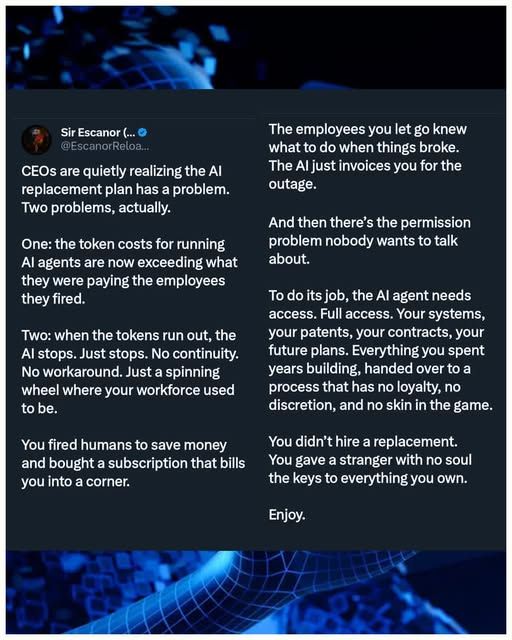
The attached post 👇 is absolutely true for those companies that approached AI in a mindless way. The fact is that pretty much everybody is using AI. The "you'll be left behind if you don't adopt AI" thing is stale. Everybody's adopted AI. The results of that adoption are widely disparate, however.
Some companies are seeing benefits (in the 20% improved productivity range, not the 100% or 1000% the hype-mongers claim), and others are seeing considerable declines in productivity mixed with huge increases in cost. For companies in the latter category, the AI expenses far outweigh the costs of the employees they fired, and they are doing less productive work overall.
The companies that succeed are the ones that take software engineering seriously. They didn't fire anybody. Instead, they gave everybody a new tool and let them figure out how best to leverage it. The companies had good practices and processes in place long before adopting AI, and continue to use those practices and processes (product and customer focus, TDD, CI/CD, collaborative ways of working, a focus on removing dependencies, iterative development—the list goes on, but shouldn't be earth shattering). They use AI in a deliberate way, integrated into a solid software-engineering culture. Most importantly, they let the people doing the work figure out how to do the work.
The companies that succeed do not focus on increased output. Output focus (e.g., KLOC) has always been a hallmark of incompetent engineering management. Producing vast amounts of garbage benefits nobody, and it dramatically raises "inventory" costs (money spent that is not producing revenue). Rewarding people for increasing inventory is rewarding people for wasting money. We're seeing that play out in front of us with AI driven by that same incompetent management.
The lesson we should get out of all this is that we can benefit from using AI in a deliberate way, used judiciously and integrated as just one more tool of a competent engineering culture. The way to benefit most from AI is by nurturing that culture. Destroying that culture by firing half your staff will amplify the bad. That's expensive by all measures.
Out today!
HH examines the rise and fall of Helenio Herrera, one of the finest minds in football, and his role in the game’s first ‘white death’.
Available now in bookshops (and to order from the link in my bio). @BloomsburySport ⚽📚
Katie Crawford @UniofBath is this week's guest on The Sport Psych Show "Coaching Teamwork". Katie and I discuss how coaches can facilitate teamwork within their teams.
Listen to the full episode here https://t.co/DslVCwqOJD
Check out this brilliant backdoor cut by Ben O’Carroll to set up Brian Derwin for a crucial goal in the All-Ireland final! 🙌
Clever & creative movement and effective execution of teamwork at its finest 👏
@SmallerFishGAA Kilcoo had 15 behind the ball at that point and just wanted to close the game out. This is the purpose of the mark working ie stopping the blanket. In fairness to Hughes, the kick was not a gimme, far from it.
I've been taking a break from work for the last few weeks, so missed much of the brouhaha over the McKinsey developer productivity article. But I'm sure that I could not write a better response than this one from @tastapod
https://t.co/3PlzZ37kgb
@barryduf @cormacpro Could we not agree on, “come home Paddy Reilly…”. It has a garden of Eden, a bridge in Finea, you’re halfway to Cootehill, sure the only thing paddy could do is come home ?
Q: What factors explain the PayPal Mafia?
The employees of PayPal went on to build many of the companies that defined Silicon Valley in the 2000s, such as Tesla, SpaceX, LinkedIn, YouTube, Palantir, Yelp, Yammer, and more.
In the clip below, David Sacks—founding COO and product leader at PayPal—talks through the factors that he believed contributed to the success of the PayPal mafia.
The crux of his thesis is that the PayPal Mafia innovated on distribution, not just product. They leveraged viral, platform, and embed strategies to achieve explosive growth at PayPal and then took these strategies to their next companies.
PayPal had ~220 employees pre-IPO and they produced 7 unicorns post-PayPal. Compare this to a company like Google that hasn’t had 7+ unicorns created by ex-Googlers despite having 100x the number of employees.
He argues that scrappiness around distribution is part of the reason for this disparity. When you work at a large company like Google, distribution is guaranteed.
@SportsOrla shameless request to see if there is any chance you’d give my buddy Tara @Taznelson a retweet for her Irish sports clothing startup https://t.co/xK8F36ttPM producing quality clothing, specifically cut for female cyclists.
#veloflamingo#styleishcycling